Thus succeeding at making the telecommunications vendors used for Top Secret US national security data less secure, the obvious goal of the US National Security Agency, and the only reason they wouldn't use the better cryptography designed by Dr. Bernstein. /s
Truly, truly can't understand why anyone finds this line of reasoning plausible. (Before anyone yells Dual_EC_DRBG, that was a NOBUS backdoor, which is an argument against the NSA promoting mathematically broken cryptography, if anything.)
Timing side channels don't matter to ephemeral ML-KEM key exchanges, by the way. It's really hard to implement ML-KEM wrong. It's way easier to implement ECDH wrong, and remember that in this hypothetical you need to compare to P-256, not X25519, because US regulation compliance is the premise.
(I also think these days P-256 is fine, but that is a different argument.)
I genuinely do not understand how someone working in the capacity that you do, for things that matter universally for people, can contend that an organization who is intentionally engaging in NOBUS backdoors can be remotely trusted at all.
That is insanely irresponsible and genuinely concerning. I don't care if they have a magical ring that defies all laws of physics and assuredly prevents any adversary stealing the backdoor. If an organization is implementing _ANY_ backdoor, they are an adversary from a security perspective and their guidance should be treated as such.
The world just doesn’t work in such a binary way. Forming a mental model of an entity’s incentives, goals, capabilities, and dysfunctions will serve you much better than making two buckets for trusted parties and adversaries.
As you are someone building cryptographic libraries used by people all over the world, which includes those who might be seen as "enemies" by the organization in question, this is not a gradient — it's quite binary in nature.
> Thus succeeding at making the telecommunications vendors used for Top Secret US national security data less secure, the obvious goal of the US National Security Agency
NSA still has the secret Suite A system for their most sensitive information. If they think that is better than the current public algorithms and their goal is to make telecommunications vendors to have better encryption, then why doesn't they publish those so telco could use it?
> Truly, truly can't understand why anyone finds this line of reasoning plausible. (Before anyone yells Dual_EC_DRBG, that was a NOBUS backdoor, which is an argument against the NSA promoting mathematically broken cryptography, if anything.)
The NSA weakened DES against brute-force attack by reducing the key size (while making it stronger against differential cryptanalysis, though).
> Thus succeeding at making the telecommunications vendors used for Top Secret US national security data less secure, the obvious goal of the US National Security Agency, and the only reason they wouldn't use the better cryptography designed by Dr. Bernstein. /s
I guess the NSA thinks they're the only one that can target such a side channel, unlike, say, a foreign government, which doesn't have access to the US Internet backbone, doesn't have as good mathematicians or programmers (in NSA opinion), etc.
> Timing side channels don't matter to ephemeral ML-KEM key exchanges, by the way. It's really hard to implement ML-KEM wrong. It's way easier to implement ECDH wrong, and remember that in this hypothetical you need to compare to P-256, not X25519, because US regulation compliance is the premise.
Except for KyberSlash (I was surprised when I looked at the bug's code, it's written very optimistically wrt what the compiler would produce...)
So do you think vendors will write good code within the deadlines between now and... 2029? I wouldn't bet my state secrets on that...
That's a timing side-channel, irrelevant to ephemeral key exchanges, and tbh if that's the worst that went wrong in a year and a half, I am very hopeful indeed.
> The industry standard and general recommendation for quantum resistant symmetric encryption is using 256 bit keys
It simply is not. NIST and BSI specifically recommend all of AES-128, AES-196, and AES-256 in their post-quantum guidance. All of my industry peers I have discussed this with agree that AES-128 is fine for post-quantum security. It's a LinkedIn meme at best, and a harmful one at that.
My opinion changed on the timeline of CRQC. There is no timeline in which CRQC are theorized to become a threat to symmetric encryption.
It's purely a matter of _potential_ issues. The research on lattice-based crypto is still young compared to EC/RSA. Side channels, hardware bugs, unexpected research breakthroughs all can happen.
And there are no downsides to adding regular classical encryption. The resulting secret will be at least as secure as the _most_ secure algorithm.
The overhead of additional signatures and keys is also not that large compared to regular ML-KEM secrets.
We can disagree on the tradeoff, but if you see no upside, you are missing the velocity cost of the specification work, the API design, and the implementation complexity. Plus the annoying but real social cost of all the bikeshedding and bickering.
The 'social cost' will be borne by attempting to push anti-hybridization too.
> velocity cost of specification work, the API design, and the implementation complexity
These aren't arguments against hybrids, these are arguments for standard bodies to do their jobs better. Or better yet someone suborning them and pushing out their own standards that get adopted without consulting the slowpokes.
> Sure, papers about an abacus and a dog are funny and can make you look smart and contrarian on forums. But that’s not the job, and those arguments betray a lack of expertise. As Scott Aaronson said:
> Once you understand quantum fault-tolerance, asking “so when are you going to factor 35 with Shor’s algorithm?” becomes sort of like asking the Manhattan Project physicists in 1943, “so when are you going to produce at least a small nuclear explosion?”
To summarize, the hard part of scalable quantum computation is error correction. Without it, you can't factorize essentially anything. Once you get any practical error correction, the distance between 32-bit RSA and 2048-bit RSA is small. Similarly to how the hard part is to cause a self-sustaining fissile chain reaction, and once you do making the bomb bigger is not the hard part.
This is what the experts know, and why they tell us of the timelines they do. We'd do better not to dismiss them by being smug about our layperson's understanding of their progress curve.
The thing is, producing the right isotopes of uranium is mostly a linear process. It goes faster as you scale up of course, but each day a reactor produces a given amount. If you double the number of reactors you produce twice as much, etc.
There is no such equivalent for qubits or error correction. You can't say, we produce this much extra error correction per day so we will hit the target then and then.
There is also something weird in the graph in https://bas.westerbaan.name/notes/2026/04/02/factoring.html. That graph suggests that even with the best error correction in the graph, it is impossible to factor RSA-4 with less then 10^4 qubits. Which seems very odd. At the same time, Scott Aaronson wrote: "you actually can now factor 6- or 7-digit numbers with a QC". Which in the graph suggests that error rate must be very low already or quantum computers with an insane number of qubits exist.
We are stretching the metaphor thin, but surely the progress towards an atomic bomb was not measured only in uranium production, in the same way that the progress towards a QC is not measured only in construction time of the machine.
At the theory level, there were only theories, then a few breakthroughs, then some linear production time, then a big boom.
> Something doesn't add up here.
Please consider it might be your (and my) lack of expertise in the specific sub-field. (I do realize I am saying this on Hacker News.)
> That graph suggests that even with the best error correction in the graph, it is impossible to factor RSA-4 with less then 10^4 qubits. Which seems very odd.
It's because the plot is assuming the use of error correction even for the smallest cases. Error correction has minimum quantity and quality bars that you must clear in order for it to work at all, and most of the cost of breaking RSA4 is just clearing those bars. (You happen to be able to do RSA4 without error correction, as was done in 2001 [0], but it's kind of irrelevant because you need error correction to scale so results without it are on the wrong trendline. That's even more true for the annealing stuff Scott mentioned, which has absolutely no chance of scaling.)
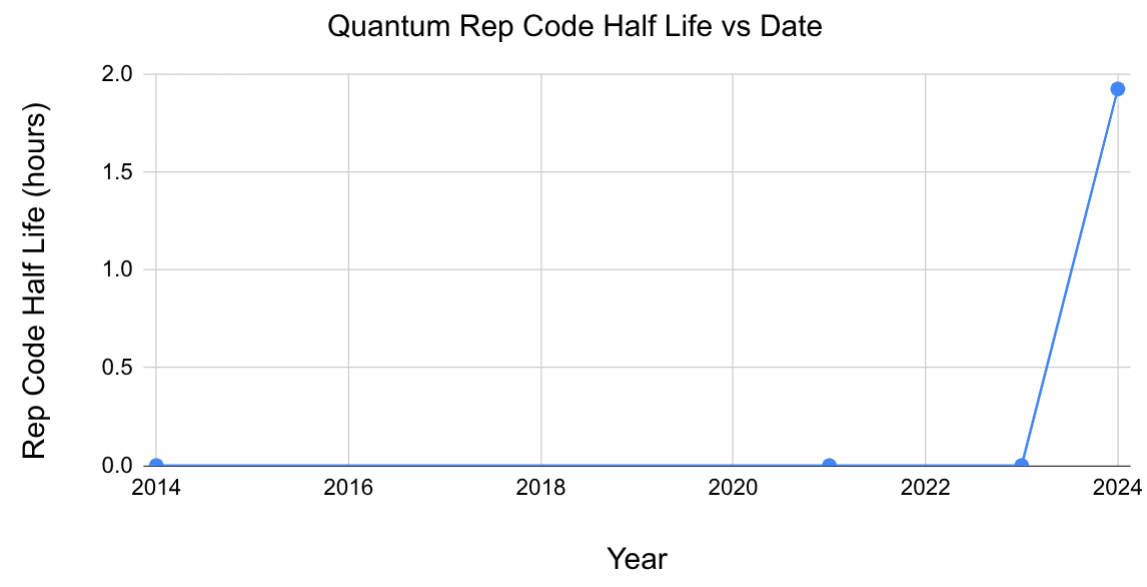
You say you don't see the uranium piling up. Okay. Consider the historically reported lifetimes of classical bits stored using repetition codes on the UCSB->Google machines [1]. In 2014 the stored bit lived less than a second. In 2015 it lived less than a second. 2016? Less than a second. 2017? 2018? 2019? 2020? 2021? 2022? Yeah, less than a second. And this may not surprise you but yes, in 2023, it also lived less than a second. Then, in 2024... kaboom! It's living for hours [4].
You don't see the decreasing gate error rates [2]? The increasing capabilities [3]? The ever larger error correcting code demonstrations [4]? The front-loaded costs and exponential returns inherent to fault tolerance? TFA is absolutely correct: the time to start transitioning to PQC is now.
You can already factor a 6 digit number with a QC, but not with an algorithm that scales polynomially. The graph linked is for optimized variants of Shor's algorithm.
So today you have 1 gram. No bomb. Tomorrow you have 2 grams. Still no bomb.
...
365 days later, you have 365 grams after spending ungodly amounts of energy to separate isotopes. AND STILL NO BOMB! Not even a small one. These scientists are just some bullshit artists.
The Manhattan Project scientists actually did this before anybody broke ground at Los Alamos. It was called the Chicago Pile. And if the control rods were removed and the SCRAM disabled, it absolutely would have created a "small nuclear explosion" in the middle of a major university campus.
Given the level of hype and how long it's been going on, I think it's totally reasonable for the wider world to ask the quantum crypto-breaking people to build a Chicago Pile first.
In truth the Chicago Pile crowd were all about power generation and didn't think it was feasible to make a nuclear bomb ..
( Not impossible, more strictly "beyond reach" economically and processing wise, operating on over estimates of the effort and approach )
They ignored letters from Albet Einstein on the topic, they ignored or otherwise disregarded several letters from the Canadian / British MAUD Committee / Tube Alloys group and it took a personal visit from an Australian for them to sit up and take note that such a thing was actually within reach .. although it'd take some man power and a few challenges along the way.
Remember that the entities most likely to heed those governments recommendations are those providing services to said government and its military.
I feel like the NSA pushing a (definitely misguided and obviously later exploited by adversaries) NOBUS backdoor has poorly percolated into the collective consciousness, missing the NOBUS part entirely.
IMO the idea that NSA only uses NOBUS backdoors is obviously false (see for example DES's 56 bit key size). The NSA is perfectly capable of publicly calling for an insecure algorithm and then having secret documentation to not use it for anything important.
DES is the algorithms that was secretly modified by the NSA to protect it against differential cryptanalysis. Capping a key size is hardly a "backdoor."
Also, that was the time of export ciphers and Suite A vs Suite B, which were very explicit about there being different algorithms for US NatSec vs. everything else. This time there's only CNSA 2.0, which is pure ML-KEM and ML-DSA.
So no, there is no history of the NSA pushing non-NOBUS backdoors into NatSec algorithms.
In fairness, that was from 1975. I don't particularly trust the NSA, but i dont think things they did half a century ago is a great way to extrapolate their current interests.
This article is more aimed at those specifying and implementing WebAuthN and SSH, than at those using them.
They/we need to migrate those protocols to PQ now, so that you all can start migrating to PQ keys in time, including the long tail of users that will not rotate their keys and hardware the moment the new algorithms are supported.
For example, it might be too late to get anything into Debian for it to be in oldstable when the CRQCs come!
> This article is more aimed at those specifying and implementing WebAuthN and SSH, than at those using them.
Sure, I'm just trying to understand the consequences of that. Felt great to finally have secure elements on smartphones and laptops (or Yubikeys), protecting against the OS being compromised (i.e. "you access my OS, but at least you can't steal my keys").
I was wondering if PQ meant that when it becomes reality, we just get back to a world where if our OS is compromised, then our keys get compromised, too. Or if there is a middle ground in the threat model, e.g. "it's okay to keep using your Yubikey, because an attacker would need to have physical access to your key, specialised hardware AND access to a quantum computer in order to break it". Versus "you can stop bothering about security keys because with "store now, decrypt later", everything you do today with your security keys will anyway get broken with quantum computers eventually".
If you are doing authentication with those hardware keys, you will probably be fine, if we do our job fast enough. Apple's Secure Enclave already supports some PQ signatures (although annoyingly not ML-DSA-44 apparently?) and I trust Yubico is working on it.
If you are doing encryption, then you do have reason to worry, and there aren't great options right now. For example if you are using age you should switch to hybrid software ML-KEM-768 + hardware P-256 keys as soon as they are available (https://github.com/str4d/age-plugin-yubikey/pull/215). This might be a scenario in which hybrids provide some protection, so that an attacker will need to compromise both your OS and have a CRQC. In the meantime, depending on your threat model and the longevity of your secrets (and how easily they can rotated in 1-2 years), it might make sense to switch to software PQ keys.
I mean "your OS and have a CRQC" because they will need to compromise the software PQ key by compromising the OS, and derive the hardware YubiKey private key using the CRQC.
That was my position until last year, and pretty much a consensus in the industry.
What changed is that the new timeline might be so tight that (accounting for specification, rollout, and rotation time) the time to switch authentication has also come.
ML-KEM deployment is tangentially touched on in the article because it's both uncontroversial and underway, but:
> This is not the article I wanted to write. I’ve had a pending draft for months now explaining we should ship PQ key exchange now, but take the time we still have to adapt protocols to larger signatures, because they were all designed with the assumption that signatures are cheap. That other article is now wrong, alas: we don’t have the time if we need to be finished by 2029 instead of 2035.
> For key exchange, the migration to ML-KEM is going well enough but: 1. Any non-PQ key exchange should now be considered a potential active compromise, worthy of warning the user like OpenSSH does, because it’s very hard to make sure all secrets transmitted over the connection or encrypted in the file have a shorter shelf life than three years. [...]
You comment is essentially the premise of the other article.
I agree with you that one must prepare for the transition to post-quantum signatures, so that when it becomes necessary the transition can be done immediately.
However that does not mean that the switch should really be done as soon as it is possible, because it would add unnecessary overhead.
This could be done by distributing a set of post-quantum certificates, while continuing to allow the use of the existing certificates. When necessary, the classic certificates could be revoked immediately.
> I agree with you that one must prepare for the transition to post-quantum signatures, so that when it becomes necessary the transition can be done immediately.
Personally, my reading between the lines on this subject as a non-expert is that we in the public might not know when post-quantum cryptography is necessary until quite a while after it is necessary.
Prior to the public-key cryptography revolution, the state of the art in cryptography was locked inside state agencies. Since then, public cryptographic research has been ahead or even with state work. One obvious tell was all the attempts to force privately-operated cryptographic schemes to open doors to the government via e.g. the Clipper chip and other appeals to magical key escrow.
A whole generation of cryptographers grew up in this world. Quantum cryptography might change things back. We know what papers say from Google and other companies. Who knows what is happening inside the NSA or military facilities?
It seems that with quantum cryptography we are back to physics, and the government does secret physics projects really well. This paragraph really stood out to me:
> Scott Aaronson tells us that the “clearest warning that [he] can offer in public right now about the urgency of migrating to post-quantum cryptosystems” is a vague parallel with how nuclear fission research stopped happening in public between 1939 and 1940.
Couldn't NSA have not known about an issue with ML-KEM, and thus wanted to prevent its commercial acceptance, which it did simply by approving the algorithm?
What's the PQC construction you couldn't say either thing about?
As a practical matter, revocation on the Web is handled mostly by centrally distributed revocation lists (CRLsets, CRLite, etc. [0]), so all you really need is:
(1) A PQ-secure way of getting the CRLs to the browser vendors.
(2) a PQ-secure update channel.
Neither of these require broad scale deployment.
However, the more serious problem is that if you have a setting where most servers do not have PQ certificates, then disabling the non-PQ certificates means that lots of servers can't do secure connections at all. This obviously causes a lot of breakage and, depending on the actual vulnerability of the non-PQ algorithms, might not be good for security either, especially if people fall back to insecure HTTP.
Indeed, in an open system like the WebPKI it's fine in theory to only make the central authority PQ, but then you have the ecosystem adoption issue. In a closed system, you don't have the adoption issue, but the benefit to making only the central authority PQ is likely to be a lot smaller, because it might actually be the only authority. In both cases, you need to start moving now and gain little from trying to time the switchover.
> In both cases, you need to start moving now and gain little from trying to time the switchover.
There are a number of "you"s here, including:
- The SDOs specifying the algorithms (IETF mostly)
- CABF adding the algorithms to the Baseline Requirements so they can be used in the WebPKI
- The HSM vendors adding support for the algorithms
- CAs adding PQ roots
- Browsers accepting them
- Sites deploying them
This is a very long supply line and the earlier players do indeed need to make progress. I'm less sure how helpful it is for individual sites to add PQ certificates right now. As long as clients will still accept non-PQ algorithms for those sites, there isn't much security benefit so most of what you are doing is getting some experience for when you really need it. There are obvious performance reasons not to actually have most of your handshakes use PQ certificates until you really have to.
Yeah, that's an audience mismatch, this article is for "us." End users of cryptography, including website operators and passkey users (https://news.ycombinator.com/item?id=47664744) can't do much right now, because "we" still need to finish our side.
If you want something book-shaped, the 2nd edition of Serious Cryptography is updated to when the NIST standards were near-final drafts, and has a nice chapter on post-quantum cryptography.
If you want something that includes details on how they were deployed, I'm afraid that's all very recent and I don't have good references.
That’s a fun list, the only hits in the top 100 are actually Cloudflare, for whom automatic DNSSEC is a feature, and would be a bad look not to dogfood it.
(I did a lot of the work of shipping that product in a past life. We had to fight the protocol and sometimes the implementers to beat it into something deployable. I am proud of that work from a technical point of view, but I agree DNSSEC adds little systemic value and haven’t thought about it since moving on from that project almost 10 years ago. It doesn’t look like DNSSEC itself has changed since, either.)
Then a few government sites, which have mandated it. The first hit after those is around #150.


Truly, truly can't understand why anyone finds this line of reasoning plausible. (Before anyone yells Dual_EC_DRBG, that was a NOBUS backdoor, which is an argument against the NSA promoting mathematically broken cryptography, if anything.)
Timing side channels don't matter to ephemeral ML-KEM key exchanges, by the way. It's really hard to implement ML-KEM wrong. It's way easier to implement ECDH wrong, and remember that in this hypothetical you need to compare to P-256, not X25519, because US regulation compliance is the premise.
(I also think these days P-256 is fine, but that is a different argument.)
reply