I really value tests on projects I work on alone because the work is usually intermittent. I don't have the time or energy to deal with regressions, and I may not remember everything about the system by the next time I work on it.
I also find manually testing to be tedious, so I'd rather spend that time writing code that does it for me.
Fzf is brilliant. Recently I found fzrepl (https://github.com/danielfgray/fzf-scripts/blob/master/fzrep...), which blew my mind. It uses fzf and its preview window to create a repl for other programs, such as jq. That's great for figuring out a query for jq since I use it so rarely.
I'm not sure if I'm missing something here or what.
> HTTPS doesn't hurt anything and actually has some nice side effects (it separates backups onto a separate port than the majority of your web traffic, allows for traffic shaping if you want to do it).
Wouldn't using HTTPS put it on the same port as virtually all web traffic?
Would we really lose them? My understanding is that, after a fire, a forest experiences very rich growth, especially of plants that don't grow much under the shade of old trees, which are good food and cover for many animals.
These current fires are much more destructive because of a combination of the extreme conditions, a dense under story from fire suppression and lots of standing dead wood from beetle kill etc.
So ideally for a forest you would have small fires come through regularly and clean up the under brush but leave a fair number of large mature trees standing leading to open fire resistant mature forest.
With these large super destructive fires that wipe out everything you get slower reseeding which can let invasives weeds take hold. And you get dense stands of young trees and brush which are less fire resistant than mature forests.
Partial solutions include controlled burns in the wet season and thinning where you shoot to leave the large mature trees but reduce fuels. (This isn't always commercially viable though developing wood products that can be made from small trees or even brush harvested during thinning is an interesting area.)
> With these large super destructive fires that wipe out everything you get slower reseeding which can let invasives weeds take hold. And you get dense stands of young trees and brush which are less fire resistant than mature forests.
If you're real unlucky an above average wet season after a super destructive fire will cause untold amounts of topsoil erosion and damage, impacting the follow on reseeding even more.
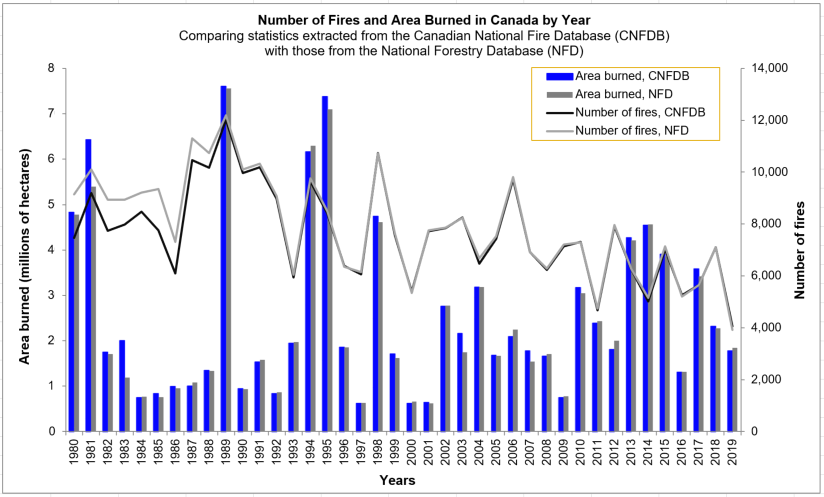
You are correct that there have always been really bad years (that chart doesn't go back very far but look up the great burn of 1910). However total size is effected by us getting better at fighting them.
What has changed is that the fires burn hotter and so fully destroy vegetation and even seeds with intense heat which makes it much harder for the forests to regrow in the way they typically would in a "fire adapted ecosystem": https://www.cpr.org/2020/09/01/colorado-wildfires-forests-re...
In California they absolutely are. Canada has wild land that have been undergoing a natural burn cycle. In the US, fires have been put out, leading to 150 years of built up fuel
Is the increase in beetle kill related to the suppression/reduction in small scale cooler fires? Would be interesting to understand.
In Australia it is only now becoming widely understood that stopping of the indigenous peoples burning of the bush has lead to an increase not only of large destructive bushfires but also a changing of the nature of the plants growing in an area. We are seeing more weeds and certainly more fire prone species which is leading in turn to an increase in the flammable fuel load. With the widespread 2020 bushfires causing so much destruction there has been an increase in appetite for looking at other options for land management, including trying to tap the fading knowledge of the indigenous elders on there traditional practice.
Ironically, if topsoil isn't sterilised or washed away, and both can and do happen with the mega fires we've been seeing, fresh growth after a wildfire can be stunningly quick.
A mature forest is self-limited by the existing mature growth --- juvenile trees simply cannot get sufficient light. If mature growth is cleared, the juveniles grow quickly.
It's still a slow process, and we're talking about ~30--50 years for a redwood to hit 100' or so (coast redwoods can grow to over 380' / 115m, giant sequoia are more massive but not quite so tall --- 286' / 87m.
As carbon sinks, redwood, doug fir, ponderosa, and other trees common to the western coastal ranges, Sierra, and Cascades are not insignificant, but probably pale compared to bogs, swamps, wetlands, mangroves, and tropical rainforests. Thats' a general sense, though I don't have solid numbers at hand.
Burning down the Sierra, Cascades, and Rockies isn't going to do us any favours. But it's still relatively modest. I'd be more concerned about tundra / permafrost melting and release, bog fires, wetlands loss, and rainforest.
Unfortunately we'll likely see all of that as well.
There is a small but growing movement towards controlled burns of forests and such because not burning for long enough creates conditions that make wildfires even bigger and harder to stop. If you can rotate between enough zones over time the burned area can regrow fully. It has been said that part of the reason wildfires get so bad now is because we do not let them partake in their normal cycle of burning down occasionally.
Yes, at least without human intervention. The stress concept in ecology predicts more biodiversity at minor events, but much less at large-scale global events. A pinch of disturbance is good for the life beings. This levels of disturbance at the same time in the North and in Brazil are not good.
This right here is something I want to say every time the "people said x, now people say y" paradigm appears. The word "people" in both cases are not the same persons.
It is a shorthand but it always seems like it's designed as a "gotcha". I haven't thought enough about it to figure out what fallacy it entails, just enough to ignore it anytime I see an argument that uses it.
The company has this to say about synthetic leather.
> Fish leather is more ecologically sound than vegan leather alternatives because it requires less energy than the creation of vegan leather, it does not include petroleum products, and it works with the circular economy using existing waste from food fisheries to create a durable finished good. Fish leather doesn’t need the extra (chemically induced) step of removing hair that mammal leather requires, either.
It'll be interesting to see if this change is going to get rid of extension support or not. I'm a Firefox fan, but uBlock Origin is more important than the browser.


I also find manually testing to be tedious, so I'd rather spend that time writing code that does it for me.