Wow, I finally have a word to describe my mental experience. To others, I've described the vividness of my memory as like a wireframe. I can feel spatial relationships but I don't see them like a picture in my head. There are occasions that I can see color in my minds eye, but it's mostly greyscale.
Woah, I always thought that what you've described was the universal experience of mental visualization. A combination of wireframes / blueprints / spatial relationships.
When I think of my living room I can very clearly place where the couch is, its three dimensional form, what's next to it, the colour of the couch. However, when I recall these things in my head it's almost like I recall a "couch" object with a certain "couch" shape and a "blue" colour, as if they are semantic tags attached to my memory of the couch. For the life of me, I can't "see" the couch in the minds-eye. However, I could probably draw it by iterating over my memory of its properties.
I'm wondering whether work with 3D modeling software can improve that. I used to play a lot with Blender when I was young and my brain has clearly installed some sort of graphics engine as a result. I can easily imagine specific perspectives in my room, rotate objects in ~10 degree steps and tweak the point of view. It's surprisingly difficult to translate objects by a small amount though. It also takes a while until I get the colors right, and they are just superimposed on the eigengrau and fade quickly. Colors work very well with specific objects, for example a Red Bull can or an apple.
Interestingly, I'm pretty good at mental rotations, thinking of complex shapes, etc though I don't actually "see" the objects in my "minds-eye". They still remain abstract concepts.
The only analogy I can draw is this:
Imagine these "concepts" in your head:
    Recursion
    Monad
    Quantitative Easing
They don't particularly have an "image" associated with them. I can think of "recursion" as an idea and have a mental understanding of the concept, yet I don't see it as a picture (I assume that most people don't actually see it as a picture, but perhaps they do).
Now, when I think of things like:
    A Dog
    Flower
    Sunset
I still think of them as abstract concepts. Like the activations in my mind when thinking of "recursion" are of the same kind as when I think of "flower". If I really focus strongly on thinking of a dog, I get a really fuzzy "flash" of a visualization of a dog, but it's in no way "image-like". When I do this I can feel my brain really really working hard and it's mentally tiring.
Understandably, it's hard to express the internal mental life in words :)
Interesting. I think about recursion both in terms of linguistic/symbolic rules that are associated with it, but I also associate it visually with call tree diagrams, nested structures and loops. I can't think about dogs, flowers and sunsets just in terms of language though, there are always images, smells, sounds, movements etc. associated with it.
Perhaps take an empty piece of paper and imagine drawing a big letter on it. I've read before that non-visual thinkers can experience visual thinking that way.
Yeah, that's a good way to put it. I can "feel" myself navigating my house in my mind, can draw a floor plan, etc., but I can't picture it. More like knowing "I can expect a chair there, or a wall there" or whatever.
I kind of suspect it might be similar to how blind people experience "visualizing" something where they've got the contours well-mapped in their head, but of course I have no way to know that for sure.
Wow, it's crazy how different our minds can be. And I thought it 'strange' to see colours differently - I always double-check with my wife if I can wear this shirt with these pants. Now, this is amazing, I can't even picture what you are describing, but wish I could!
OP's description of waking imagination matches mine and I dream vividly. In fact, for a while I tried to lucid dream and as I watched myself call asleep there would be an instant of sudden clarity. Like a light switch had turned on and whatever I was thinking of would jump into view, fully colored and textured. The difference to the vagueness of my normal imagination was so striking I would jolt awake. Same with sounds; I will get beautiful, complex music pouring into my head as I drift off. While awake, I hear noises I imagine but instead as if I were making sounds with my throat. I can't hear Beethoven but I can hear myself hum the notes even without doing so.
So I can say with some confidence that both extremes exist in the literal sense and this is not at all just a matter of describing the same qualia differently.
Honestly the questions given in the test don't seem to well capture my abilities. I have no ability to recall my own mother's face, but I can is of reconstruct it from facts I know (length of her hair, shape of her jaw, anything I've noticed explicitly). I get sensations of colors in short bursts if at all, it is not a dimness. And motion, rotations, and spatial relations feel real to me even if I can't see them. When it tells me to imagine a rainbow I don't see color, but I feel it's arc in the sky, even trace it mentally with imaginary hands. That aspect is not dim and vague. Makes me wonder if the author of this test either did not have this condition or had it in a different way than I.
A lot of my dreams I recall mostly as sensations, eg, I'll recall the sensation of being scared, but not any particular stimuli causing me to be scared.
This is not about memory, it is about what you can access consciously. Those of us who have no image in our minds have memories of our houses, cars, friends, etc. just like you do (as far as I know!), they are just not part of our conscious experience. If you want to relate to this, think of language processing: you are not aware of how your brain parses the sentences you hear, though you still have access to the meaning that is produced by that parsing. We don't have access to the visual images, but they are there somewhere and can be used by our memory system.
(ps. I suspect that getting images to reach consciousness or not is not just a random 'accident', but rather reflects a more generally different brain organisation -- just not wrt memory having access to visual representations or not)
I think I have a mild version of this. I can picture things, but it generally takes a fair bit of effort and concentration to get decent detail if the thing is complex, and it's a fleeting image. Especially picturing people's faces is difficult. I can get like.. an idea of the person's face, so I know I'd recognize it if I saw it, but I rarely see a picture of their face in my head.
I do have normal visual dreams though, which apparently many people with full-on Aphantasia don't. And I can picture and manipulate geometric objects in my head, that kind of thing.
Again, I guess it's mostly that my mental images tend to be vague and indistinct. I really wasn't aware that some (apparently most!) people see perfectly clear mental photographs of things. Now I'm trying to figure out how I haven't noticed the lack of this ability more! It seems pretty significant.
Your self-description sounds entirely typical to me. I don’t think most people can imagine detailed photographic images (e.g. of faces), though there do seem to be some who can, like certain autistic savants.
It seems likely that people’s external verbalizations of their internal experience vary widely enough that it’s difficult or even impossible to gain a useful understanding of that experience from survey answers. Sort of like when people claim non-human mammals have no consciousness or sentience because they don’t talk.
For example, just because the picture-book illustrator profiled in this article has a “vivid imagination” doesn’t mean she can literally visualize a full-fidelity photographic mental image of a whole book spread. As a photographer, when I see a scene I can “previsualize” what kind of picture I might get after fully editing/printing the image days later. But that just means I can conceptualize particular visual effects, think about the lighting, texture, contrasts, colors, and put them together in an abstract thought, not that I can precisely “see” the picture exactly as if it were finished in front of me. I would say I have a “vivid imagination” for photographs, but my mental experience of remembered or imagined vision is probably pretty similar to yours.
What about people who complain about how a character looks in a movie adaptation of a book? I never see characters in a book so the movie can do whatever they want as far as I care. But other people get quite indignant over this. Can anyone here attest to what level of imagination one has to do that? I strongly suspect you're over generalizing from your own experiences, this might be a way to test it.
Maybe it's difficult to judge because people don't usually talk about it. I'd say I can visualize things just as vividly as I would experience when I look at them. That is, I won't notice every detail, but I don't notice every detail even when I'm staring right at something. I can look at something, look away for a while and visualize it, then look back at it and compare the subjective experience, and it's pretty much the same. It's more along the lines of getting the same mental stimulation of recognition and experience as I would get if I were looking at something, and it's the same as other senses. I can imagine myself on a beach, see the contrast of colors of leaves and the sky, hear the waves, feel the courseness of the sand, smell the sea, and I know from experience that if I were actually there, I would have the same sensations except I couldn't turn them off easily.
See, descriptions like this make me think that many people do indeed see clearer mental pictures than I (grandparent post) do. I'm going to have to do some informal surveys of friends and family!
It's just that we have predefined looks for a given type of characterization that sometimes adaptations don't get quite right. With time I've gotten over the fact that yes, a character from an adaptation probably will look different from what I imagined and I expect it as a normal thing.
Think of it as personal stereotypes. For example I often imagine how a character looks before getting to the physical description and in that case it's very hard to change my predefined image. Even if e.g. the description says it's a tall blonde character with a big nose if I had already imagined the character small and with black hair I can't change that throughout the book. I've actually tried to and it's very hard. If I concentrate I'll get the correct image out but next time I'll encounter the character I will automatically think of the previous picture.
Personally I think this is pretty regular and other people are like that too, but how can I be sure?
Its a useful technique, to never describe your protagonist in a book. Allows the reader to customize, imagine themselves in the role, to really identify. I know 'Twilight' is famous for Bella's blank aspect. Also an old childrens' book "Harris and me" had a main character that not only was never described; they never had a name.
Is there a more objective test than telling someone to visualize something and then asking, "Well, could you visualize it?"? For instance, are there visual tasks a person with or without aphantasia objectively could not perform?
Like a psych 101 student, I immediately think I have a touch of any vaguely described mental condition, but I also know I probably don't.
How about this - Picture an elephant sideways. Don't let the elephant move. Is the trunk on the left or on the right side? If they can't answer, then it's possible they have Aphantasia.
That's easy to answer without images. Either by reasoning your way out of it, or more plausibly, with this kind of 'geometrical imagery' that comes instead of images. I 'see' a sort of figure-stick elephant and can tell you immediately where the trunk is. Maybe a test involving details of pictures would fare better?
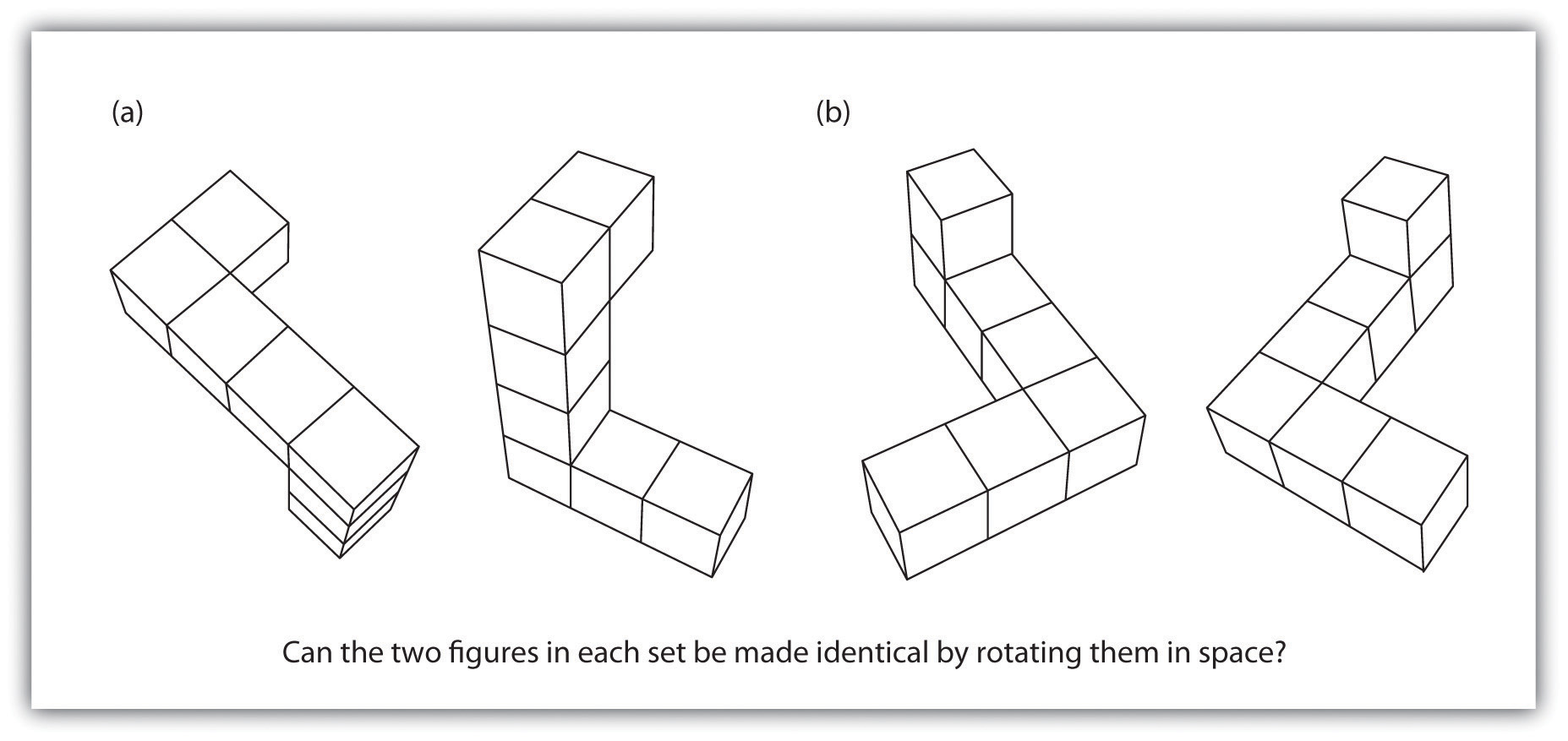
some questions on IQ tests depict rotated images of figures, and ask things like:
> can the two figures in each set be made identical by rotating them in space? [0]
this isn't my domain, so without knowing any better i would kind of expect the Vividness of Visual Imagery Questionnaire and its abridged version to ask similar questions. but if they didn't, and you wanted to create another test, here's where i'd start:
1. devise a test with a bunch of similar questions (to the one in the above example) of varying difficulty. use these hypotheses:
H_{0}: there will be no difference in performance for people with aphantasia
H_{1}: people with aphantasia will perform worse.
2. find some people with aphantasia and test them to get a baseline.
Other commenters and myself feel we have low visualization ability but do well on those tests. In fact, at one point for me they were significantly my best area in a battery of similar IQ-like tests.
The test in the article was extremely easy for me, I guess I can visualize better than most people (I had no idea some people have trouble with that). It's funny, because I've considered myself to be an "auditory" person.
> Close your eyes and imagine walking along a sandy beach and then gazing over the horizon as the Sun rises. How clear is the image that springs to mind?
Very clear; I see some cons cells, making up a list, whose CAR holds the symbol BEACH, the main connective of an abstract syntax tree describing the whole situation.
How clear are the pictures normal people can visualize. Is it like seeing but with your eyes closed? Because what I can do is nothing like seeing. Visual memory doesnt appear like a vision. Just a vague memory.
Can people actually see memories. I'm really missing out if so.
Yes. I find that when I imagine a scene there might be a lot of details missing without extra effort to imagine them. If I imagine a beach I might immediately get a detailed convincing image just like watching a video clip, with waves, birds, etc, because beach scenes come to mind very easily. But if I have to visualise some vague memory or novel scene I do get a very vague impression that isn't really an image at all. If I ask myself: "what's the carpet?", "what's on the walls?", etc, I can slowly add details until I get a proper image by piecing together memories.
On the other hand I am very bad at recognising people or visualising faces! Even if I try to visualise my own face or the faces of my parents or a celebrity like Bill Clinton I get something that's very uncanny, distorted and missing details. The part of your brain for recognising faces is signicant in size and very specialised, so it makes good sense that you might be able to visualise faces but not other scenes or vice versa.
BTW, I am a VERY visual thinker, I even do algebra in my head by imagining equations floating in space in front of me and moving terms around "physically". But I'm not an extrovert. If I can't visualise something (e.g. much of abstract algebra) I'm hopeless at it.
For myself, visualizing isn't exactly 'seeing'. It's just sight-like, in that the same general information about shape, color, arrangement, etc. can be pulled up, with effort. Closing the eyes isn't strictly necessary, but helps avoid the distraction of actual sight.
It's very sensitive to attention/intention: asked to visualize a person, I'll mostly imagine the face and general build – not even picking specific clothes – unless that person is very associated with some outfit. But if I think more about some specific prompt – say, "what were they wearing at some recent event", or "think about their hairline" – I can call up (or pick) reasonable details.
I suppose you could say it's no more vivid than it needs to be, and with concentration it becomes more vivid/detailed, but never quite like the solidity of a photograph. (Well, maybe while deeply concentrating with eyes closed, or half-asleep, or actually dreaming, there can be moments of seeming realism...)
I'm baffled as well. I had no idea people could do that. I thought that was called hallucination. I can remember images, I can't see them. I think I'm missing the point somewhere.
I'm not particularly skilled at drawing, but otherwise I'm fairly sure I could do that. I can remember all the major visual details of something like a room in my house, for example. But it's still not really like 'seeing' a picture of it in my head, except for little bits at a time, or a somewhat hazy collection of the whole. If I really focus it's a bit better, but some people seem to be able to just "see" memories by default.
Also, most of the time I have a lot of difficulty pulling up a mental image of a face, even one I know well, or holding onto it if I do manage to briefly capture it. (But I don't seem to have any particular difficulty recognizing people by their faces; I'm not picking out features or anything like that -- I definitely remember faces and what they look like; I just can't see an image of a particular face in my mind (clearly, most of the time).
Meanwhile, I once answered a question from a person on Quora whose premise was that people can imagine "audio and visual" stimulus, but not "odor, taste, or touch". I suspect that was based on the asker's own peculiar dominant senses and style of memory, as I addressed in my answer:
I've always known I'm terrible at visualizing. The first question from the quiz in the article is "Conjure up an image of a friend or relative who you frequently see". I chose my wife whom I see for hours each day. I tried to visualize what she looks like -- nothing. Is this really so rare?
I don't think I have a very difficult time visualizing things, but I seem to have a hard time describing what people look like. Whenever anyone asks what person X looks like, I always really struggle with the question and rarely give a useful answer beyond things like skin color, hair color, and sometimes height. I don't know why this is at all -- whether my visual memories (maybe of specific people?) are missing fine details, whether I'm just generally lacking in practice in describing people's appearance in words, whether I'm especially inattentive to people's appearance, whether it's a psychological block, or something else. (I don't experience face blindness; I can easily recognize and distinguish people when I see them in person.)
On the opposite end I remember every face I've ever seen (that has been put to a name). I remember most names and faces from each of my elementary classes including pre-school. Completely useless skill as I can't remember other things to save my life unless I read them 100 times over.
I have this too. If I try to recall images of people close to me, I get an instinctive flash, which is like an outline. If I try to focus in on the detail, the image disappears.
Happens in dreams to some extent too - I generally dream normally (?) but if I become lucid then everything I try to look at disintegrates.
For the record, I'm a programmer who always wanted to do something artistic. Coming to the realization that I just wouldn't be very good took a long time to accept.
I can recall anyone in a scene. I think it's a detailed image I can zoomed in, and I think I have all their details (eyes, hair, eyebrows, etc) down. It's a full color scene where the person of interest can be moving in their characteristic walking style, waving their arms the way they wave their arms, and talk the way they talk. However if I try to focus on the details, it's all a blur. It's like when you have a small 50px by 50px photo, and it looks sharp. Zoom in, and you realise it was an illusion. That's exactly it for me.
I can imagine my girlfriend's foot a little more in detail, e.g. changes in skin tone, but I can't remember the shape of her individual nails. Some of the details of my girlfriend's, I can see in my mind, the others are mostly a blur. I can't see in detail what I haven't noticed in real life. The details I see are because there was a scene where she made a very appropriate facial expression in response to a situation and I remember that detail very clearly - like the way she smiled and tried to convince me everyone said she had a beautiful smile on our second date.
Also - I notice the images I conjure in my mind are always a lot dimmer in brightness than when seeing images with my eye. I can remember them being bright, but I see them as dim - even when imagining the sun and the sky. It's like looking at a computer screen in bright sunlight.
It still doesn't seem that vivid to some of the people described in the article.
I'm pretty sure it's common for programmers to be below average visualizers. I was interested in this topic in college and asked around in my software developer friend group and many also didn't visualize well. My unscientific hypothesis is that programming requires a much larger language based memory than visual memory, so people sort themselves based on their skills.
However, this doesn't disqualify you from the arts under any circumstances! You might never be a photorealistic painter, but you might be better at, say, photography, as it's more about elimination of elements, or certain types of illustration (or music but I assume by "artistic" you meant visual arts). And, as usual, it's mostly hard work and only like 10% talent...
This is fascinating. I took the quiz and had to select "No image at all" for all the questions. I always knew I had trouble picturing things, but never realized others didn't also have a hard time. Strangely, I can play back songs in my head nearly perfectly, almost as if I was listening to them.
ME TOO!!! I also think almost purely in voices, sometimes my own, sometimes things others say (and I always remember the way they said it). I can play back songs I heard 10+ years ago with no problem. Some of us just think audio instead of video :) I didn't know there were others who thought like that!
Ha! I thought everyone without images had a sort of stylized geometric visualization instead of images, but maybe different people 'substitute' differently, some with music, some with geometry, some with ??
So many people these days seem to be writing about something "begging the question", whereas I am partial to reserving that idiom for a very specific logical fallacy, and simply saying that something "raises the question" in all other cases. Alas, language evolves with popular usage, and this may be a dying distinction.
I wonder if you can improve your visualization ability.
I stopped reading novels for fun about 5-6 years ago but this past year I've started reading at least one book every couple of weeks, and I feel that my ability to visualize things has improved.
On a related note, I wonder how you could measure one's change in visualization ability, since it's so subjective. I had a very difficult time answering the questions in the article, since I had no frame of reference.
Just want to point out that there could be a wide range of ability to recognize faces and it's probably realy hard to find a good measure of that. If someone shows you a picture of your wife (to take an example from one comment) and a picture of eg another woman with the same hair color, skin tone, whatever, would you be able to distinguish them? I'll bet you would unless you suffer from prosopagnosia, the loss of the ability to recognize faces that we know can occur after damage to a certain part of visual cortex. Then try to describe how you can tell the pictures apart. Not as easy. Artists (like the one in the article) spend all day thinking about faces (ok, not all artists, but many of them). They probably feel more confident in their ability to recognize faces and in their ability to describe them--because they discuss faces for portraits, with clients, etc.
As a skeptical neuroscientist, I'm thinking you should hold off on diagnosing yourself with this condition until we come up with better evidence for it.
This is supposed to be a 'condition' and an 'inability'? I have this and have always associated it with an enhanced ability to think abstractly, and more generally intellectual facility. I had never met anyone else having this, until I came upon a paragraph by Einstein who comments about his absence of mental images, replaced by geometrical-like thinking. That only confirmed my intuitive assumption that it related to enhanced intellectual abilities in the analytical and abstract thinking domain. It is therefore bizarre to read about this as a 'condition' or even 'disability'... On the bright side, it is wonderful to see that it is shared by others, even studied and meet fellow geometrical thinkers here -- hi fellow Jedis ;)
Hm, I never really realized that the rest of the world was better at visualizing than I am, but I'm definitely below average. My ability to imagine vividly comes very rarely, and, when I'm trying, I can usually only conjure a small image and only for what seems like an instant.
Definitely not the severe case that the article describes, but I didn't realize that this was unusual.
i used to have this ability. i know i had it as a child. i remember visualizing fantastically complex systems.
i seem to have lost it at some point in adulthood. i have no idea when.
i started doing it again while using drugs, and this caused me to become aware that i'd lost an ability i once had. it was very hard to explain to people what this ability was, but i rememberd being able to visualize fantastically complex scenes in my head, as a kid, and getting some sense of this back while high.
in the past i could imagine any complex system of gears - like a clock, and zoom in and look at any part of it.
it's like the projector bulb is broken. an image flashes and goes away.
Of course insights from drugs may not always be fully reliable, but what drug did you take, and did you try taking more?
Almost everything gets better with practice. Memorization experts have often used visio-spatial 'memory palaces', imaginary places they can fill with items to remember. Simply trying to use that technique might help build visual recall flexibility.
Perhaps it'd separately be worth trying a sensory-deprivation soak-tank?
My experience has been that visual vividness comes and goes with mental fatigue. When I am well rested, comfortable, and haven't spent much time thinking earlier in the same day, I can close my eyes and plainly see detail in childhood toys, places I've traveled, faces, and even illustrations from high school textbooks. When I'm tired or have spent the whole day thinking intensely, I can barely remember what my roommates faces look like. I suspect that the ability to vividly imagine images is an expensive neural process that becomes much more difficult when the brain is not at peak performance.
Curiously, my ability to recall sounds and music does not seem to change with fatigue. Whether I'm feeling energetic or super tired, I can bring to mind any song I'm familiar with or hear arbitrary words spoken in the voices of my close friends and family. My suspicion here is that simulating sound is much less expensive and therefore the ability not as easily degraded. That would not be surprising considering the anecdotal point that I can get headaches from too much sunlight but not too much noise (unless it interrupts my sleep).
Perhaps the most interesting aspect is not the experience itself, but the fact that people are so surprised when they discover that other people's mental experience can be so different to their own.
It does fundamentally divide humanity into those that can imagine, and those that can't. Its not unreasonable to guess others experience the world similarly to oneself; not at all interesting that folks would be surprised by that.
It's perhaps an exaggeration to describe them as 'those that can't imagine': Galton noted that inability to visualise was much more prevalent among his colleagues, the scientific men of the day, than among the general public.
If you have aphantasia, and wantto describe it to someone else: try asking them to picture "democracy" or some other abstract concept. Most people don't then have mental images of ballot papers or flags. Then tell them that what they're experiencing is what you experience when someone asks you to picture an elephant.
That's interesting, because I did! When I read the word "democracy" I started thinking about the concept, and my mind delivered pictures (or really, scenes) to me, The White House, scenes of the UK Parliament, diagrams representing political systems, a game of Civilization, me queuing to vote at the last election etc. etc.
In a conversation that moves quickly, I probably wouldn't begin this process of streaming images, but if I spend more than a few seconds on an idea, they just start arising. To me, it is "thinking" - it is much closer to me and more effortless than the logical articulation of abstract concepts.
Interesting! I think I have this, though I didn't know there was a name for it. I don't imagine things visually at all -- I just kind of "feel" things. I also have a limited degree of something like touch-synaesthesia... music, mathematics and emotions have some strong haptic associations for me.
And I'm terrible at recognising faces, but pretty good at remembering facts.
I usually practice the art of visualization to picturize images in my mind. The more visual impact you have in your mind, its better to create things positively.