Engineering in the ancient world has quite a few examples of "megaprojects" like this one.
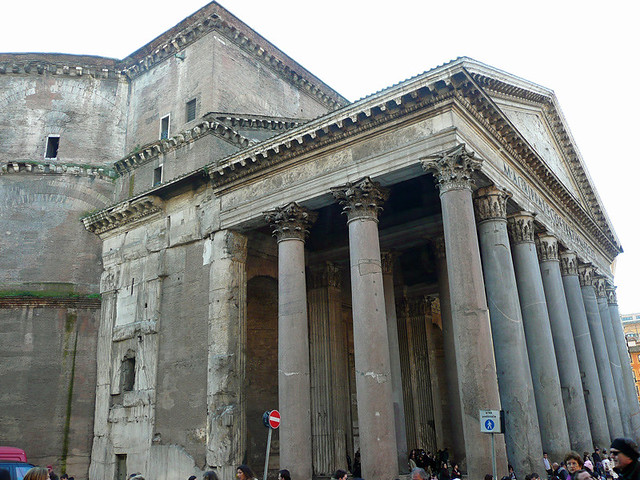
Besides the well-known Egyptian Pyramids and Roman aqueducts, one interesting one I've recently learned about was about the columns in the Roman Pantheon were built: They were carved from single blocks of granite and then imported all the way from Egypt[0]:
"The grey granite columns that were actually used in the Pantheon's pronaos were quarried in Egypt at Mons Claudianus in the eastern mountains. Each was 39 feet (11.9 m) tall, 5 feet (1.5 m) in diameter, and 60 tons in weight.[43] These were dragged more than 100 km (62 miles) from the quarry to the river on wooden sledges. They were floated by barge down the Nile River when the water level was high during the spring floods, and then transferred to vessels to cross the Mediterranean Sea to the Roman port of Ostia. There, they were transferred back onto barges and pulled up the Tiber River to Rome.[44] After being unloaded near the Mausoleum of Augustus, the site of the Pantheon was still about 700 meters away.[45] Thus, it was necessary to either drag them or to move them on rollers to the construction site."
The Romans also had a passion for importing ancient Egyptian obelisks, which could be a hundred feet tall and weigh 450 tons. They were also made from single blocks.
Ancient Perisans had a few mega projects as well. Persepolis is fairly well known, the Qanat water system [1] that conveyed water from the Alborz mountain range [2] to nearly the edge of Persian Gult is a bit better known. But the first attempt at a Suez Canal [3] is even news to most Iranians.
Saw the Pantheon in May and it is very impressive the columns are massive. The inside is equally impressive. It's one of the only, if not the only Roman temple where the interior survived.
So much of the Ancient world impresses me the more I learn. Seeing it amazes me more.
It's sad a lot of Ancient buildings or knowledge was destroyed as the next ruling party or ideology came to power.
The interior didn't survive unscathed. The design of the upper walls was "fixed" during the renaissance, with one small section now restored to something more like its original design (based on paintings of the original, see top right of photo): https://userscontent2.emaze.com/images/9fd064fa-8fb9-409b-ac...
Additionally, Pope Urban VIII had the bronze ceiling of the portico melted down to make cannons in the 1600's.
On the left side of the portico, you'll also notice that some of the columns don't match. If I'm remembering right, these were taken from a nearby Roman bath complex to repair earthquake damage to the portico. https://upload.wikimedia.org/wikipedia/commons/3/35/Pantheon...
All that said, it's still in remarkably good condition for being close to 2000 years old.




Besides the well-known Egyptian Pyramids and Roman aqueducts, one interesting one I've recently learned about was about the columns in the Roman Pantheon were built: They were carved from single blocks of granite and then imported all the way from Egypt[0]:
"The grey granite columns that were actually used in the Pantheon's pronaos were quarried in Egypt at Mons Claudianus in the eastern mountains. Each was 39 feet (11.9 m) tall, 5 feet (1.5 m) in diameter, and 60 tons in weight.[43] These were dragged more than 100 km (62 miles) from the quarry to the river on wooden sledges. They were floated by barge down the Nile River when the water level was high during the spring floods, and then transferred to vessels to cross the Mediterranean Sea to the Roman port of Ostia. There, they were transferred back onto barges and pulled up the Tiber River to Rome.[44] After being unloaded near the Mausoleum of Augustus, the site of the Pantheon was still about 700 meters away.[45] Thus, it was necessary to either drag them or to move them on rollers to the construction site."
0. https://en.wikipedia.org/wiki/Pantheon,_Rome#Portico