Choice 1: Burn lots and lots of coal + Fischer Tropsch + electric vehicles.
Choice 2: Thorium reactors + electric vehicles.
That's about it.
BTW, The "Peak Oil Community" are 5% oil and gas industry people, and 5% energy policy wonk want-to-bes.
The rest are radical environmentalists eagerly anticipating the ecological-Malthusian-doom rapture (see dieoff.org, etc) and are not interested in practical solutions and are just sitting in front of their computers waiting to be raptured up into their ecological-hand-tools-subsistence-agriculture wonderland.
but it's us stinky hippies that bang on the loudest and for the longest about sustainable transport solutions, renewable energy and sustainable population. (~>_aside form nuclear energy_<~) where do you draw that stereotype from?
> but it's us stinky hippies that bang on the loudest and for the longest about sustainable transport solutions, renewable energy and sustainable population.
Nope. Wasn't the "stinky hippies" the groups that consistently protested against nuclear power? Being anti-nuclear power in the 70ies and 80ies was the bandwagon for the far left (now it is global warming).
I have a Prius. I also support massive expansion of nuclear energy, just like Stewart Brand (of the Whole Earth catalog) and David McKay (British physicist). Caring for the environment doesn't mean forgetting physics. In addition, if we're talking TCO, many more people have been killed in oil wars than nuclear disasters...
No way dude, the stinky hippies only complain, they don't offer solutions. So yeah re-reading your comment, maybe you're right, but it's hardly the morally position they/you always claim it is.
hm didn't know that, guess it all depends where the line runs if you are going to make a serious environmental case vs's NIMBY.
fwiw the greens just got us a feasibility study for australias first high speed line (under the world 4th busiest flight corridor) but i'm sure i'll be a very old man b4 anything comes of it
Incredibly frustrating that all the figures were thumbnails that are illegible and don't link to a higher-resolution version---and then the text doesn't even fully explain them. Does anyone know which country he's talking about for Fig. 3?
I like Orlov, find his writings to be a useful and interesting perspective, however there is much that is inaccurate or that remains unconsidered in this piece.
For instance, the issue of Iraq and Iran, both very undeveloped in terms of wells drilled and the modernity of the infrastructure that runs those wells.
Iraq, for all its recent investment, remains underdeveloped, and Iran has not had access to newer oil tech since 1979.
Further, there is the question of whether we are suffering from an "oil coming out of the ground" problem or "refine the crude oil into something we can actually use" problem.
The bottleneck at this point appears (from my admittedly limited, amateur research) to actually be in total refining capacity.
I let myself get scared a little, as I should with any good peak oil story, and then went looking for an Achilles' Heel.
"Some might also wonder why a shortage of oil should automatically trigger a collapse. It turns out that, in an industrialized economy, a drop in oil consumption precipitates a proportional drop in overall economic activity. Oil is the feedstock used to make the vast majority of transportation fuels -- which are used to move products and deliver services throughout the economy. In the US in particular, there is a very strong correlation between GDP and motor vehicle miles traveled. Thus, the US economy can be said to run on oil, in a rather direct and immediate way: less oil implies a smaller economy. At what point does the economy shrink so much that it can no longer meet its own maintenance requirements? In order to continue functioning, all sorts of infrastructure, plant and equipment must be maintained and replaced in a timely manner, or it stops functioning. Once that point is reached, economic activity becomes constrained not just by the availability of transportation fuels, but also by the availability of serviceable equipment. At some point the economy shrinks so much as to invalidate the financial assumptions on which it is based, making it impossible to continue importing oil on credit. Once that point is reached, the amount of transportation fuels available is no longer limited just by the availability of oil, but also constrained by the inability to finance oil imports."
This is the part which attempts to convince the reader that a simple recession/stagnation cannot occur.
Unfortunately, it vastly underestimates our resourcefulness and runs on the fallacy of the USA only ever being capable of transportation with petroleum, or of a collapse so swift and sudden(from full consumption to zero in a matter of months; an unlikely event, between price hikes, austerity measures, the application of strategic reserves, opening of existing private stocks, etc.) that no response can be made. If it ever becomes too costly to run petroleum-based freighters, we can still revive coal and sail technology. That alone will ensure the survival of ocean-bound transportation(and hence a lot of import-export dependencies). Overland, goods in the USA are transported through the most cost-effective freight system in the world; trucks are "last mile" haulers in most situations. Our existing rail and electric systems can revert to coal for some time to come, although nobody likes the ecological costs involved in coal. And this even leaves open the possibility of refrigerated transit, just not necessarily at present-day schedules.
So the remaining energy problems, as I see them, are in petro-agriculture dependency and infrastructure(primarily in housing stock). Difficult? Yes. Impossible? No. People will die as a result of pretty much any peak oil scenario. A full collapse, though, requires both an overnight cratering of production, and an awful lot of faith in people to do exactly the wrong things.
While I also prefer to be an optimist in such matters, I never quite get the "we are so resourceful" reaction. Yes, a couple of times in history we (I mean earth, humans, as I am not from the US) have been lucky, and some looming crisis was averted. A lot of other times things didn't go so well. History is full of civilizations collapsing, wars, famines and so on. There is not always some genius at hand who invents a wonderful rescue device (as apparently with the agricultural revolution last century).
Personally, I used to hate cars and everything oil related. So I am the first who would welcome it if the economy would run on sustainable alternative energy. But I think oil is ultimately simply this: free energy. It is as if somebody gave your country several trillions of dollars (without inflation). So if you take that away, you suddenly have several trillions of dollars less (or more, just picked a random number here). You can not simply replace them, they are missing from the equation completely. So overall, you will be that much poorer, with all the consequences. Sure, you can build other things, but it will take time.
Yes, a couple of times in history we (I mean earth, humans, as I am not from the US) have been lucky, and some looming crisis was averted.
We avert stuff every day. It's just not "news" so you don't much hear about it. ("News" generally involves dirty laundry of some sort, not good outcomes.) When we had some huge earthquake in the East, it was News. When the world rose to the occasion and averted hundreds of thousands of expected additional deaths from famine and disease in the aftermath, big yawn. Moving on. Has Hollywood got some juicy scandal for us? When Iraq set fire to the oil wells as it was leaving Kuwait, Big News. When the entire world converged upon Kuwait with every available crack team for putting out such things and invented new methods on the spot to kill the fires in a much shorter time frame than was predicted, big yawn. Moving on. Can we come up with some juicy gossip from somewhere? When the desert bloomed like no one had seen in decades (if ever) from all the water and carbon in the aftermath of the fires and attempts to put them out, also hardly mentioned. Y2K also was a huge anticlimactic non-event after years of people getting ready for a global meltdown of our banking infrastructure...etc...
I've been talking about Peak Oil for years. I think it is a serious issue. But I'm an optimist and I think we can adapt. It doesn't have to be some nightmare scenario. It will only turn into that if we engage in too much denial and foot dragging and resistance to change.
You are talking about temporary natural catastrophes, though, not the kind of disasters that develop slowly.
It's easier to give examples of that which people can readily see. For a "slower" problem, how about the general trend that people are living longer? IIRC, when social security was invented in the US (which you qualify for after age 65), the average life expectancy here was 67. It was intended to make life easier for folks in extreme old age. Now this country is in crisis trying to figure out how to deal with the fallout from supporting people for decades when it was only designed to do so for a couple of years.
Also, the last statistics I heard on bankruptcy in the US is that more than half of all bankruptcies here are due to high medical bills. Bankruptcy in the US is generally chalked up to "irresponsible behavior". In reality, it is more often due to devotedly doing whatever it takes to try to save the life of a loved one.
Then there is cystic fibrosis. The life expectancy in recent decades has gone from age 18 to age 37-ish.
As for people living in squalor: The US definition of poverty routinely places 12-14% of the US population under the poverty line. But one study I read indicated that less than 1/2% of Americans qualified as "poor" by the standards of India when measured not by income but by things like "number of meals eaten per day" and whether or not they had a roof over their head. Plus I currently live with zero furniture and no car and generally few possessions. I'm happy this way and healthier than when I had the stereotypical American lifestyle of affluenza. So I am not sure what you mean by "a huge percentage ...living in squalor". Perhaps you would like to clarify what standard you think "everyone" should live by? Given that giving up my possessions has been a keystone to getting healthier, I have my skepticism about (and objections to) ideas that material wealth is a terribly important measure of quality of life.
> Also, the last statistics I heard on bankruptcy in the US is that more than half of all bankruptcies here are due to high medical bills.
Actually, it's not. The bulk of the so-called "medical bankruptcies" were due to job loss due to being sick or addicted, aka "if you can't work, you're not going to be paid". (And gambling is considered medical....) Yes, those folks have medical bills, but free medical care wouldn't have kept them employed.
FWIW, there is universal free medical care in the US. It isn't as good as paid and you get to wait in the medical equivalent of the social security office, but it exists.
There are free clinics in every reasonably-sized city and all but the most uninhabited counties have a county hospital which treats people for free. And then there's medicaid and the state analogs.
FWIW: The last statistics I heard on that were from a few years back, before this recession. I have no idea what the current situation is. I generally don't bother to keep up with mainstream news (which shouldn't come as any surprise given the opinion I expressed above).
I haven't been to India myself, but from what I have heard, maybe you should travel to India. The problems you mention are not real problems (yet).
Also I said "squalor", not "poverty". By that I mean no clean water to drink, no sanitation, no access to physicians and stuff like that. Hint: the US is not the world (no offense).
Edit: I agree that we constantly solve problems, too (or the Scientists do). But we don't have an answer for everything.
It's a study I have been quoting a long time, so I don't doubt it no longer reflects conditions in India. My only point was perceptions of poverty change and can be very subjective.
Historically, wine and beer were drunk in Europe because you could not drink the water. It was not clean. The expectation that everyone "should" have clean water is a relatively new concept. Would I like everyone to have clean water? Sure. But I don't think the lack of clean water for many people somehow magically wipes out the value of other gains.
I think we are talking about different things. What I mean is: there are people living in squalor right now. Therefore it follows that "we" do not automatically always find a solution if people live in squalor. Therefore "resourcefulness will solve all our problems" has been refuted in my opinion.
I know that the definition of poverty is subjective, hence my use of the term squalor. In my country (Germany) poverty is defined as having less than a percentage of the average income. So most people "below the poverty line" are actually rich - they have health insurance and everything. It is indeed rather meaningless to use the term "poverty" in that way.
I've been talking about Peak Oil for years. I think it is a serious issue. But I'm an optimist and I think we can adapt. It doesn't have to be some nightmare scenario. It will only turn into that if we engage in too much denial and foot dragging and resistance to change.
Can doesn't mean will. I imagine lots of Americans will drag their feet and only embrace change when a gun is to their head on this issue. But I will not and I hope others can be encouraged to be more proactive as well.
Econtalk had an episode about carbon shortage recently. It turns out that synthetic fuels manufactured from coal become economical far before petroleum is totally gone. And there are other more expensive technologies that come into play when the coal is gone.
All the while, renewable energy is getting cheaper by the year.
Here's the link. It is a fascinating podcast, though it wanders a bit near the end:
With Thorium reactors you can generate so much electricity you can convert CO2 into hydrocarbons directly. If for whatever dumb reason thorium reactors don't happen, yeah Fischer-Tropsche Coal to Oil is the way to go. Al Gore will be upset though at all your non-carbon neutrality, for what it's worth but they'll sure as all heck do it in China. Problem is is that building an industrial scale Fischer-Tropsch plant is a big undertaking, on the scale of building a major oil refinery and you'd have NIMBYs up the wazoo anywhere you tried to build that in the U.S.
"become economical far before petroleum is totally gone"
What does that even mean, though? If oil was gone today, dragging things by hand or with horses would become economical, too. That doesn't imply that it would afford us the same luxurious lifestyle we enjoy today (luxury == not having to drag stuff around by hand, among other things).
Sasol, the world's largest coal-to-liquids (CTL) and gas-to-liquids (GTL) producer, has stated that GTL becomes financially viable at $10-$20 a barrel while CTL reaches the same level at $50-$60 a barrel. So with the current price of oil at over $70, it's reasonable to assume that CTL, supplemented by GTL, could maintain prices at close to current levels.
I must admit I don't understand what this means? So Sasol could provide a replacement for oil that only costs 10-20$ per barrel? Why isn't everybody using their stuff now, instead of the 70$ "real" oil?
Also, in my mind "peak oil" was actually just "peak fossile fuels" - how much more coal and gas is there than oil?
"So Sasol could provide a replacement for oil that only costs 10-20$ per barrel?"
With sufficient natural gas feed stocks, yes.
As to why it's not being used now, until the very recent fracking revolution the supply of gas had been pretty tight, at least at where it's needed for consumption. See e.g. Russia's regular fights with the Ukraine.
Probably the only places where it might make sense to build GTL plants are in relatively unstable oil producing nations that are currently flaring off their gas instead of doing anything else.
There's also the issue of your confidence in predicting the future. These are expensive plants, and if e.g. a world-wide recession eventually leads to a crash in demand then you may not be able to service your debt on what you're able to sell your product at (there are plenty of people who suspect oil might crash to $10 a barrel, e.g. what if the PRC's demand sharply drops?).
It just means that it's profitable for them as a company to make it at that price, but their volumes are still relatively tiny compared to the overall fuel market. Presumably were we all to switch to gas-to-liquids to increased demand on liquid natural gas supplies would push the price up quite significantly. So it's not likely that we could replace oil with a $20 a barrel substitute, but it's plausible that coal-to-liquids and gas-to-liquids could serve as relatively affordable substitutes even on massive scales.
And I'm not sure how much gas there is, but there's enough coal to last for 50-140 years, depending on demand.
ideally there should be a solar-wind-powered atmospheric CO2/H20 to hydrocarbon synthesis device in every backyard, and i believe that's how our grand(grandgrand)children will operate. it'll take a while to get there, though.
almost, except trees take too long to grow and cars don't run very well on wood. i mean something that gets CO2 and H20 and yields gas, lpg, diesel or something else that can be put into your tank without making a trip to a refinery first.
Looking back at some of the things our grand parents expected us to have now, I would have to say predicting a lean green future seems a little foolish.
> People will die as a result of pretty much any peak oil scenario.
Not really. South Africa was a third world country under heavy sanctions.
Yet it created industries to produce petroleum from coal (and even today these companies produce 40%+ of SA's liquid fuel requirements).
If a crappy third world country can do it with 70ies technology (most of which they weren't even allowed to import legally), why can't first world country do this?
We'll probably be too busy fighting each other every step of the way. I don't know much about SA's situation but I'm going to take a guess that it was the pro-apartheid government that made it happen. Maybe they weren't so consumed about fighting with each other since they had a common enemy to focus on. I'm somewhat convinced we're at the point in the US where the opposition party (either one) would sabotage the plan for short term political gain.
> Maybe they weren't so consumed about fighting with each other since they had a common enemy to focus on.
<rant>
And who would this “common enemy” be? The Spiel that white people considered black people their enemies during Apartheid is a bit incorrect (yet a popular sentiment in the west).
It is ironic that statistically, the plight of the majority of black people is now far worse in SA than during Apartheid (life expectancy, income inequality, unemployment, infancy mortality, matric pass rate, TIMSS score, etc…). Apartheid (i.e. separate development and rule for all ethnic and cultural groups) as an ideology is failed (mostly due to industrial development which caused South Africa to become a scrambled egg of people). Yet the ideology of full democracy (i.e. tyranny of the majority) is also spectacularly failing. Yet no one would acknowledge the latter failings.
<\rant>
> I'm somewhat convinced we're at the point in the US where the opposition party (either one) would sabotage the plan for short term political gain.
But in any case, I digress. You are right about this part. Everyone is NIMBY. The problem is also that using coal to make fuel would release CO2. And this is counter to the ideology of the far left (which only wants non-practical solutions to be implemented).
The USA landed people on the moon in less than a decade. I am sure that if they put their minds to it, they can expand nuclear power generation significantly (to reduce CO2) and start to make a significant part of their liquid fuel requirement from coal.
Your rant doesn't mention that benign-sounding "separate development and rule for all ethnic and cultural groups" under Apartheid forced blacks onto 13% of the land, even though they formed by far the largest population group in South Africa.
Nor does it mention the fact that generations of blacks were forced by state policy into inferior "Bantu Education". Nor does it mention the fact that the migrant labour system, coupled with the other degrading laws to deprive blacks of economic and social freedom helped wreck the fabric of black society.
I am as disgusted by the current ruling party's corruption as anyone, and I am appalled by the way the west generally seems to turn a blind eye to its massive failings.
Apartheid was designed to turn black people into failures, and into an exploitable manual labour pool. And any attempt to decouple apartheid from its aftermath is, at best, highly inaccurate.
Look here, I am not in support of Apartheid (or the current system for that matter). The fact is that Apartheid could not work (for a multitude of reasons, including economic reasons).
But a lot of attacks on Apartheid ignore the basic facts and do not perform a simple statistical comparison with the NSA.
> "separate development and rule for all ethnic and cultural groups" under Apartheid forced blacks onto 13% of the land, even though they formed by far the largest population group in South Africa.
What does this number include? Blacks were deprived of their land well before “Apartheid” started. During the creation of homelands, white people also lost their land (land was bought and sold to create contiguous homelands). A good example is the large farms of Lisbon, Berlin, etc… that became KwaNdebele.
It is clear that the deprivation of land from black people is wrong. But the fact is that most of the depravation/deprivation was done well before Apartheid.
> Nor does it mention the fact that generations of blacks were forced by state policy into inferior "Bantu Education"
Bantu education was inferior, that is a fact. But it is a question of resources. During Apartheid more money was spend on Bantu education than on the education of white people (although less per capita). White people almost exclusively pay taxation (as is still more or less true today).
The problem is that there are only so many math teachers, etc…
By the way, Bantu education is vastly superior to all education that every person in South Africa receives. This is not my opinion, but the opinion of Dr. Mamphela Ramphele and prof. Jonathan Jansen. OBE failed.
Even South Africa’s president Zuma, said the following of the previous education minister:
> This comes shortly after ANC president Jacob Zuma blamed former education minister Kader Asmal for closing down these institutions, causing more damage to education than had been done under apartheid.
http://www.iol.co.za/index.php?art_id=vn20080425091635396C60...
There were a lot of teacher colleges whose function it was to train teachers. These colleges were often in rural areas and focussed towards black people. The ANC government closed down basically all these colleges, leaving SA in a severe shortage of (black) teachers (and people in these places without the opportunity to get education).
How many black universities did Apartheid government build? I can think of quite a few (MEDUNSA, University of the North, University of Venda, several Technicons, etc…). How many was built by the ANC government? None – they however closed down colleges.
Why wasn’t there at least a University built in the past 20 years in Mpumalanga? The province doesn’t have a single university.
> Nor does it mention the fact that the migrant labour system,
Migration is a natural cause of South Africa’s industrialization. The population is still rural and development is in the cities.
What you should bear in mind is that Apartheid government tried to get industrial development started in black and rural areas. This was done by means such as development zones (e.g. Babelegi) and making companies in homelands free from VAT.
Another thing that the NP government was fearful for was that black unemployment would lead to revolution. There were active programs in order to reduce unemployment. During Apartheid, SA’s unemployment was much lower than it is now. Do you know what unemployment is now? Narrow definition 25,3% (people who are actively looking for work but do not find any: http://www.statssa.gov.za/keyindicators/keyindicators.asp). Broad definition (people who are capable of work but have given up) is over 40%! (see articles by Kingdon, G. and J. Knight)
This had another effect – spreading development around the country. Now we have a lot of development in cities, but many rural areas are basically abandoned. Rural areas (where many black people live) have now extremely high unemployment rates and there is almost zero industry. The ANC abandoned the country site to its own fate.
> Apartheid was designed to turn black people into failures, and into an exploitable manual labour pool.
That is debatable. The primary goal of Apartheid was arguably to ensure the existence and security of minority white people (from real and perceived threats such as communism (“Rooi gevaar”) and black crime (“Swart gevaar”).
The amount of money spent on black education (e.g. universities) would indicate that the “exploitable labour pool” theory is not completely correct. I would like to remind you amount of black teachers and craftsmen trained during Apartheid were much higher than it is now.
I personally suspect that the aim of the ANC government is to create very stupid and untrained voting cattle while cultivating a very small and rich black elite with close ANC ties.
Regarding the consolidation of universities, I wouldn't take Zuma too seriously (I have to wonder he was motivated to say that by individuals who lost power through the consolidations, and in any case Zuma was in Cabinet and didn't voice any objections at the time). There was a lot amount of duplication between racially segregated institutions, and cutting administration costs is a good idea. The merging of teacher training colleges into universities may be more problematic, but overall, in South Africa, the less institutions, the less chance for waste and looting. I also have to wonder how good the teachers produced by those colleges really were.
>Bantu education was inferior, that is a fact. But it is a >question of resources. ...
>White people almost exclusively pay taxation (as is still >more or less true today).
Hendrik Verwoerd's comments about Bantu education clearly indicate, that it was about more than resource constraints http://africanhistory.about.com/od/apartheid/qt/ApartheidQts... Per capita spending on education for black children was 10% of that on white children. I do agree the Outcomes Based Education (introduced by Asmal's predecessor, if I recall correctly), has been a tragic waste.
The idea that blacks didn't contribute to the tax base, and were not therefore entitled to its benefits is absurd. They were systematically excluded from economic opportunity, so they couldn't contribute, even if they wanted to (and they have always payed sales taxes).
>Migration is a natural cause of South Africa’s >industrialization. The population is still rural and >development is in the cities.
Migration and the migrant labour system are two very different things. The Apartheid ideal was black men in hostels, black women and children in Bantustans.
The rural industrial development was worthy, and it is regrettable that it has been abandoned, but one has to question the sustainability of those developments. Their motive, like much development in apartheid South Africa, was to further racial segregation by keeping the races apart. If they had provided job opportunities close to major economic centres, those jobs might have proved to be sustainable.
> There was a lot amount of duplication between racially segregated institutions, and cutting administration costs is a good idea.
Yeah, closing them down isn’t such a good idea. You know that most universities which merged basically closed down their “satellite” campuses in black areas? This simply serves to keep away affordable education from black people.
> The merging of teacher training colleges into universities may be more problematic, but overall, in South Africa, the less institutions, the less chance for waste and looting.
Most teacher colleges weren’t merged, they were simply closed down. Note that waste and looting wasn’t such a big problem before, why is it now?
By the way, you know what is one reason why they were closed down? Provincial governments became extremely corrupt (the funding for colleges came from provincial governments). They simply closed it down to ensure more money for looting.
> I also have to wonder how good the teachers produced by those colleges really were.
Look, they were not the best teachers in the world. But the problem is that we do not need the best teachers in the world, we need a lot of teachers. A good teacher in a class of 40 doesn’t help a thing. Also, the idea of removing teacher diplomas ensures that there are even less teachers (teacher training courses at universities is now 1 year longer).
South Africa loses some 12, 000 teachers a year (6, 000 produced by universities but 18,000 lost due to retirement and immigration). It is a disaster waiting to happen.
> Hendrik Verwoerd's comments about Bantu education clearly indicate,
Hendrik Verwoerd was not the be all and end all of the NP government. You know that many of the policies changed after him? In any case, I do not care what someone has said (or what the motives were) but what happens on the ground.
> Migration and the migrant labour system are two very different things. The Apartheid ideal was black men in hostels, black women and children in Bantustans.
Can you give a citation for that? During Apartheid, there were a lot more industries closer to the living area of black people. The industrial zones (of which there were numerous) are an example of that.
Today the economic activity near large centres of black population is a lot lower. The economic outlook in rural areas also forces people to become migrant labourers.
> that it has been abandoned, but one has to question the sustainability of those developments.
Whatever the motive, those developments worked.
> If they had provided job opportunities close to major economic centres, those jobs might have proved to be sustainable.
There are many reasons why those businesses moved (from high crime to non-functioning municipalities). The fact of the matter is that work and businesses are now far from where many employees work. So they have to rely on non-existent transport (such as taxis or horrible metro lines) each day to commute 30km+.
>But the problem is that we do not need the best teachers in the world, we need a lot of teachers. A good teacher in a class of 40 doesn’t help a thing.
The conventional wisdom on class sizes is being challenged currently.
>Hendrik Verwoerd was not the be all and end all of the NP government. You know that many of the policies changed after him?
In the 1970's, well after Verwoerd's demise, a black child's education got 10% of the funding given to a white child.
>There are many reasons why those businesses moved (from high crime to non-functioning municipalities). The fact of the matter is that work and businesses are now far from where many employees work. So they have to rely on non-existent transport (such as taxis or horrible metro lines) each day to commute 30km+.
This is a rather strange argument. The reason why blacks, Indians and Coloureds have historically lived so far from their workplaces is that the apartheid government (literally) forced them out of urban centres and onto the periphery of urban areas.
Transport infrastructure was neglected for 20 years, starting in the 1980's, and continuing under Mandela and much of Mbeki's tenure. The taxi industry/mafia was deregulated in the late 80's by the apartheid government. Car-centric urban sprawl also first took hold under the apartheid government (even today, mass transit between the black areas of Soweto and white-flight Sandton, established in the late 70's is nonexistent).
If the Apartheid economic model of decentralised and seperate development was so worthwhile, why was did that government have to run up massive deficits to support the system? Communist countries also enjoyed low unemployment, just as Apartheid South Africa did, thanks to similarly massive misallocations of resources, and coercion, in pursuit of a failed ideology.
Apartheid was declared a Crime against Humanity, with good reason. The only place where pro-apartheid revisionism gets much currency is in obscure corners of the internet.
> The conventional wisdom on class sizes is being challenged currently.
This is a statement without any meaning. Yeah, large class sizes with 800 students is OK in college.
But it is a huge as difference between primary schools and secondary schools where children need more individual attention. How will a teacher check that each child writes properly, or get a chance to speak? I’ve been learning a foreign language recently and I found a class of 14 people too big. Imagine being a poor black kid in a class of 80 trying to learn English or another language?
You know that some rural schools have a ratio of 1 to 80? These are the kids that need more attention than any other student. Yet they do not get it.
You are right that in some sectors of education the idea of class sizes are irrelevant – notably college kids or self-motivated students (a very small percentage). This is not what you will find in your typical overfull and run down rural school.
> The reason why blacks, Indians and Coloureds have historically lived so far from their workplaces is that the apartheid government (literally) forced them out of urban centres and onto the periphery of urban areas.
The reason why most black people historically lived far from business centres was because they were spread around the country (This was the same for white Afrikaans people in the beginning of the century).
At least in Gauteng, business centers arose around mining sites and are unnaturally densely packed around this. By the way, look at groups such as Venda’s, N. Sothos, etc… They were historically far from business centers, not because they were moved there by the Apartheid government, but because there was not big industrial development in the area that they historically lived (such as a town which grew from mining roots).
> Transport infrastructure was neglected for 20 years, starting in the 1980's, and continuing under Mandela and much of Mbeki's tenure.
Again, this is debatable. Quality of roads in rural areas rapidly declined in the last 15 years. This is mostly due to the fact that the provincial governments and local governments lost almost all capacity to function (again, this is truer for rural areas).
> Car-centric urban sprawl also first took hold under the apartheid government (even today, mass transit between the black areas of Soweto and white-flight Sandton, established in the late 70's is nonexistent).
South Africa will always be a car based country as far as passengers go. We simply do not have the high densities needed to form passenger rail networks.
It is however interesting to note that freight rail has almost completely declined in South Africa with most freight transport occurring with trucks (increasing danger). The South African rail company (Transnet) is also a corrupt ANC cadre cesspool.
> why was did that government have to run up massive deficits to support the system?
The Apartheid government did not have to run up massive deficits to support that system. The deficits were created by defence spending (which was in the 80ies around 10% of GDP) and things such as sanctions.
> Communist countries also enjoyed low unemployment, just as Apartheid South Africa did, thanks to similarly massive misallocations of resources, and coercion, in pursuit of a failed ideology.
Yet, in 1994 SA’s economy was 50% the size of the whole sub-Sahara Africa’s economy. Whilst many of those countries followed a Marxist ideology, SA still remains the only industrialised country on the continent.
> The only place where pro-apartheid revisionism gets much currency is in obscure corners of the internet.
Look. Your argument is now “something is bad because someone said so”. I said at the beginning of this post that I do not see Apartheid as good, but I do not see the new government as good (Majority democracy failed horribly in South Africa). Or do you describe a government that presides over a 15 year drop in life expectancy as “good”?
I also do not care about moralizing. As an example, Singapore was ruled by a dictator and the PAP political party ever since it existed. They are generally condemned by people who take the (western) moral outlook and whatnot. Yet it is one of the most developed countries in the world with a higher standard of living than any of its more politically correct neighbours. When cold and hard statistics and facts are used, Singapore is one of the best governed countries in the world – and much better developed than its neighbours.
Regarding class sizes, I refer you to the recent news about Gates Foundation findings regarding class size, versus teacher quality. Large numbers of poor/mediocre teachers and small class sizes are not necessarily better than good teachers with larger class sizes.
South Africa's densities are low because of apartheid planning. Segregation trumped density or sustaintability.
Freight rail has indeed declined in South Africa, partly because of corruption, but the neglect started many years before. South Africa's railway rolling stock is, on average, decades old, so the lack of investment in rail, and promotion of road transport, started long before the present government took over.
The lower life expectancy is due to HIV/Aids and it is similar to neigbouring countries. In the (highly unlikely) event that the Apartheid government had survived, I doubt that the life expectancy figures would have been much better. (And the AIDS epidemic took hold under the apartheid government).The infant mortality rate remains better than the world average.
The Apartheid regime was not viewed as a benevolent dictatorship by the majority of South Africans (or the rest of the world), so comparisons to Singapore are spurious. Instead, Apartheid was an organised state policy to further the interests of white people, at the expense of all others, monopolising the wealth and resources of the country, while throwing enough crumbs at a deliberately dumbed-down black population, to keep them docile.
> Large numbers of poor/mediocre teachers and small class sizes are not necessarily better than good teachers with larger class sizes.
I suspect that this probably referred to class sizes of 15 (small) and 30 (large). In South Africa, a small class is 35 and a large class is 80. It is quite a difference.
How do you think a teacher would keep rudimentary discipline in such a big class? You cannot even check their homework.
Learning a new language, it is important to talk it. In a class size of 80 people, each person would get 45 seconds to talk or answer a question in a double period (assuming that there was no lesson or any interruption otherwise). Learning a language would be impossible for these people.
> South Africa's densities are low because of apartheid planning. Segregation trumped density or sustaintability.
South Africa’s densities are low because South Africa only industrialized fairly recently and we have a natural low density (40 people per square kilometre).
> The lower life expectancy is due to HIV/Aids and it is similar to neighbouring countries.
I think that you set the bar artificially low when you compare with neighbouring countries (Civilwartorn Mozambique, Mugabe Zimbabwe and the Kleptocracies of Lesotho and Swaziland).
> In the (highly unlikely) event that the Apartheid government had survived, I doubt that the life expectancy figures would have been much better. (And the AIDS epidemic took hold under the apartheid government).
The NP government of De Klerk had a surprisingly good AIDS program (seeing as the disease was then a smaller problem).
You seem to gloss over Mbeki’s AIDS denial (he did not want to give pregnant mothers even Nverapine which would have prevented mother to child transmission of AIDS during birth). The courts had to be used to force the government to change.
Even Harvard University had a study which they claimed that Mbeki’s government at least caused 300,000 deaths. That is genocide. The world would have been up in arms if the Apartheid government had a similar policy.
> The Apartheid regime was not viewed as a benevolent dictatorship by the majority of South Africans (or the rest of the world),
So? Neither Singapore (or for that matter, Pinochet’s Chile) is/was viewed as benevolent dictatorships. All things considered, statistically the country was governed better than neighbouring countries.
> Instead, Apartheid was an organised state policy to further the interests of white people, at the expense of all others,
It is ironic that it is middle class white people whose income grew* the most in post-Apartheid South Africa (see again the Knight & XX study I mentioned) while unemployment and real salaries fell for black people.
So, if you complain about the enrichment of white people, the current government is doing a much better job of it. Income inequality increased significantly the past 15 years.
> deliberately dumbed-down black population, to keep them docile.
This is also debatable. The biggest expansion of tertiary education on the African continent (for both black and white people) occurred during the 70ies and 80ies. Even the TIMSS study (Trends in International Mathematics and Science Study) scores were higher in 1994/1995 than in the newer study. There are numerous international benchmarks which showed that the quality of education declined.
Maybe yes, maybe no. I think it's impossible to predict what will happen and how far human resourcefulness will get us. People alive in developed countries today take technological progress as a historical given, and we all have a vested interest in the current system. To imagine every aspect of our lifestyle to be eradicated overnight is almost unfathomable, so it becomes a psychological necessity to believe we will somehow figure it out. Of course there are always those prophesizing doom, and they have so far been wrong and crazy (at least during modern times), but just because it hasn't happen yet doesn't mean it won't.
And frankly I don't put much creedence in economic theory here, because there's no historical model for such a huge and global economy. I'd be more interested in the behavioral biology perspective, because the social seams are going to start coming apart very quickly if the world economy ever hits truly insurmountable difficulties.
I completly agree. I think there is a ton of low-hanging fruit in our economy, in terms of energy use. The fact is that energy has not been a resource worth conserving during the entire industrial expansion thus far. Energy's always been something that is cheap and getting cheaper. So there's never been any economic imperative for energy efficiency, so it's always been cheaper to burn more energy than to invest in efficiency.
I think an economy in which renewable energy sources are exploited, and in which energy is used as efficiently as possible, is one which could continue expanding for a long time after peak oil extraction is reached.
Your argument may be too simple. If you have a look at the history of the steam engine, you will see massive gains in efficiency.
Those gains are what allowed industrialisation to escape Britain in reach the rest of Europe, where coal was more expensive than in Britain and labour less so.
Or look at the history of steel making. The 19th century alone saw huge decreases in the amount of coke used to make a single ton of steel---while improving quality all the time.
Interesting, but he wants a bit too much collapse to be inevitable. The current crisis is probably related to the 2006-2007 oil prices hike (the first actual effects of Peak Oil), and the situation will remain so for a decade or two : oil prices climb, demand is killed off, crisis ensue, prices drop, partial recovery comes, and we start the cycle again.
That means that instead of a brutal collapse, we'll live a state of depression, recession and incomplete recovery for the next decades, with at some point an inflexion from less growth to more depression. That's what we have to get prepared to.
As the price of oil goes up, alternatives for the various uses of oil will appear. There are plenty of those already, they are just not economically viable. At the same time, everything is still getting cheaper and we are faring better and better. I don't see why the net result couldn't be a switch away from oil that takes a few decades, without our (increasing) wellbeing being jeopardized.
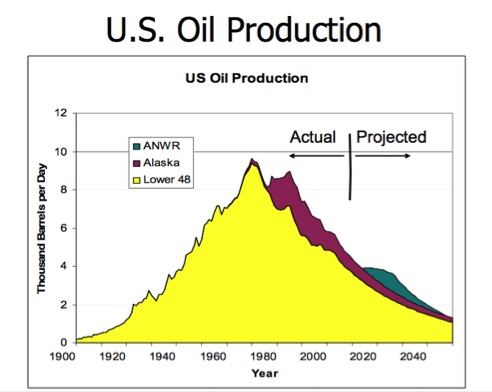
I find it amazing that so much of the peak oil arguments come from looking at production in the USA, and also from seemingly looking only at production of light sweet crude.
Production in the USA is much harder now because of environmental regulations. These drive up costs and naturally would result in companies going offshore to produce... Yet I bet if you looked at proven reserves in e USA you might see a different figure.
Especially if you include forms other than light sweet crude. This easy oil is cheapest to refine but it is just one grade of oil, with many heavy grades going all the eay in to oil shale and coal tar and oil sands..... And the reserves of these types of oil are massive in the USA and staggering in Canada.
Further exploration is very difficult and banned for the Americas richest locations, such as ANWR. Before it was cut off from exploration, I believe many geologists believed that north of prudhoe bay there was more oil than was found in Saudi Arabia, and at the time they were keeping it under wraps as strategic reserve..... Now we pretend like it doesn't exist.
Finally peak oil is based on the theory that depleted fields never produce again, while I understand there are many fields that were previously depleted that refilled while lying fallow for several decades. It is possible that oil is actually a natural product of geological forces, not ancient plant matter, and that most fields will refill over time.
I'm looking forward to a world not running on oil.
Finally, for the first time, there's global pressure to develop alternatives. The result of this can already be seen in hybrid cars and cheaper solar power.
Getting rid of oil is a Good Thing for so many reasons. We should salute it, not fear it.



Choice 2: Thorium reactors + electric vehicles.
That's about it.
BTW, The "Peak Oil Community" are 5% oil and gas industry people, and 5% energy policy wonk want-to-bes.
The rest are radical environmentalists eagerly anticipating the ecological-Malthusian-doom rapture (see dieoff.org, etc) and are not interested in practical solutions and are just sitting in front of their computers waiting to be raptured up into their ecological-hand-tools-subsistence-agriculture wonderland.