- Visual computing is pretty heavily used, unreal engine, blender, houdini, etc. All have a very similar node based visual programming system. It seems to work pretty well (better than text) for most of what they use it for. I think because of the ease of jumping in the middle and making small understandable changes.
- Many programming languages today have a format that is like <tree of files, each containing> <set of items, each containing> <list of expressions>. It would be nice if that <set of items> step was treated as an unordered set instead of an ordered one, with editors having a better understanding of how to bring up relevant elements of the set onto your screen at the same time. Split pane editors, "peeking" in editors at code definitions, etc. hint at how this should work, but I don't feel like they do it as well as possible.
I feel like a lot of users on HN are producers rather than users of software, and haven't used node-based systems like in blender or nuke. They are extremely productive, and end up being very similar to functional programming while being super easy to pick up. It's a great "inbetween" representation for non-programmers that really need to do domain-specific programming.
Experience with tools like Blender or Nuke and particularly with visual programming in games engines is actually where a lot of the better informed dislike of visual programming comes from.
The biggest problem with these tools is scalability and maintainability. You will hear many stories in the games and VFX industries of nightmare literal spaghetti code created with visual programming tools that is impossible to debug, refactor or optimize.
Visual programming seems easy for very small examples but it doesn't scale. It has no effective means of versioning, diffing or merging and usually lacks good mechanisms for abstraction, reuse and hierarchical structure. It doesn't have tooling for refactoring and typically lacks tooling for performance profiling.
Some of these problems seem to be more fundamental and others like they could potentially be addressed with better tooling but that tooling never seems to emerge.
I've got a lot of experience with shader programming and have never found node based shader editors to be better than text over the long term, although there are some nice visual debugging features which are rarely implemented in text based IDEs (though I have seen it done). I've also found visual scripting to all too frequently get out of hand and have to be replaced with code due to being unmaintainable, undebuggable or unoptimizable.
I think there is possibly fertile terrain to explore in trying to get some of the benefits of visual programming approaches while avoiding all these downsides but many of us have been burned enough to be very skeptical of the majority of visual programming systems that don't even try to fix the worst problems.
> code due to being unmaintainable, undebuggable or unoptimizable.
I would argue that the shader editor in UE3 had none of these properties. It showed you cycle count and each step of the graph visually for debugging.
Also, I don't mean to be blunt but you aren't the target for those tools. Where they shine is when you have a level artist that needs to make a small tweak to how a shader looks. With those systems you don't have to loop in a dev to make it happen. You still need a solid tech artist to make sure things don't get out of hand and they're not a tool for every problem but in the domains where it aligns you see 10x gains on a regular basis.
I think rather than the shader editor (which uses a similar-but-different node based interface) they are referring to the Blueprint programming system in UE4 which effectively wraps C++.
It's extremely powerful, but it comes at a cost because it's nigh impossible to create diffs between different versions of Blueprints AFAIK.
That is neat, I'd never noticed that. Although in the context i've heard it discussed, it was more in the vein of "can't generate textual diffs/patch with them, as you can with C++".
I could be wrong but I believe the Blueprint assets are stored in a binary representation. So that rules out vanilla tools like patch/diff for the most part.
See the sibling poster, they did actually add a visual diff/merge tool in a much earlier version and I missed that.
Ascii is a binary representation. It's just that we've built up a lot of tooling around being to visualize/manipulate that representation. There's no reason that similar tooling couldn't arise for other binary representations
I'm not really sure what your point is. The point is ASCII/UTF-8 are a binary representation that is easily parsed by humans, which is why we use it for writing code. Sure, if you want, dump both files with xxd and do a diff on that instead.
There's been ways to diff binary files forever. Doesn't mean it is a great idea to store source code in that manner though. With UE4 you're not really supposed to be able to edit the Blueprint "code" outside the UE4 Editor.
> It has no effective means of versioning, diffing or merging
Color solve this one problem just like they solve the text equivalent better than annotations. This is not fundamental.
> lacks good mechanisms for abstraction, reuse and hierarchical structure
VLSI circuit designers have some abstraction mechanisms that are not that bad. This one is fundamental, but it's not as bad as most people say.
> It doesn't have tooling for refactoring and typically lacks tooling for performance profiling.
I can't imagine how those could be fundamental problems either.
In principle the largest problems of visual programming are our lack of capacity of understand complex images, compared to text, and the added information that most visual languages add (making the complexity worse) (that do not apply to things like GUI designing). I don't see any other showstopper, but those two are really bad.
> our lack of capacity of understand complex images, compared to text
I'm not sure I agree with this. Not as a fundamental law, at least. I find complex text pretty difficult to understand. Sure, I can read the words or even expressions, but to really understand how everything is connected and how the data and control flows through what's written, I find that incredibly difficult. A large part of programming is keeping that contextual information in my head so that I don't have to re-evaluate it all again.
Which is the reason why I love pen & paper and boxes & lines when I try to map out some code, a data structure, algorithm or idea. Obviously everyone is different, but for me, when things get too complex, I reach for images and diagrams to help me understand and form a clear mental model of what's going on or what I want.
Having said that, I've yet to find a visual programming language that does this. When I used Max/MSP a number of years back, I found it helped me think in "code" as I could map out ideas visually, reducing the need for pen and paper, but it had a ton of shortcomings. It gave me a glimpse of what it could be though, and I think the problems could be solved to a point where I can skip pen and paper altogether. We're not there yet, but if you think about how much time and effort went into making textual languages, its no wonder visual languages are so far behind. Also, its clear that not every task is well suited to visual languages, so the best environment would need to be a mix of both.
Good point about complex images. I do not think this issue will be solved anytime soon. An individual's mental image of a complex idea like inheritance or a data structure is subjective. Tying a specific visual GUI to a complex model (that many users would agree upon) is a very difficult design problem. Text allows the user to interpret the model using their own imagery.
I don't think I agree. We know that there are diagrams that come from category theory that behave very well, this is what statebox uses. It enforces certain constraints, so we pivot everything around this and see if we can recover some form of programming from it.
certain cases are still much better done in text and statebox itself is written in text, so nobody is claiming programming itself should be 100% pictures, but then again, I think it can be done and I think there is merit to it.
after all, text is also some sort of picture; on the screen but also in your head
Very much agree on these points. In my experience the pragmatic path for larger projects has been a hybrid of keeping visual programming graphs self-contained -- roughly within the "asset" boundary -- and then using a hierarchical format with textual representation to assemble those assets and drive their interface parameters. This is roughly how animation studios use USD (openusd.org), for example. Arguably this is just a strategy of combining a couple domain specific languages, with edges where the optimal tradeoffs of each domain flip. It's a very interesting question whether these limitations of visual programming are essential complements of their benefits, or if there is some good way to provide better abstraction, re-use, etc. Certainly Houdini, Nuke, Katana, etc. all provide limited forms of those things (ex: Houdini OTL's; scripts that version-bump nodes and try to auto-upgrade the parameters), and they do see lots of use in industry.
so I started my studies in animation actually, I used a lot of those tools, you can think of statebox as applying category theory to restructure aftereffects or https://en.wikipedia.org/wiki/Shake_(software)
when done right, we claim, you can target many different things ("semantics")
what we claim is something like, the compositional aspect of many such node based systems can be described as a certain type of mathematical object (monoidal category) ~ we can build an editor for that and then map that "dsl" to particular targets (image processing, state machines, etc)
> The biggest problem with these tools is scalability and maintainability.
This has been my biggest complaint with both Unreal and NI Reactor... you can build some brilliant things, but not without creating a mess of connections that becomes very difficult to reason about, let alone work on. A lot of production "visual programming" diagrams are spaghetti code, without comments or a changelog you can study.
While written code tends to the same way (just try diagramming the class tree in most software), at least we have tools for dealing with and reasoning about it in text form.
Indeed, spaghetti is a big deal. However, in systems like [Node-Red, Antimony, Apache NiFi] you can make function nodes that abstract out the actual data vs the function. And then, your function primitive can be called and instantiated for the particular purposes.
I know in Antimony CAD, you can even instantiate a function, edit the function's flow or individual python subroutines, and the delta is saved for that instance.
I know the hardest graphical programming I've had was with the Lego Mindstorms ev3. There were multiple "simplifications" that removed functions along with a nigh-unusable gui (the if block was this huge encapsulating thing, and other branch codes also had onerous things on screen).
the tools for reasoning about text can be limited if the text is in a language unsuitable for reasoning
this is why we work in a typed, purely functional setting.
spaghetti is difficult to deal with, for starters, you need "compositionality", so that you get no undefined or emergent behaviour.
then second you need some form of "graphical macros", or a "meta-language" for diagrams, code that generates diagrams or "higher order functions" for diagrams.
> ...and usually lacks good mechanisms for abstraction, reuse and hierarchical structure. It doesn't have tooling for refactoring...
Arguably, the whole point of having a diagrammatic representation with good formal properties is to provide new mechanisms for accomplishing these things. Of course these mechanisms, features etc. won't quite resemble the ones that are in use with text-only languages.
Read it as refactoring, or equivalent; the described functions all fall under organizational and editing tools, both of which are necessary in visual and text environments. Lacking decent mechanisms would make a full buy-in difficult for any larger project, regardless of the precise manner in which its done. Without it, you have a write-only language
You shouldn't generalize like this. Even in massive projects visual programming can be enormously helpful. Nobody seriously tries to script game levels in an IDE. Nobody tries to match sprite parameters, which eventually become code, to image files in an IDE. Nobody tries to design GUIs in IDEs.
The right tool for the right job. For 50% of a game's code visual programming is absolutely the right tool. For some other parts it probably isn't.
You seem to be using a different definition of visual programming than the normal one. The article and my comment are talking about visual programming as a graphical representation of code / logic rather than a textual one. Examples would be things like Unreal's Blueprint visual scripting, node based shader editors (Unreal has one of those too) or the Petri nets described in the article. Visual / GUI tools like sprite editors, level editors or GUI builders are not what is usually meant by visual programming.
Unity is a very popular game engine that doesn't have an official visual programming solution (they're previewing one in the very latest version). Unity has a powerful level editor that is used to lay out the levels in a GUI tool but no visual scripting / programming tools. The majority of Unity games that currently exist therefore do all level scripting in C# code. Many other games engines have no visual scripting solution and all level scripting is done in either a scripting language like Lua or in some cases in C++ code. Unity has sprite editors, visual GUI builder tools etc. but those are not what is generally meant by "visual programming". The closest Unity has had until recently was its graphical animation state machine editor.
awesome comments, really cool to read all of this.
anyway, I would argue both are valid examples is graphical progamming, but they happen at different levels.
the "node based" tools usually define some sort of function or system, ie. a "type"; for this you need category theory to describe how the diagrams look and this is not what any editor I know does, but it means a whole of difference.
And the map editors are for defining "terms of a type", given a definition of a "map datatype" there is a graphical way to edit it.
when we talk about graphical programming we are initially focussing on the first, well defined graphical protocol definitions. you can think of it as type checked event sourcing, where the "behaviour" or "type" is described by a (sort of) graph representing a (sort of) state machine)
but we have relatively clear idea's to extend this to the second case as well.
The difference with other (older) approaches is that in the last 20 years a lot of mathematics appeared dealing with formal (categorical) diagrams or proof nets, etc. that we leverage. I claim we (the world) now finally really understand how to build visual languages that do no suck.
Things like a GUI designer or level editor map a 2D or 3D domain to a 2D or 3D-projected-to-2D space. A 3D animation editor maps a 4D domain to a 2D projection of a 3D representation plus a timeline representing the 4th time dimension. These mappings are natural, intuitive and work well generally.
Visual programming tools attempt to map logic to a (usually) 2D domain where there is no natural or intuitive general mapping. The representation has both too many degrees of freedom (arbitrary positions of nodes in 2D space that are not meaningful in the problem domain) and too few (connections between nodes end up crossing in 2D adding visual confusion due to constraints of the representation that don't exist in the problem domain).
I've been exploring colored Petri nets for our product and they do seem to have promise for certain use cases though so I do think it's an interesting area to explore.
> Visual programming tools attempt to map logic to a (usually) 2D domain where there is no natural or intuitive general mapping. The representation has both too many degrees of freedom (arbitrary positions of nodes in 2D space that are not meaningful in the problem domain) and too few (connections between nodes end up crossing in 2D adding visual confusion due to constraints of the representation that don't exist in the problem domain).
In general this is true, but the diagrams we use at Statebox are different in the sense that there is a completeness theorem between the diagrammatic language and an underlying mathematical structure (a category). In this case the mapping is sound by definition.
Also, it is worth stressing that our diagrammatic calculus is topologically invariant, meaning that the position of diagrams in space is meaningless, everything that matters is connectivity. This is also the approach originally used by Coecke and Abramsky in the field of Categorical Quantum Mechanics, which is getting huge success to define quantum protocols :)
Why does category theory magically transform node diagrams into something usable from something not? Unreal blueprints/Reactor schematics/whatever are quite fine in their current form, even if their usage falls apart in advanced constructions. Is statebox going to magically make huge node-and-graph-designed programs reasonable?
Your writeup didn't convince me that "category theory" adds any significant value, and neither does it help inform as to what category theory actually is. How does statebox improve upon existing node-based programming implementations?
CS formality and big words misses the point of visual programming entirely, in that it is to simplify the process of software creation to make it more approachable to non-programmers. Unless your UX is absolutely top-notch you are going to lose these novice users as they struggle to deal with the constraints without a good reason or UX to do so.
Also- The memetastic design of statebox's main page is a pretty big turnoff :(
> Why does category theory magically transform node diagrams into something usable from something not? Unreal blueprints/Reactor schematics/whatever are quite fine in their current form, even if their usage falls apart in advanced constructions. Is statebox going to magically make huge node-and-graph-designed programs reasonable?
Your writeup didn't convince me that "category theory" adds any significant value, and neither does it help inform as to what category theory actually is. How does statebox improve upon existing node-based programming implementations?
nothing magical, just good engineering and UX design and solid theoretical underpinnings.
cat. th. does add value: there are many ways to build diagrams and build syntaxes for diagrams, but they are not all equivalently powerful or general. but it turns out that there are diagrams that _are_ suitable, and this is what we use.
It will improve upon existing diagram tools in that it gives a formal theory of how they work, so you can really build huuge diagrams and still be sure everything works.
I didn't write the blog post, but I could try to write one about the value of category theory, because it is often misunderstood. It is however very abstract and takes the mind a while to see the value off, which is not so easy to convey.
> CS formality and big words misses the point of visual programming entirely, in that it is to simplify the process of software creation to make it more approachable to non-programmers. Unless your UX is absolutely top-notch you are going to lose these novice users as they struggle to deal with the constraints without a good reason to UX to do so.
oh, yeah this is something often misunderstood, we are not trying to target novice developers (yet). we need to develop a lot of stuff and CS formality is right now still the simplest way to understand the system. I mean, we are not trying to be arrogant or puffy or something, but for instance the way we realise our compilation is with "functorial semantics". we have a functor between categories that does the trick. We could call it something else, but it doesn't help (at this stage).
anyway, if we do our job well then all the category theory would be under the hood and you just get a nice UX for coding with diagrams.
> Also- The memetastic design of statebox's main page is a pretty big turnoff :(
opinions differ :) I thought it was quite funny 2 years ago and many people thought so as well and then it got turned into this homepage.
at the moment we don't really have time to spend time on the site, but it will def. be changed in the future
Smalltalk would be an exception. The graphical elements are provided for you to make your own inside the image on the fly, or you can modify the IDE as needed.
> Experience with tools like Blender or Nuke and particularly with visual programming in games engines is actually where a lot of the better informed dislike of visual programming comes from.
Maybe the better informed dislike, but the bulk of the dislike in general is usually of the form "this kind of thing never works, nobody uses it", when in fact it is being used, in multiple disciplines.
> scalability and maintainability
> easy for very small examples but it doesn't scale.
this is very true, that is why we do it differently; we clearly define the semantics of our diagrams and take guidance from category theory in this. this is different from other graphical languages; we try to assume the minimum but then guarantee you that some stuff is always preserved.
think of it like deterministic, pure functional programming, but with diagrams.
> usually lacks good mechanisms for abstraction, reuse and hierarchical structure.
> f versioning, diffing or merging
very important points, we try to address this by having everything based on immutable, persistent data structures with built in content addressing; similar to git for instance.
diffing and merging is very complicated and still research but there are many hints that this can be done
I think those examples are a bit misleading in that nobody actually prints 100,000 lines of code and looks at them all at once. So those examples are showing probably the whole "program" at once, which is impressive and looks daunting, same as a big textual code base.
Rather, in order to understand a certain aspect of the system, I imagine picking just one of the nodes and then asking the IDE to show me, say, the immediate inputs. Some of these may be semi-hidden (code folding!), others may show more detail, etc.
BTW, I've been thinking it would be great if these systems had a textual representation in the vein of Graphviz' dot language. So one could have the best of both worlds. For diffing, a simple textual diff could do, but one could come up fancier semantic diffs in the same vein semantic diffs for code or XML exist.
When I used Max/MSP a few years ago, a lot of people's code snippets looked like this, however, an important thing to remember is that the target audience for most visual programming tools are not trained software engineers -- ie they don't know about encapsulation and abstraction and all of the other concepts we take for granted.
I found Max/MSP code could look extremely tidy, as I would group my functionality together in a similar way as I would in a textual language (short single-purpose functions and such). You can write horrible spaghetti code messes in textual languages too, its just we've used enough textual languages to have learned how to abstract our code and how to organise it for maintainability. Its not an inherent feature.
I did some programming in Max/MSP way back when, which was fun, and you have a point about the "functional" aspect. It was sort of the opposite of say, C, in that it was actually hard to create side effects even when you needed them.
But overall I agree with other people that I wouldn't want to maintain anything particularly large in that format. The Max "patches" were on the order of big scripts at most.
:) I also did a lot of Max/MSP and many similar systems, [nord modular](http://nmedit.sourceforge.net/) , and also wrote such tools back then, for audio and 3d and video, which is what led to statebox ultimately.
I would say the spaghetti aspect of max is the main complaint with visual programming.
To modularise it (small diagrams), you need to contain the behaviour of the boxes (ie. typed purely functional code).
And to generalise it (audio, video, microservices, ...) you need to separate the syntax from the semantics.
(took me about 15yrs to figure out a way to do this properly :-)
I don't know if any of them are extremely easy to pick up. Any re-use between applications are the domain-specific parts (knowing about color space, UVs, shaders, and cameras) not the UI. Node based interfaces are pretty limiting. A lot of the power of these systems are things like having a Python runtime or text representations of scene files that you can find/replace. The other pro/power features are shortcut keys and templates, just like other apps like Lightroom or Avid.
Node based systems is a great pattern for certain things, but large scenes get unwieldy quick. Even if the project files are text, diffing with version control is useless. Profiling is often difficult--a pet peeve of mine when apps load all the whole scene file and often the geometry when you just want to change a parameter.
You can see node based systems "grow up" by adding variables or attribute references, which means your data isn't just flowing down the graph, but you have to track references in this new dimension. You then often see encapsulation (hda/otl, Gizmos), which can really help with re-use but create more limitations.
The problems with visual programming have never changed: at one point you need functions, macros, identifiers, user-defined types, error paths, diffs...
(EDIT: it's an idea that doesn't work at all for _general purpose_ programming, but for some reason it sounds like a good idea from a distance).
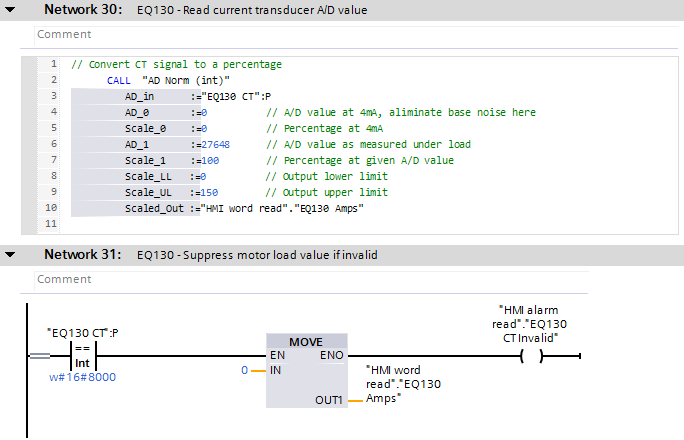
Visual programming is also used a lot in plc programming (Siemens S7/TIA, Mitsubishi MELSEC, etc..).
Programming visually is usually called FBD or LAD. We use often FBD for simple logic. It's easy to read, even for inexperienced maintenance guys. LAD is a no go for me, but it seems a lot of guys still like it.
http://szirty.uw.hu/lang/Siemens_TIA_FBD.png
As long there is a simple and clear code structure, it is a good thing.
Today, special since Siemens made SCL (kind/like of Pascal for PLCs) usable and in there new IDE (old was Step7, new is TIA), we use it also a lot.
Today it's even possible to mix FBD/LAD and SCL. So you can make al simple logic in FBD or LAD, and then calculate things in between in a SCL network.
As user of both worlds in my job, I can say both worlds have a right to exist. It's just like is C better than C++ or is Python even the most best ... is a car better than a bike .. is a house better than a tent ..
>As long there is a simple and clear code structure, it is a good thing
I've seen sprawling, massive ladder logic jumbles that made no sense and were completely undocumented before. Once visual-style plc things reach beyond a certain level of complexity, if they are undocumented they can be a nightmare to use.
I don't know if this says more about the medium itself or that a lot of PLC guys just don't know or were never taught proper standards to follow in writing their code. Either way I've seen a lot of really bad PLC code.
Sure, I should have maybe made my point clearer and say PLC programmers in my experience are often guys with no programming background who have an Associates in automation technology or something similar from a local community college.
They have often not been taught basic things like don't name a variables or identifiers that have no significance like 'b123' and are in a workplace where as long as the lines are running properly nobody cares. There are leagues of difference between what I would consider a pretty messy codebase at say, some B2B enterprise software company, and a large codebase maintained by people who actively don't know how to program for lack of a better description.
As you can imagine, I've seen also a lot more or less funny ladder logic.
And yes is true, most plc programmer don't have a "just software" background and yes a lot of plc software is not super pretty but with the old IDEs it was also not so easy.
there is some pretty solid theory on how to translate between the kind of diagrams statebox uses and digital circuits. In fact we are doing some experiments with direct diagram to wafer (chip) translation using LibreSilicon http://libresilicon.com/
this is certainly not a done thing, but something we'd love to work more on in the future
It was possible since Simens Step 5 (since late 70s) to change your view between FBD/LAD and AWL. But AWL is just like Assembler, so .. yes. In old machines (we still have about 20 machines with Siemens S5) sometimes it's a must to use AWL.
Translate an IF statement you need to add jumps, so it's not really the same code.
Also for ex. the very simple Siemens LOGO controller has a simple software to program it. But if you use FBD, it's just possible to use a tag once. So if you need a tag multiple times, so you have to draw lines from the single tag. Even for super simple stuff it get's messy super quick.
Many programming languages today have a format that is like <tree of files, each containing> <set of items, each containing> <list of expressions>. It would be nice if that <set of items> step was treated as an unordered set instead of an ordered one, with editors having a better understanding of how to bring up relevant elements of the set onto your screen at the same time. Split pane editors, "peeking" in editors at code definitions, etc. hint at how this should work, but I don't feel like they do it as well as possible.
Back in the day, in VisualWorks, with the RefactoringBrowser, you could bring up a browser for a search, say, everyone who implemented
methodNamedFoo:
Then you could rapidly narrow that down (effectively and-ing it) to those methods which also sent
thisOtherMethod:
These were lightning quick operations, just right-click and done! But what's more, you could even compose little queries (think like you would in a SQL query client, but using snippets of Smalltalk code) that would be applied to/and-ed with the contents of each browser window. Done right, this resulted in a few accurate, complete, and highly focused sets of code applied to the exact problem you were working on.
What's more, you could write scripts to pop up such query browsers automatically. They would also be saved in the "image" and just pop up to the same state when you restarted the environment. On top of that, you could write syntactically accurate code transformations against all of the above, even writing ad-hoc code against the meta level or even runtime state from the middle of a runtime debug session.
A small amount of "visual augmentation" might benefit most programming languages
Agreed. Where various visual programming have fallen down over the past 3 decades:
1) Scaling complexity -- If diagrams get too busy, and there's no good way of managing complexity. This especially applies to multiple programmers changing the same diagram.
2) Scaling size/optimization -- Many visual programming systems in past decades could bog down and become marginally responsive or unusual when managing large systems.
If you can handle those two, you will have a huge leg up towards a viable visual programming augmentation.
I think the take away from existing visual languages is that they can be quite nice but the less they mimic imperative blocks with drag and drop the better. Functional programming is a better fit.
They work well for stream processing.
They can often be more elegant in how they define and consume inputs. Many more parameters can be supported in a visually pleasing way, which cleans up parameter over loading and makes it easier to compose function block together without making Tuple types.
This could very well exist but I think a visual Lisp would be interesting.
yep, the diagrams are like typed purely functional programs
also stream processing is possible, we can (at least in theory) use the same diagram to compose state machines or stream processing functions or DB queries or ...
Ordered <set of items> have the advantage of working well with the brain's ability to map its surroundings. "function foo is defined 5 arrow downs above function bar". When the <set of items> jump around our eyes in arbitrary order, we tend to experience disorientation.
OTOH I always wonder if it would not be beneficial if our brain and the code would not rely on spacial distances in code files, but on _call_ distances.
Should our spacial map of the code not be the call graph instead of the structure in files and disk?
I recently learned Smalltalk (Pharo), and since it's image based it treats classes/functions as more of a collection than trees of files. Of course, there's still structure, but the way you can navigate from function to function is great.
Smalltalk of course has its own problems. It suffers from one of the major problems of many less popular languages, namely the lack of libraries. But I agree that I wish more (or all) languages were as good at debugging, peeking at definitions, jumping to different things, searching code, etc. Of course editors can make up some of the problems, but it's not quite the same.
Depending on the use, I think it can be fantastic.
Jetbrains makes an editor called MPS that is used to make DSLs and you can include things like tables and diagrams into the code. In places where you have very specific requirements and structure, it can help experts in the domain produce the logic for it. That's the same with level editing, level editors need good creativity and views of spaces not experts in C++, so a DSL and graphical editing is great, because it lets them focus on something else.
That said, when it comes to the code behind things, text gives you an immense amount of expressibility that can't be replicated very well with graphical things. It's the same reason why a lot of developers prefer the command line to graphical configuration; you get far more expression for your expertise in a text environment. You get every combination of letters/symbols on the keyboard entered through a large physical interface; using the mouse to click on things feels slow by comparison.
What you say is true. Text is way more expressive, but sometimes it is difficult to spot the overall code structure just by using text. What Statebox does is this: It implements Petri nets as categories and maps them functorially to a "normal" functional programming semantics. What this means is that:
- You draw the structure of your code in a behavior-oriented way using petri nets. This step is completely visual.
- You use a ton of formal tools to verify that this net has nice properties.
- You map places and transitions of the net to datatypes and functions, respectively.
You see that in this approach nets serve the purpose of giving an high-level understanding of how the code behaves. You still have the freedom that you get by using text in filling the net with meaning, but you gain also this high-level overview that saves a ton of work!
It is certainly true that keyboard input can be much quicker when what you're trying to convey to the machine is logical rather than spatial/kinetic information. But it is entirely possible to use keyboard input to manipulate a graph instead of an array of characters.
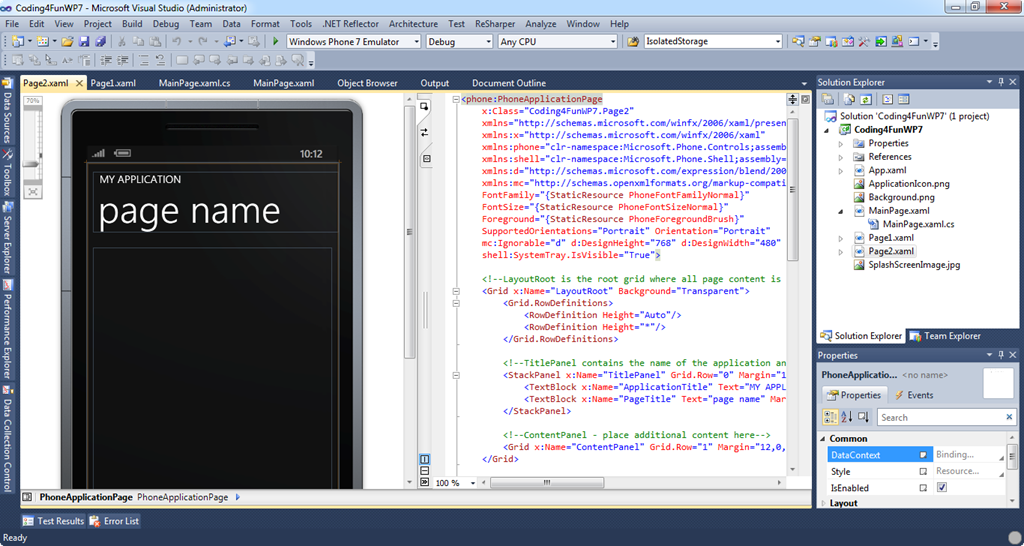
Regarding visual augmentation, the Visual Studio XAML designer is another good example. You can edit the XAML markup and see the generated UI in another pane.
> It would be nice if that <set of items> step was treated as an unordered set instead of an ordered one, with editors having a better understanding of how to bring up relevant elements of the set onto your screen at the same time.
IDEs sorta move in that direction, though not too fast. You can list methods in a class, jump to the definition of a method, etc.
Not many seem to realize that Java's strict OOP structure is (or was) a mover of IDE functionality: you can statically describe the structure of the entire program at a high level, and code is only contained in methods, so you have methods as organizational units, to which you navigate and otherwise reason. So now we have IDE functionality that can move methods and variables around like they're toy blocks.
I do a bit of Clojure and it feels like manipulating an AST rather than text, especially with structural editing (because code is data). It applies to any Lisp I suppose
Visual programming of data-flow does not add much to programming, I think that's the lesson of history.
That said, I think that visual programming which is not aimed to data-flow can be very interesting. For example Lisp is pretty visual (or topological) in a sense.
I think saying that most programmers don't like FP is a bit more extreme than the actual case here, which is that I think most programmers aren't familiar with FP (although this seems to be growing rapidly due to introduction in Java and other places).
That said, I think many of them seem to find it harder, especially in the beginning. But I think we have to conquer familiarity first.


- Visual computing is pretty heavily used, unreal engine, blender, houdini, etc. All have a very similar node based visual programming system. It seems to work pretty well (better than text) for most of what they use it for. I think because of the ease of jumping in the middle and making small understandable changes.
- Many programming languages today have a format that is like <tree of files, each containing> <set of items, each containing> <list of expressions>. It would be nice if that <set of items> step was treated as an unordered set instead of an ordered one, with editors having a better understanding of how to bring up relevant elements of the set onto your screen at the same time. Split pane editors, "peeking" in editors at code definitions, etc. hint at how this should work, but I don't feel like they do it as well as possible.
- A small amount of "visual augmentation" might benefit most programming languages, I'm not sure I can explain this better than linking to a few images of what emacs auctex package does to latex http://lh6.ggpht.com/_egN-3IJO0Xg/SpIj6AtHOTI/AAAAAAAABj8/O1... https://upload.wikimedia.org/wikipedia/commons/4/42/Emacs%2B...