Boutique guitar stompboxes are an interesting market: there's a lot of cork sniffing sane nose thumbing generally, even though two designs may be electrically exact.
That being said I really do like their design. The spring reverb in my guitar amp sounds great but does not have tone control and get overly bright with a single coil guitar.
> there's a lot of cork sniffing sane nose thumbing generally, even though two designs may be electrically exact.
You nailed it. An old friend of mine wanted to get me to start a boutique stompbox business with him since I was a bit more technically inclined (ie, I could read a schematic and solder).
I just couldn't do it. It's too much. I love messing around with that stuff, but I could not be bothered to wade through all the cruft and politics of that. I just like music.
BTW, you should be able to cut the highs well enough with your guitar tone knob or EQ on the amp. You can get something like: https://www.youtube.com/watch?v=ZIU0RMV_II8 (Fender Stratocaster -> Fender Showman w/ spring reverb. I was saddened to find out just now that he passed away this spring)
Check out the build quality of Bartel Amps. Mark Bartel has been hand making every part of the amps he designed for over 20 years. He is an EE who makes product decisions based on science - not marketing
Oh that's just great. So an MSRP of ~ $6375 CAD. They're beautifully done—guess it goes on the bucket list. Here I thought the wiring job on my AC30 was the nicest I'd seen in a long time (http://www.voxshowroom.com/uk/amp/ac30hw2_2010.html - also w/ tremolo and spring reverb tank)
I am friend of Mark Bartel and helped him a little with the "wire trees" that he custom molds. I made many suggestions along the lines: "Why don't you just..."
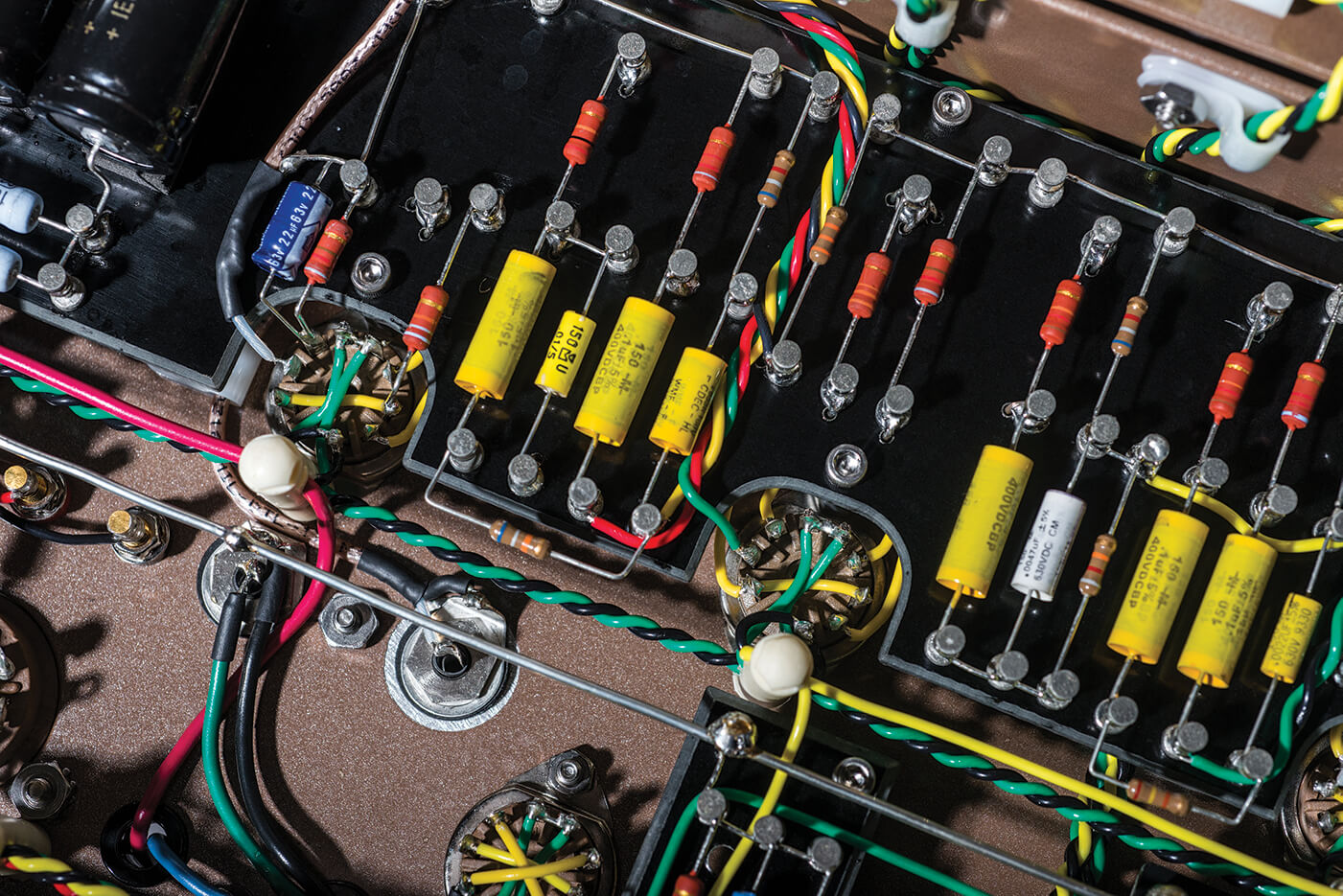
He constitutionally can't - he is the definition of uncompromising. I don't play guitar, but I want to buy one of his amps because of how it is made. Take a look at this:
That is a work of art. The cable post and how everything is layed out and tightened down looks fantastic.
I haven't opened my Orange Tremlord. I expect it to look nice, but not nice like this. The Orange Tremlord has a very nice reverb with a real reverb tank. And is imho a very nice amp:
Really depends which little corner of the pedal market you’re talking about. In the digital realm I would disagree, there are a lot of really interesting designs from the past 5 years or so. Some of them hide complex dsp algos behind a couple of simple knobs, and some of them have full menus or fit an entire modular synth crammed into a pedal format. There’s also some really cool stuff happening with open source algorithms, for instance the popular clouds modular synth module is fully open source to tweak and port to new formats. There are other pedals that can run different formats of open source dsp algorithms.
Even in the crossover analog/digital world (chase bliss being one of the biggest examples) there’s some cool and fairly new stuff happening, like fully analog circuits that are completely controllable over midi or other lfo type control signals.
In the fully analog realm, yeah, there is a bit of what you could call cork sniffing, dressing up the same circuits that have been used for the past 30 years in a boutique package and selling it for twice as much.
The challenge behind some of that cork sniffing is the differing behavior of "identical" circuits is often trivially measurable and audible.
Many of the "revered" circuits perform very differently due to component variations (e.g hFE or Vgs), and also have substantial drift in performance with temperature. So even different units from same manufacturer will sound different.
It's interesting because on one hand, the corksniffing can be really silly, but on the other hand, differences in "identical circuits" are often plainly audible.
Senses are a funny thing, including hearing. When playing, I can easily hear subtleties like whether the Jazz III pick I'm using is made of Ultex or nylon. But I can listen to recordings I made, and not even be sure which guitar I played. (I've been playing for 35 years and recorded many albums.)
So these subtleties and details are real, they're audible (in certain circumstances), and the mockers generally don't know what they're talking about. But they're also easy to overfocus on.
> but on the other hand, differences in "identical circuits" are often plainly audible.
I wonder how much of that is component tolerances. If you have two identical circuits with +-1% in resistors and +-5% in caps, how different would these sound with the components in each circuit at opposite ends of the tolerance range?
Plenty of non-rookies are using Behringer gear these days, and plenty of Behringer gear has been built just fine; I have a Behringer mixer from the late 90s that is still in use and 100% functional, and I've got a new XR18 digital mixer that can't be beat for bang-for-buck.
Want to help rookies? Steer them away from the $500 tube-screamer or dual-blues-breaker clones that you need to be on a waiting list for 2 years before you can even buy one! :)


That being said I really do like their design. The spring reverb in my guitar amp sounds great but does not have tone control and get overly bright with a single coil guitar.