- The Great Pyramid is a scale model of Earth, at a ratio of 1:43,200 (a significant number)
- It also encodes its own latitude and longitude
- Its base perimeter is equal to 1/2 a minute of latitude (1/43,200th of 360 degrees)
- It's aligned to true north within 3/60 of one degree (making it, I believe, the most accurately aligned structure on the planet)
These are not undisputed claims, but there is absolutely something different about 4th dynasty pyramids that is worth exploring. There are many, many anomalies about Giza that defy explanation. Another example is precision stone cutting and drilling from thousands of years ago.
For detailed explanations of the above, check out the video here:
> It's aligned to true north within 3/60 of one degree (making it, I believe, the most accurately aligned structure on the planet)
3/60 of a degree is mildly impressive (Wikipedia says 4 minutes of arc rather than 3), but I seriously doubt that it's the most accurately aligned structure on the planet. With modern technology, surely we could align something much more closely than that given a good reason to do so.
I definitely agree that we could, given a good reason to. I took a cursory look and couldn't find anything to dispute its precision relative to other structures on Earth.
So, what are the odds that this is or isn't a coincidence? Could the ancient Egyptians have measured the two circumferences of the Earth that accurately at that point in history?
> So, what are the odds that this is or isn't a coincidence?
The odds of the sides of the pyramids being reasonably close to some convenient multiple or fraction of some other pair of measures that are related to each other, and that that would happen by coincidence alone, is about 100%.
It's much lower for any particular pair of measures, or any particular fraction or multiple, but given all the possibilities for both base measurement pairs and fractions/multiples, it's near certain that any pair of measurements would fit that with some other pair of measurements.
For what it's worth, base-60 were used by Babylonians, which were somewhat contemporary with Egyptians; it's not unreasonable for them to use the same 360-degrees-in-a-circle scheme.
But quick glances at Wikipedia don't suggest anything concrete, and in fact it seems like Egyptians used base-10 numbers. So yeah - it does seem to be a stretch that they'd set the bases of their pyramids to be exactly 1/1440th of the Earth's circumference along two different great circles.
The great pyramid used to have a limestone casing. The measurements of the pyramid without the casing are meaningless, since the intended dimensions included the casing. And while we may have a sense of how large the pyramid was with the casing, I wouldn’t trust any estimated measurement with that many sig figs.
Given the other "anomalies" about the pyramids, along with their relationship to sacred geometry, my opinion is it's impossible these are coincidences.
https://www.nature.com/articles/35042510 argues they were aligned to the stars, using a method which co-incidentally aligned it best to the Earth's spin at the time the Great Pyramid was built:
> Here I use trends in the orientation of Old Kingdom pyramids to demonstrate that the Egyptians aligned them to north by using the simultaneous transit of two circumpolar stars. Modelling the precession of these stars yields a date for the start of construction of the Great Pyramid that is accurate to ±5 yr, thereby providing an anchor for the Old Kingdom chronologies.
> Instead, the alignment of successive pyramids first steadily improved up to the building of the Great Pyramid, then later deteriorated. This makes perfect sense, she says, if the architects were measuring the alignment using not one star, but two: Mizar in Ursa Major (the Big Dipper) and Kochab in Ursa Minor (the Little Dipper).
The alignment of a structure fixed to the ground, relative to true north, will change over time, because the while the axis of the earth can be viewed as fixed, the land on the Earth is not fixed with respect to that axis, but moves.
Not really. The time scale for large movement is much larger than thousands of years.
Since the great pyramid was build 4500 years ago the mid atlantic ridge has only moved about 100m. That's just lateral translation, most of which probably did not end up moving egypt much anyway and definitely not enough to throw off the direction a pyramid is pointing by more than a second or two.
Although I’m still confused on this: how would the Egyptians know to align a building with this specific point on a sphere before the geographic convention existed, and both magnetic North and astronomic markers were in different positions?
True North is the point the axis of rotation passes through. So, assuming you're aware that you're stood on a sphere (which basically anybody who'd thought about it hard enough or had conquered enough of the planet to do experiments knew since antiquity) and that the sphere is spinning then you know in some sense which way North is by watching the stars apparently gracefully moving in the night sky.
If you're lucky, as the stars move one of them stays still or almost still, it points North (or, in the other hemisphere you've got one pointing South). Today Polaris fills that role and we call it the "North Star".
> The Great Pyramid is a scale model of Earth, at a ratio of 1:43,200 (a significant number)
No, it's not.
It's a rectangular pyramid, and the Earth is a slightly oblate spheroid. If you were given a task to make a scale model of the latter and produced the former, regardless of measurement, you'd be laughed out of the room.
Having a couple measurements that are the same multiple of a couple measurements of another object, but a radically different shape, doesn't make a thing a scale model.
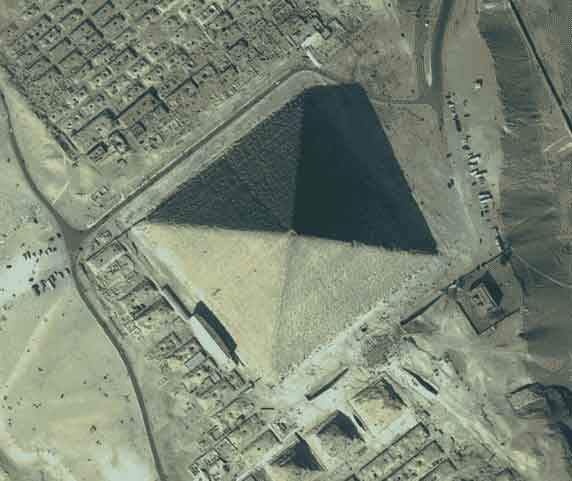
A search for "great pyramid from above" will return a ton of images where you can see this for yourself. It's definitely true, just not very well known.
It's a four sided pyramid, where each side has a concave bend in the middle, only really visible from a top down perspective. The article contains enhanced, but completely valid photos of it.
It is unknown if this was an intentional design aspect. It does not seem to be a feature of any occult purpose. Sneferu's Bent Pyramid does "not" have 8 sides, but was incorrectly completed at a later date at the wrong angle, thus often used as a (useless) comparison.
All other pyramids in Egypt seem to just be normally 4 sides with no concave outer walls.
tl;dr The Pyramid of Giza is only 8 sides on a technicality. It approximates the usual, and expected, tetrahedral shape.
I'm still not convinced. Are you sure the photos are valid?
Is curiosmos a trustworthy site?
William Matthews Flinders Petrie is mentioned as having written La Description de l’Egypte in the 1700's - this is inaccurate, the man was born in 1853: https://en.wikipedia.org/wiki/Flinders_Petrie. On a quick search I can't find mention of La Description de l’Egypte, either in French or English.
Don't know if the site is legit, however you can literally go to Egypt and see the Giza Pyramid in person. If you know what to look for, it can be seen from ground level.
It's extremely slight. And, again, not an occult or religious feature, just a quirk of its design.
Hey, if being convex with a crease on the middle makes an otherwise tetrahedral pyramid “8 sided”, does convexity plus a protrusion in the middle of each of the four faces also count as 8-sided? Because, of so, there are lots of 8-sided mesoamerican pyramids.
The link is unreadable for me on mobile (Safari on ios 13). The usual cookies popup appears hiding the view and no action can remove it (neither accepting not rejecting it).


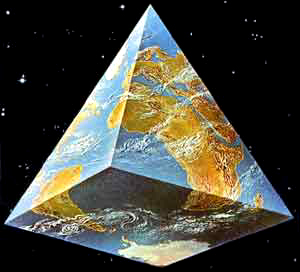


- The Great Pyramid is a scale model of Earth, at a ratio of 1:43,200 (a significant number)
- It also encodes its own latitude and longitude
- Its base perimeter is equal to 1/2 a minute of latitude (1/43,200th of 360 degrees)
- It's aligned to true north within 3/60 of one degree (making it, I believe, the most accurately aligned structure on the planet)
These are not undisputed claims, but there is absolutely something different about 4th dynasty pyramids that is worth exploring. There are many, many anomalies about Giza that defy explanation. Another example is precision stone cutting and drilling from thousands of years ago.
For detailed explanations of the above, check out the video here:
https://www.youtube.com/watch?v=rhGQU3m9E34&t=795 (timelinked, but the entire video is excellent)
https://youtu.be/H43z2xAis4c?list=PLvuraN2vNappZ6m4jNiK5rDDm...
and this blog: http://garyosborn.moonfruit.com/1-43200/4594099844
This is one of my favorite topics to discuss.