A: Two thoughts. First, you can leave a foreign country behind in an orderly way. Ask the British Empire, which mostly ended its colonial occupations in an orderly way.
The interviewee says this as though it's common sense, but is it true? The examples that stick out to me are India, Israel/Palestine, and the South African colonies. Can these really be described as safe and orderly withdrawals? What are the examples of successful withdrawals? Are they really that much better than US withdrawal from Vietnam or Afghanistan?
> What are the examples of successful withdrawals?
Canada, Australia, New Zealand, and the Caribbean territories. Arguably Hong Kong.
You could also make a reasonable case for Egypt, Ghana, India/Pakistan... The withdrawal itself was peaceful and didn't leave the state in immediate civil war, even if it wasn't stable in the medium term.
I’d say the difference is that those territories were more or less “at peace”. The colonists had “won” the war, at least per some definition of winning.
Afghanistan was a barely held together mess even before we withdrew.
I’m not arguing one way or the other for Taiwan—I don’t want to go to war with China for all sorts of obvious reasons—but we would have the backing of the Taiwanese people, and that’s a major difference versus Afghanistan.
You don't leave the country when you have tens of thousands of military troops still on land with major military equipment stationed there. The US never left Japan and certainly never left Germany.
Given what it costs to station troops outside the country (including an aircraft carrier with its air wing), there has to be a strong reason to keep them there for 70+ years. And it's not because we needed to maintain an occupying force [0] - it was to have bases with pre-positioned equipment near likely foes where troops could be quickly sent and move-out.
The REFORGER exercises [1] went on for nearly 30 years, testing the ability to rapidly move troops to Germany in the event of a Soviet attack. Not only was this expensive in monetary terms, it was expensive in human lives - each year people died from various causes associated with being around heavy equipment. Such as sleeping under vehicles that would roll over them in the night. Or crossing rail lines with their antenna still up and getting electrocuted.
The US didn't do this for any imperial reasons. It was to keep commitments made to those governments in the post-war years.
[0] Disclaimers: Dad crossed into Germany at the Remagen bridge before it fell, and I was stationed in Germany during the Cold War.
I'm not even claiming that. The US has clear strategic reasons to be positioned in many places around the world (like at Okinawa, for example). And Japanese people, despite wanting these troops out, are not going to see them leave anytime soon. So Japan has about no say in it.
> The US never left Japan and certainly never left Germany.
It left the the running of their governments. The US military is/was not needed to keep order and prevent a collapse of civil society in either of those two countries. Contra Afghanistan.
>>India/Pakistan... The withdrawal itself was peaceful and didn't leave the state in immediate civil war, even if it wasn't stable in the medium term.
The partition of India was a very bloody event in History. The mess left behind by British, doesn't just include partition, it also includes the Kashmir problem over which wars have happened till date.
Not to mention the horrible economic and social conditions that British left behind in the then Indian subcontinent.
Egypt? The British left in June 1956 and immediately tried to invade their way back in, October 1956. There is a reason that for a generation, "Suez" was a trigger for humiliation.
India/Pakistan? Do you mean the event that caused the death of somewhere between 200,000 and 2 million people? And the displacement of another 10-20 million people? That was much, much more catastrophic than what just happened in Afghanistan.
Ghana did have a somewhat smoother path to independence than either of those.
Canada, Australia and New Zealand were always a separate category: settler colonies where the new arrivals almost completely displaced the natives. Ireland shows the difficulty when you try and send settlers but don't genocide the natives first.
The dissolution of the Soviet Union and Russia leaving the former soviet constituent countries in Europe (e.g. Ukraine) and Central Asia (e.g. Kazakistan) turned out OK in the end, tension didn't flare up until this decade.
That's a non-sequitur. Did the British leave Canada & Australia in a peaceful state? As far as I know, there were no civil wars or disarray in those countries, whether ex British subjects or original stock of native populations.
That may be so. But was it governable when they left?
Whether or not we wiped out the masterminds of 9/11 or not, when we left Afghanistan, despite all the military activity up and till August 31, we left them in disarray. Most of the blame goes to the utterly corrupt and despised Ghani government but it’s quite clear we left it ungovernable.
I think that's an altogether different question. The original question was if left governable? I think the answer is yes.
Did The Romans leave England governable when they pulled out? I think yes. Did the Romans do shit, sure, but that's not the question.
Pullout from Afghanistan regardless of military actions and who was killed was left Ungovernable. Australia it appears to me was left governable when they left.
The British left Jamaica probably with few Tainos, but the question isn't were Tainos treated fairly, was Jamaica governable by the new government when they left?
> Did The Romans leave England governable when they pulled out? I think yes.
Would knowing that pretty much all trace of Roman rule, down to the material cultures and currency, completely vanished within a generation change your mind? Of all of the the Roman Empire, England saw the most severe, and most abrupt, fall in living conditions. And this is centuries before the Vikings wreaked yet more havoc on the region.
And, for what it's worth, while we don't know that much about what the remnant Breton polities looked like, the Anglo-Saxon petty kingdoms that replaced them were a variety of small kingdoms that constantly jostled each other for power, until the Vikings destroyed several of them outright and the Wessex King Albert conquered the rest. That's pretty damn close to the notion of an array of warlords jostling for power that you seem to be categorizing as ungovernable.
I agree with you that this looks like it has diverged into two separate questions.
But I think it is the view from the majority compared to the minority.
The majority see things as peaceful, quiet, fine. After the original slaughter, it was a peaceful federation of states (at a time where killing a native was 50/50 to come with any consequences) and no large scale civil wars.
The minority - the original inhabitants of this land - the war never stopped. Just changed in nature. Instead of outright killing, it was disenfranchisement/segregation, then blatant racism, now subtle/systemic racism. There is no peace.
And that can carry through generations. As the recent riots in the US show - which had similar sentiment here in Australia - even the killing on basis of race hasn't really stopped 100%.
Ask the minority, if the withdrawal was peaceful? YeahNah...
Where are you picking that up? That's your own making. nowhere were such things being thrown. The original question was was the place left governable, nothing more. You are giving the question with your own meaning.
Did the Soviet Union leave Cuba governable when they pulled out? Yes. The question isn't did the Soviets allow the Cubans to jail and kill dissenters. That would be a totally different question.
* India: the Partition led to massive loss of life, displacement in the tens of millions, traumatized communities, and deadly polarization between peoples to this day.
* Palestine: the end of the Mandate and the 1947-1949 Palestine war saw largescale displacement, loss of life, and (as is obvious to everyone) once again a deadly and unshakeable polarization between peoples that persists to this day.
On the one hand, it is certainly true that the British did not intend for these consequences, but on the other, the British were fully in charge as the sovereign government of India and Mandatory Palestine (unlike the US in Vietnam or even Afghanistan) - in particular having ruled India for over three centuries by the time they left - and so more deserving of blame.
The intention was there - according to Pakenham's "The Scramble for Africa" the idea was that prior to independence you educate a generation of civil servants who will then run the country along essentially British lines. I'd argue this worked well in India, largely though because Indians were already running the country in most important particulars. In Africa less so because independence movements gained unstoppable momentum which preempted such planning, plus many of those countries had been colonies for decades rather than centuries.
> civil servants who will then run the country along essentially British lines
While this may mean structural continuity, I can’t help but feel this is also a bad outcome - it’s just a continuation of imperialist force/cultural projection.
I won't say that a working electoral / parliamentary / judicial system, civil engineering, medicine, etc left intact is a bad outcome. It's a much better outcome than a civil war.
With some exceptions, there were no comparable systems in native cultures; those that existed (some definitely did) often were not capable to keep together a country, even if they worked well on tribal level, or were scalable but belligerent by design.
I also don't think that cultural projection, to a degree, is not a bad thing. It happens constantly, and allows for cultural cross-pollination. It is, of course, best done in peaceful ways.
> the idea was that prior to independence you educate a generation of civil servants who will then run the country along essentially British lines. I'd argue this worked well in India…
I certainly wouldn’t draw that conclusion. Immediately after the British left Nehru adopted 5 year plans based on the soviet model. Nehru and Stalin didn’t get along because he was still too Britain-friendly for Stalin, but India and The USSR developed very close relations within a very short period of time.
Some elements of India’s governance structure were distinctively non-Soviet, like having a multiparty democracy. But if you look at the way the country was run, it was done in the style of soviet central planning, most certainly not along British lines.
I don't want to speak well of the USSR/Russia but it's not hard to make an argument that they left Eastern Europe in an orderly way... well at the end. Honestly between Hungary, Czechoslovakia, Poland, and others there were some bad times in the there.
Worth noting that there was no Russian presence in Romania at the fall of communism back in '89. Russian military withdrew peacefully starting in '58 through early 60s.
Would you add a similar disclaimer before pointing something positive about the U.S. because they’ve done some bad shit too, like, I dunno, being the only nation to actually nuke another?
Pedantically, I don't think the US was ever part of the UK. The UK ultimately had sovereignty, but that's not the same thing. Even now the United Kingdom's former colonies are not part of the UK: it "has sovereignty over 17 territories which do not form part of the United Kingdom itself: 14 British Overseas Territories and three Crown dependencies.¹
But that's kind of the same point that I didn't articulate. A colony is not part of the country that is ruling it. The Baltic states were part of the Russian Empire, independent between the wars, and then reincorporated into the USSR. They weren't "militarily occupied", they were part fully incorporated. When someone says "militarily occupied Eastern Europe", I'd only assume they meant the countries that were "behind the iron curtain" but de jure independent, like Poland or Romania.
In that case, a better example would be Ireland, which was incorporated fully into the UK with the Act of Union, and was colonised. Another example would be Algeria, which was a French department.
Technically the UK (and Spain and France) conquered and colonized several native American nations, almost wiping them out. The US didn't even exist as a separate nation state until 1776.
The Soviet withdrawal was a bit different since the Union was actively falling apart and the occupied territories were pushing for independence. It wasn't all that smooth either - Georgian civil war and the first Nagorno-Karabakh War directly resulted from USSR's dissolution.
Those are settler colonies, a completely different kettle of fish. From the point of view of the (majority) settler population, they gradually ceased to consider themselves as British and underwent a multi-step disentanglement of legal and constitutional connections to the UK beginning almost a century ago but still ongoing. From the point of the (minority) indigenous populations, well I'm sure it varies but they may not agree that a withdrawal has occurred...
It still strikes me as a bit weird that Canada did not have its own constitution, as in technically completely independent of the British Parliament, until 1982.
And technically the head of state is…well it’s complicated.
Yeah, similar stories and timeline in other former dominions. I find https://en.wikipedia.org/wiki/Sue_v_Hill fascinating, when a court in Australia was forced to consider whether the UK was a foreign power.
Yeah this statement kinda discredits everything he says. The world is littered with countries that exist only because some existing adjacent kingdoms happened to both be colonized by the British, and they merged them into one colony. Countries fell apart after they left because there was no shared national identity to begin with.
The withdrawl from India was safe (for the British, let's ignore the partition bloodshed) and didn't lead to immediate regime collapse... so I certainly don't think it went as badly as Afghanistan or Vietnam.
No let’s not ignore the loss of over 1 million lives. Borders are still contested, with several wars having been fought, the scale of the disaster dwarfs Vietnam.
I personally don't think those withdrawals are truly orderly. Let's take India - leaving aside the partition of India (which is a huge matter in itself), a big crime is that the country that was left behind by the British did not resemble its historical culture or way of governance. It was instead turned into a secular nation, which just means defaulting to a status quo of colonial Western values. Ironically the partitioned areas (like the Islamic Republic of Pakistan) were not secular, but Hindus no longer had a land to practice a life that was fully dictated by their principles and their principles alone - instead they would live by rules and structures the British left behind. India also retained a lot of colonial structures outside of its government. For example the British education system continued, meaning that Indian children were taught out of Western-controlled/sourced materials that glossed over the horrors of British rule. Those children were also not taught the cultural things they would have learned in a pre-colonial era. This pattern isn't unique to India, but I wanted to call it out as an example of how seemingly peaceful withdrawals still result in long-lasting damage to a people and their culture. Is that peace? Maybe in the most literal sense. But it's not the same as making that place whole.
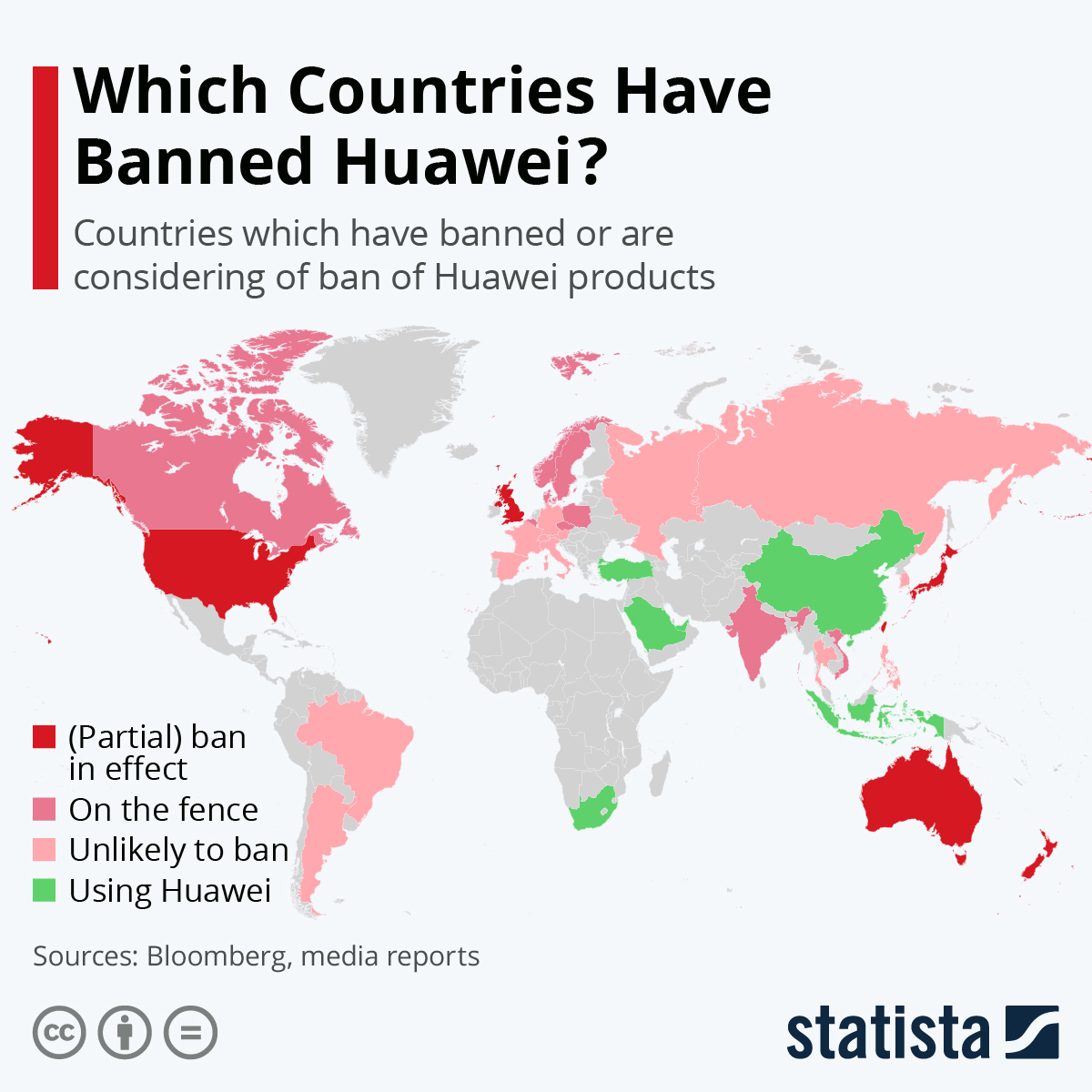
> "When the battle over Huawei began, over 5G, I saw a map of the world, and it was a map of the world according to whether countries were allowing Huawei in or not, and I said to one of my young colleagues, "Oh, that's the Cold War.""
So we have 3 categories that mean "has not banned", and 1 category that actually means "banned". What on earth does "on the fence" mean? How is "unlikely to ban" any different from "using Huawei"? This chart is one of the worst I've ever seen, regardless of the color coding - seems the objective was to make China look alone or something? Who knows.
I've heard that China is currently at it's demographic peak. From here on out people are aging with less replacing them, and more and more youth have to support multiple grandparents (effect of one-child policy, which while no longer in effect still has lasting impact).
As such I suppose if they were going to make a move now would be the time.
This is one of the more idiotic extrapolations of demographic bomb. Even the one-child policy annual birth rate in China is ~9-10M per year. That's an incredible amount of bodies to recruit from for the needs of modern air / naval warfare with limited casualty potential. Around half of births will be from underclass, where becoming a military martyr for the cause of reunification would be the surest guarantee their family has a meal ticket for the rest of their lives. Throw in upward mobility incentives like preferential queuing for universities, real estate etc - there won’t be a manpower problem.
Those military-age only children are expected to take care of their elderly parents and grandparents.
In a world war over Taiwan, it's likely millions of them would die. Leaving each family as "bare branches" since they have no siblings. And eldest male children are especially important in Chinese culture.
Given it would be a mass casualty conflict, the upward mobility "support the troops" impact (and guaranteed "meal tickets") would seem to be have a pretty limited.
Bare branches are already a reality due to one-child. See meme of military wives getting knocked up and married and leeching off military housing when troops deploy in the US. That's what will happen in PRC as well, deployed soldiers with increasing perks due to military modernization / restructuring will be some of the most competitive suitors.
>likely millions of them would die
It would not be a mass casualty conflict. People who don't follow the subject matter still assume PRC has antiquated military capabilities and relies on dangerous Normandy style amphib invasion. Reality is PRC will steamroll TW like US did Iraq, except force balance is even more lopsided towards PRC in quantity and quality. Logistics of taking TW in PRC backyard is multitudes easier than US occupying Iraq or Afghanistan across the globe. Taking TW without substantial losses is more or less foregone in most strategic thinking. The only concern is the risk of fighting the US on the sea, and that still caps casualties to sub 100,000s even if every PLA ship and plane was destroyed. Which bluntly, relative to other social programs at PRC scale, is a completely tolerable amount. Short of going nuclear, the limits of personnel loss in modern combat is not going to impact CCP political thinking.
> Taking TW without substantial losses is more or less foregone in most strategic thinking.
Do you have a source for this? Everything I've read says that the PLA Navy would struggle to take Taiwan even without US involvement.
Amphibious landings are the hardest thing in all of warfare, especially since landings can only occur along a Taiwan's well-fortified beaches, and not along its rocky cliff coastline and given the Taiwanese are dug-in and well-armed.
Nothing consolidated. It's _recent_ read between the line consensus from US/PRC strategic thinkers if you follow the space closely. See most recent US war gaming scenarios and current indo-pac PRC proposals. War games mostly conclude PRC accomplishes air superiority and control over TW within days and the US can't credibly operate near PRC shores to defend TW. Think tank blobs are all about blockades or IRBMs within 1st island chain to box PRC in, or making TW porcupine to create deterrence, or making US deployments in Japan more survivable. The TLDR is that defending TW directly isn’t even being contemplated anymore, it's assumed to be lost to PRC. The literature around “rescuing” TW if island can put up a fight is becoming just as sparse.
>Amphibious landings are the hardest thing in all of warfare, especially since landings can only occur along Taiwan's well-fortified beaches, and not along its rocky cliff coastline and given the Taiwanese are dug-in and well-armed.
TW is well defended the same way Iraq’s Republican guard was well dug in. All of it will be gone after PRC controls the battle space from air, TW won’t be in position to threaten the amphib fleet in the first place. Again think Iraq/Afghanistan not Normandy. PRC military modernization was modelled around these capabilities. PLANavy doesn't even have major amphib acquisitions, they're relying on civilian sealift capacity. PLAN too focused on challenging the USN, large scale landing on TW is a secondary consideration kicked down to the merchant fleet. That's how uncontested they expect the eventual landings will be.
Many folks are regurgitating very old talking points made popular by articles like “Taiwan can win a war with China'' by Tanner Greer in 2018, himself regurgitating conventional out of date tropes. He was one of the last holdouts and changed his position after seeing the woeful state of the TW military. I would read this follow up article: Why I Fear for Taiwan [0] from 2020 to get a better understanding of TW reality. And I argue he’s still underestimating because he’s not familiar with developments on the PRC side. Reason why I emphasize _recent_ and publication dates of articles is that PLA is modernizing so fast that assumptions from even a few years ago no longer holds true.
>The demographics are not a problem because of how they constrain the number of troops they can field - their population is still quadruple the US, so no problems there. The problem is the economic weakness that comes with a country where each working person supports two retired people (either directly as in family or indirectly as in taxes). That doesn't work as far as we know. So China is right near the peak of their power (maybe 15-30 years away.) I still think that means they'll be patient and wait for their moment. But they can't wait forever.
PRC military budget is ~2%, without global commitments that's enough to procure a military that can pace or eclipse the US in relevant domains. Demographic decline problems are mostly social, increase in per capita productivity projected to keep the economy growing. Money is not going to be an issue, and frankly inverted pyramid social problems, which will suck, isn't going to undermine military spending below what's necessary to maintain security interests. Countries much poorer than PRC spends more on military while mainstreet suffers simply due to security realities. And the security reality of PRC is it will always need to take over TW, or have sufficient military to challenge USN in its backyard.
Historically, it’s not unusual for large powers to spend 5-10% or more % of GDP on defense. 2% is indefinitely sustainable goal for PRC even with demographic decline. Also Chinese demographics peaking =/= Chinese military capability and appetite for reunification peaking. Realistically PRC could rationalize 2x/3x military spending, especially in time of need.
There is also a sex imbalance that could result in tens of millions of un-paired male adults because of the one child policy. These are men who will not be able to compete against more attractive men (money, power, influence rather than looks)
I don’t think their preferred tactic is a human wave attack anymore. They’re advanced now. Better to ensure the US stays out of open conflict, which probably still means playing the waiting game.
The demographics are not a problem because of how they constrain the number of troops they can field - their population is still quadruple the US, so no problems there. The problem is the economic weakness that comes with a country where each working person supports two retired people (either directly as in family or indirectly as in taxes). That doesn't work as far as we know. So China is right near the peak of their power (maybe 15-30 years away.) I still think that means they'll be patient and wait for their moment. But they can't wait forever.
What does it mean to be in a Cold War with China? On the US side, the Cold War with the USSR involved coups (many but not all successful) in the Middle East and Latin America, training death squads at the School of the Americas, installing nuclear ICBMs in Turkey and on submarines surrounding the USSR, propping up puppet/minority governments resisting “contagion” (and even going to war on behalf of some of them). This was all done to resist “contagion” (sometimes USSR imperialism, but mostly just people agreeing with ideas we didn’t like).
What does it mean this time? There doesn’t even seem to be any argument akin to “contagion”. I don’t see any Chinese imperialism or even a big ideological soft power push. Even China’s loans and purchases associated with the Belt and Road come with almost no ideological strings, especially compared with IMF loans and US’s push for the Washington Consensus. What material actions are being asked for here, in order to make up for the lost focus on this supposed “Cold War 2”?
This whole article is saber rattling nonsense to me.
Cold War I ended with the breakup of the USSR. Quite possible that Cold War II will have the same end, marked by economic crisis and ethnic strife, but most importantly by the complete dissolution of the average person's faith in their own country. The submarines are a side show, mostly a signal of economic health.
My questions were about the entire stretch before the end, where a lot of things took place (almost entirely openly reported contemporaneously in the press) and I don’t see analogous things taking place this time, on either side.
I mentioned submarines in the context of nuclear buildup during CW1, where they were not a distraction at all. Launch facilities in Turkey were closed as part of a deal to end the Cuban Missile Crisis/October Crisis, but the US only did so because they were to be retired anyway in favor of the submarine nuclear capability.
The '80 were a period of continuous economic decline and increase in nationalist sentiment all over USSR and satellites. Mostly an implosion. The US won by simply sustaining a level of prosperity that the Soviets could not match. Arguably pop music, blue jeans and Hollywood movies were the primary driver of the destruction of the morale of the average soviet citizen, especially the young generations for which the carnage of WW2 was a distant memory. Militarily speaking, the Afghanistan debacle was the largest contributor, though that was mostly the doing of the Afghanis.
Then that’s not a war. That’s economic competition and maybe starvation (i.e., embargos, sanctions). As a separate point, and I acknowledge it’s not at all apples-to-apples, but that tactic has been totally unsuccessful regarding Cuba.
But in an alternate reality with just economic competition and a few sanctions here and there (no coups, etc.), it’s not a war at all, even a cold one.
And if anyone, surely we’re in a cold war with Russia right now — we even have proxy military fronts in Ukraine and Syria! Nothing at all like this for China.
Edit: I don’t think it’s advisable to think of the US as being in a hot/cold war with Russia either.
Fair enough. Arguably Cold War I wasn't much of a war either. Other than perhaps a short window after WW2, there was never a risk of a Soviet invasion in Western Europe. The Soviets could barely move 10 tons of potatoes from Ukraine to Moscow, and not before losing half to frostbite.
I think I gave enough examples to show how it was far more of a war than whatever arrangement we currently have with China, but also that it involved a lot of violence and conventional hot wars by proxy — a lot of war stuff for a non-war.
Also, the Cuban Missile Crisis/October Crisis was as Hot as a Cold War can get, given Kennedy’s advisors thought the naval blockade was tantamount to a declaration of war, and we were 2/3 of the way to a nuclear tipped torpedo hitting San Francisco Bay. https://en.m.wikipedia.org/wiki/Vasily_Arkhipov_(vice_admira...
Fair enough. What changed is that since then a Cold War ended with a clear winner and a clear loser. Opposing blocks now know there are alternate ways of winning besides hot war. Think about that during the next systemic racism training at your workplace, or as your kids don't leave your house until they are 35 because they have no path to ever afford the mortgage on a house of their own.
> Think about that during the next systemic racism training at your workplace, or as your kids don't leave your house until they are 35 because they have no path to ever afford the mortgage on a house of their own.
I’m sure you think this was a very “based” sentence that attacked my insecurities and fears to which I say: lol. lmao
So, there was this enormous distraction that the Islamists created that absorbed our attention, our resources, and it turns out that it was really -- it was a detour. The big issue was the rise of China.
There were a few people who raised alarms --from IP theft, unfair trade (we can impose barriers for you, but you grant us free access), voluntary hollowing out our industry, theft of military secrets, etc.
But... most people were dollar eyed like a doe on a dark night with the blinding light from the semi coming at them freezes them in place. We could not extricate ourselves from the "promise billion-man market".
And, so here we are now, a great thanks to Nixon, Kissinger and the coup de grace from Clinton with the MFN to WTO.
Both North Korea and Iran deftly took advantage of the U.S. being preoccupied with Iraq and Afghanistan. Frankly, I'm surprised China didn't make more significant moves the past 20 years. Though, I suppose China's economy has changed significantly over the past 20 years, and the U.S. was less preoccupied the second decade than the first, which is when Iran and North Korea made their major nuclear moves.
But it's not news that China posed the greater strategic issue. One of Obama's first foreign policy initiatives in 2009 was the "Pivot to Asia". And the need for that pivot had been the consensus opinion of foreign policy analysts for years prior.
The U.S. got stuck in the Middle East because it couldn't separate itself from the rhetoric. The Bush Administration (specifically Cheney, et al) did too good a job selling the Iraq War to both the public and the defense industry. Conservatives continually carping over Iran has never helped, either. The irony that Iran would never have pursued nuclear weapons but-for the Iraq invasion--because of the threat the U.S. posed, because it distracted the U.S.--makes the dynamic starkly clear.
The US must've tappped the CCP communications in the 90s... they must've known this was their endgame. I'm surprised that only in the past few years has the China thing really come to the forefront. This should've been in like 1996 wit the taiwan straight incident.
I studied International Affairs in the late 1990s in DC, but I was putting myself through college as a programmer. I once interviewed a Taiwanese lobbyist (IIRC she worked at or at least in concert with the Taipei Economic and Cultural Representative Office) at the National Press Club as I was researching a paper regarding the futility of using export controls to prevent the transfer of supercomputing technology to China. At the time there was alot of talk about the Cox Report (https://en.wikipedia.org/wiki/Cox_Report), which was a report written by a Congressional committee that detailed the use of espionage by China to acquire technology in furtherance of their nuclear and other strategic programs. The Cox Report recommended strengthening export controls to stymie the development of super computing technology in China. As a Linux geek who knew all about Beowulf Clusters and the crypto wars, I thought export controls on hardware and software technology were futile and stupid. I had wanted to do the interview to see what the other perspective was, including whether they even appreciated the ongoing revolution in technology, which through open source would be impossible to prevent leaking outside the U.S., not to mention that software would increasingly originate outside the U.S.
I don't remember precisely what we discussed, but after sitting down for lunch at the National Press Club with someone either directly or indirectly part of the Taiwanese diplomatic mission, I quickly came to realize that the export controls weren't really about preventing the transfer of technology to China. I was being hopelessly naive and dumb. I mean, yes, I was probably underestimating the friction the controls would cause--it took China many more years than I ever thought it would take to become as proficient as they are now with Western technology systems, though the controls were probably only ever a small part of that. But the push for tightened export controls (a push that succeeded, at least nominally) was fundamentally about orienting national strategic policy. That was particularly true from Taiwan's perspective--it didn't matter if the U.S. could successfully stymie technology transfer to China, but rather that maintaining an ongoing effort to do so was part of the political and social processes for maintaining an alignment of interests between the U.S. and Taiwan.
Anyhow, to make a long story short, the U.S. was never oblivious to China's game. But 9/11 and other domestic political dynamics (e.g. 30 years of increasingly partisan politics wherein strategic interests would eventually be turned into "wedge" issues, despite neither side actually having different strategic policies) prevented the U.S. from keeping its eye on the ball. That's not an excuse, just the way it turned out. Every president since Clinton, at the latest, has been keenly aware of the specter of China. In fact, part of bringing China into the WTO was the hope that deeper economic ties would prevent or at least mitigate open hostilities. Alot of people think that was stupid in hindsight, but I think the jury is still out on that one.
Damn nice. The question is was it even possible to stay separated from cheap and efficient labor? If it was, could they have closed the gap militarily/technologically if they had less ties...
Maybe they have. But a sliver of truth, even warning about imminent great danger, is too small to overcome the inertia of the political machine.
As an example, several weeks before Germany attacked USSR in 1941, multiple Soviet spies warned Moscow about the plans to attack, and approximate dates. But Germany and USSR have officially been friendlies ever since they collectively invaded and divided Poland in 1939, were actively exchanging military technology, food, and various strategic materials. Stalin rejected these reports as provocations. Then Germans nearly won over USSR in like 6 months, but it's a different story, of course, for a different political discourse.
From an American perspective, it is understandable that a group of religious fanatics grabed all attention by acts of extreme violence. But, from a non-American perspective, I think that too much resources were needlessly invested by the US to chase a faraway bunch of lunatics. Our attention was purposefully oriented by the USA towards the Middle East for what was unclear and uncertain at the time of invasion.
Why not simply take out the top leaders or commanders? Why not stage a coup d'état? Why not put in a place an embargo? Why not sanction the financiers of radicals?
The issue with China is they are deadbeat serious about economic growth. Masquerading as communists, speaking out as socialists but deep down thinking like mere capitalists. The historian makes comparison between Soviet Union and PRC that I think are erroneous. Crimea and Taiwan could be compared on the basis of territory size or cultural affinities. But unfortunately, China decided to focus on the Xinjiang region. From there, it borders more than 5 huge countries and the region is the basis for implementing their next decade growth engine i.e. belt and road project. They have more official manpower over there than on the Taiwan borders. They are effectively able to colonize the Uyghur region more than the overpopulated Taiwan island. Why bother making scenarios that China might invade a wealthy nation instead of a lawless region? The terrorists for America were in Middle East; the terrorists for China are not far from that location.
Really, China and SE Asia will continue their rise as it's evident that Americans are self-obsessed and lack commitment to long term goals. Interagency fights lead to zero sum games in the federal administration which will then destroy any valuable foreign policy strategy. Let's learn the lesson for goodness' sake. Truly speaking, the US has always been an immigrant country, so growth will certainly come from the new-comers. The issue is that for the last five years, the USA has portrayed itself as the most anti-immigrant land. It's been losing its appeal for talented professionals. Then it's hard for me to agree with a historian who is predicting the future out of thin air with plenty of bias.
Most probably, Xi's administration will move to Taiwan... to poach its tech talent pool. Until now, the Chinese media has not yet started beating drums for their army to go hunt ennemies in the South East Asia. Their focus and attention is really elsewhere.
> There has to be some reason why Saigon 1975 and Kabul 2021 were such a mess.
Sure, the US was exiting one region while under fire from fighters from yet another place that sought to “liberate” the region. Chaos from locals that hoped to save their lives from their “liberators”.
You are comparing that to an exit from a region where there is no other party participating in the liberation.
More importantly, China is co-dependent on the rest of the world, including the US, to continue allowing large Chinese trade surpluses. And virtually all of China's foreign assets are held in US and European custodial accounts that could be instantly seized or at least frozen.
This is not the position from which one would want to upset the current world order, especially if domestic tranquility (read, employment) is dependent on the good graces of your trading partners.
On the other hand completely isolated nations like North Korea -- which are not tightly integrated into the international economy and feel they have nothing left to lose -- these are the ones that are more likely to do crazy things.
Thus China will continue to sabre-rattle and focus on largely symbolic issues in order to stoke nationalism but they will not actually act as that would immediately make a large chunk of their population unemployed and destitute. And questions of money and employment are much more important to Chinese citizens than nationalism.
The economic interdependency argument is fragile. It has been refuted at least once in history. In the 1909 book 'The Great Illusion', British lecturer, journalist, author and Member of Parliament and Nobel Peace Prize recipient Norman Angell argued along the same lines. Coming at the tail end of an unusually long and prosperous European Golden Age, the Belle Époque, it was very well received in its time. 5 years later, the trenches of WWI would put the lofty ideals to rest.
> According to Angell, the economic interdependence between industrial countries would be "the real guarantor of the good behavior of one state to another",[6] as it meant that war would be economically harmful to all the countries involved. Moreover, if a conquering power confiscated property in the territory it seized, "the incentive [of the local population] to produce would be sapped and the conquered area be rendered worthless. Thus, the conquering power had to leave property in the hands of the local population while incurring the costs of conquest and occupation."
I wasn't making an argument about interdepence. I was making an argument about one-way dependence. E.g. China being dependent on the rest of the world in very asymmetric way than the rest of the world is dependent on China. That is a different situation from just observing that there is trade between nations. China has trillions of assets held in custodial accounts in the US and other European nations. The situation is not reversed. We do not have trillions held in custodial accounts by China. It's a one way street.
Prior to WW1, trade was roughly balanced within the world. You cannot even compare the situation then and now. Hell, prior to 2000, trade was roughly balanced. What we are seeing now is unprecedented in recorded history.
This looks like a very narrow definition of "assets". Just because US & other nations outsourced everything to China – doesn't mean they now get to keep only the assets. Factories, raw materials, technology, manufacturing – all those are as much core assets as USD accounts or real estate too.
Well, Hong Kong had plenty of co-dependence with the rest of China, and everyone already expected greater integration in 2047; yet the CCP still chose to accelerate the schedule in defiance of the expectations of both a majority of HK citizens and the West.
With that said, Taiwan is both more valuable and easier to take if more Taiwanese people don't think it's much better to be associated with the US than China. I think that, if the CCP does gain control of Taiwan in the future, it's >50% likely to be no more violent than Crimea; that's not possible today because too many Taiwanese are opposed.
>What would CCP gain (compared to the status quo) in doing this move?
Same reason they are creating islands in the South China Sea: becoming less vulnerable to blockade. (They can use ships and planes based on Taiwan to attack any ships trying to enforce a blockade.)
Also, as long as the Taiwanese government exists, groups inside China seeking the overthrow of the CCP can hope to ask it to become the new government of mainland China. Of course, that would start to make sense only if the CCP weakens drastically because of severe civil disorder, but severe civil disorder has been common in Chinese history.
Taiwan is too closely situated to the Ryukyus (and American airforce/navy bases) for China to enforce an embargo on them. Unless China can block off Japan also, then they can't really cut the island off from anyone.
If you mean a direct economic embargo, then China loses a lot of its export potential (e.g. via FoxConn) driven by descendants of the mainlanders who fled to Taiwan in 1949. A lot of the factories are owned/managed by such Taiwanese, who are much more in line with a unified China than other Taiwanese, but are still unwilling to become PRC citizens.
Not the main point of the article but I'd strongly disagree that Keynesian economics were effort dropped, government spending has been ever increasing since the 1940s and in the 80s it accelerated and just before the GFC it seemed to have got really out of control. I doubt Milton ever advocated for such large government, actually I know definitively that he would have been opposed.
You guys are fucked.If you don't know HK is China's financial corridor and TW is China's tech corridor.So No! China will never use military force to TW. TW and China just play a show to World and US buy it.
Why do you think they have a right to sovereignty? They lost a civil war (and wouldn't exist without US intervention), Taiwan is a Chinese province. I doubt you would be making this claim if they were still being ruled through dictatorship by a Chiang.
Edit: You can downvote me without exploring the question, but most of the world does not recognize Taiwan as a sovereign nation.
So if the US Confederacy held onto a small bit of land in the south, with the help of a foreign power like England, you would respect their right of sovereignty? Somehow I doubt it.
There are many reasons to maintain a presence in Taiwan or South Korea, like limiting China's sphere of influence in Asia. But that would require acknowledging that they are geo political chess piece's and dropping this veneer of moral superiority.
That is quite a word salad. No I don't support a war over Taiwan. I am just questioning the cause of Post WW2 American Imperialism & Liberal Hegemony in Asia.
> The Biden administration's abandonment of Afghanistan is a kind of signal that they probably won't fight over anything.
I'm not saying it was a pretty pullout, the whole time that administration was saying we have to do this to change focus to China. Absent lots of mind games, the simple message is "we shouldn't waste our time defending Afghanistan and Taiwan at the same time."
> I'm tempted to call it "Keynes' revenge." John Maynard Keynes had a period of retreat, and Milton Friedman had a period of ascendancy, and you could date that from around 1979. Monetarism became dominant, markets were preferred to the state, and what emerged as "the Washington consensus" was much more a Friedmanite view of the world.
> Keynes' revenge began in 2008, when, in the face of the financial crisis, a really large part of the economics profession, led by Paul Krugman, essentially said Keynes was right and we need to do Keynes now, or it will be the Great Depression.
This part is true. Though I might put Joseph Stiglitz on equal par for existing big names beating the drum.
> Some Friedmanite ideas have survived. Universal basic income was an idea of the right, once upon a time...
It has an older history that that, but true.
> And the answer is because, in the 1970s, Keynesian policies led to inflation. I feel like that's all just going to replay itself and we're going to have to relive the 1970s in order to remember why we did the 1980s.
> No, it won't, because the multiplier just will be nonexistent. The U.S. is completely incapable of turning a large fiscal stimulus into the kind of investment that would have a significant multiplier. We already know what the outcome will be. There won't really be a significant macroeconomic benefit.
The "multipliers" are not so dire.
I do agree stimulus should be decoupled from infrastructure -- infrastructure simply doesn't mass-emply people the way it used to, especially if projects are completed in a timely matter, but that is a a separate point.
> That's partly because the administration cannot resist mixing up other things with the word "infrastructure." Infrastructure now means everything. If you want to do environmental, "green" policy, that's infrastructure.
Exactly wrong. Bipartisan road spending just promotes more wasteful, terrible exhurbs. It's useless and environmentally counterproductive. Things like universal Pre-K would actually be useful and certainly raise private sector efficiency.
> If you're serious, you're going to walk away from natural gas, walk away from shale gas, and increase the costs of your energy mix. That's just the reality.
The point is costs relative growth. If the prices go up but incomes go up faster, there's no problem. "Carbon dividend"-type proposals that make the poor not face the brunt of fuel prices (but still incentive them to ditch the car and pocket the difference!) are a good example to think about.
> The Biden administration's abandonment of Afghanistan could be interpreted as an unwillingness on the part of the U.S. to engage in overseas wars and could change Chinese President Xi Jinping's risk calculations, Ferguson said.
I think this is exactly backwards. Xi was previously exploiting the US’s preoccupation with the Middle East to build up China’s military and militarize South China Sea islands.
With a large chunk of the US military bogged down in a multi-front stalemate with Taliban all across Afghanistan, and maintaining stability in a destabilized Iraq, it was the perfect time for CCP to exploit their limited capabilities.
The US withdrawal from Afghanistan and drawdown in Iraq is clearly about freeing up those forces to refocus on China and possibly Russia, in a pivot back to Great Power competition and balance of power strategies.
The CCP is publicly trying to convince East Asia that the US withdrawal from Afghanistan means the US won’t stand by its allies there, but that’s just posturing. I’m pretty sure both those allies and the CCP know it means exactly the opposite.
The CCP is not trying to convince any East Asian nation that the us is flaky. It is trying to convince a populace that attacking Taiwan is going to be bloodless for an army of it's populaces only children.
That's true too, but the CCP clearly wants to convince East Asia to more closely align with China than the US. That was subtext of replacing the US-led TPP with the China-led RCEP, among many other recent developments in the region.
CCP's strategy in recent years is to convince all its neighbors that the US is an inevitably declining power, China will dominate the 21st century, that there is no choice for them, and that the sooner they realign with China the better it will be for them. The longer they hold out, the worse it will be for them. CCP uses everything from the Afghanistan withdrawal to 1/6 Capitol riot and everything in between to make that case.
I think there was all of one BCT in Afghanistan with the ANA doing most of the high risk work. I think it’s more likely that the politburo surrendered to allow China to expand into Central Asia. I’m sure there will be some book deals and paltry speaking fees collected in the coming years.
Almost nothing the federal government does makes even a modicum of sense unless you look at it through the lens of it being a corrupt criminal organization auctioning off national assets to the highest bidder.
I wonder what the total percentage of US forces were focused on Afghanistan. how much does Biden's move free up the US? I figure most of it was probably the logistical support side.
Taiwan reminds me of Switzerland. Mountainous terrain with a lot of bunkers and brimming with high end military equipment. It would be really hard to have an invasion force not be noticed by Taiwan. One the shooting started what would stop the Taiwanese from simply lobbing missiles at the heavily populated South of China. I don’t think it’s worth it for China to invade. Constantly threatening it is an interesting foreign policy move against the US.
> One the shooting started what would stop the Taiwanese from simply lobbing missiles at the heavily populated South of China.
I doubt Taiwan would target civilian centers, rather they'd be more likely to put all their surface-to-surface arrows behind sinking the PLAN's amphibious landing ships first, and the rest of its ships next. Without those, there can't be an invasion.



A: Two thoughts. First, you can leave a foreign country behind in an orderly way. Ask the British Empire, which mostly ended its colonial occupations in an orderly way.
The interviewee says this as though it's common sense, but is it true? The examples that stick out to me are India, Israel/Palestine, and the South African colonies. Can these really be described as safe and orderly withdrawals? What are the examples of successful withdrawals? Are they really that much better than US withdrawal from Vietnam or Afghanistan?