Like many mental traits there's a spectrum: Some people (like me) have extreme levels of visualization in our heads. I can picture things I'm imagining in intimate detail which is (probably) why I'm pretty good at turning code into precisely what I'm imagining (e.g. https://gfycat.com/carefulangrybirdofparadise it's a keycap). However, I have such bad long-term memory that I qualified for special needs (mental impairment edition) education (which I did not get enrolled in, for reference).
I'm blind in one eye (since birth) so I don't see in true 3D. I thought it was because of this--and my long term memory issues--that I have a hell of a time remembering peoples faces (or names). I am not the guy prosecutors want as a, "he saw the perp's face" witness to a crime... I don't have prosopagnosia (true face blindness) but a whole heck of a lot of people look the same enough to me that I have difficulty telling them apart without hearing their voices (I'm fantastic with voice ID; probably comes naturally when you have trouble with faces haha). Yet I've met people who were also born blind in one eye that are absolutely fantastic at remembering people's faces (and names, obviously).
So what I'm getting at is that even though I don't have prosopagnosia I have difficulty with faces. There's got to be a spectrum as with most cognitive measurements. Psychiatrists don't have yes/no charts when they test you for things; It's pretty much all scales from 0-10 (or 200-799 for some reason haha).
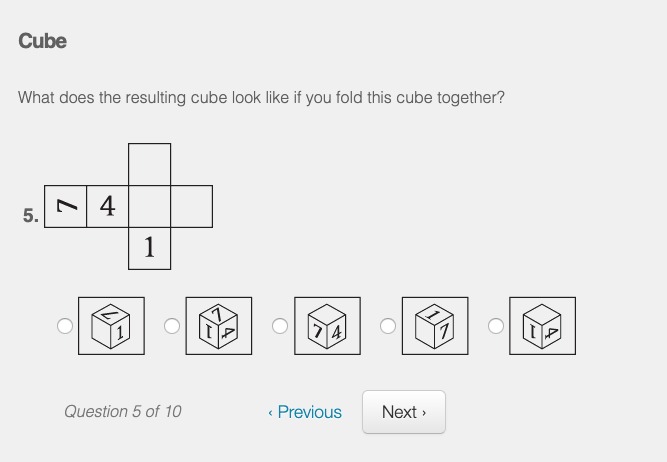
Interesting. This question is not hard to solve for me, but I can't solve it by visualizing the cube rotating despite having no trouble visualizing the cube in its initial position. More specifically, when I try to rotate the cube in my mind's eye, to get it "started" rotating, I have to anchor my focus on one particular side of the cube, which I can then rotate correctly. However, this causes me to lose focus on the other sides of the cube, and I can no longer simply look back at them to see how their numbers are oriented after the rotation completes.
When you do it, do you keep all sides "in view" at all times? Can you "focus on" one specific side during the rotation then look back at the others and see that they are still correct?
> When you do it, do you keep all sides "in view" at all times? Can you "focus on" one specific side during the rotation then look back at the others and see that they are still correct?
I visualize the entire flat object and fold it (all at once) in my head, paying attention to where all sides end up. I can then rotate it around in any direction (some are easier than others though; not sure why). Basically I visualize animating the flat object so that it folds into a 3D object at the edges. Just as if you were to do it with something like Blender.
I have a very easy time turning the flat object into a 3D object (accurately) but remembering which markers/colors were on which side is where my visualization often falls apart, haha.
Very difficult. I can't fold the cube up in my mind. I tried for a few minutes and just felt frustrated. Instead I needed to look at angles of the numbers relative to each other and eliminate wrong answers.
Same here: it reduces to a logic problem. I can imagine the transformation, the space, the cube, the rotation individually as concepts, but all of it is more memory than visualization and carrying through the shape and orientation of the numbers seems like magic.
> a whole heck of a lot of people look the same enough to me that I have difficulty telling them apart without hearing their voices (I'm fantastic with voice ID; probably comes naturally when you have trouble with faces haha).
I am the same way. I'm also highly myopic (I got glasses at age 4). There are times I've failed to recognize old friends until they started speaking to me (they did look a little different from the last time I'd seen them).
I always assumed that not seeing very well as a little kid is part of why I sometimes have visual recognition problems, too.
Very interesting, I got glasses at age 5 and I'm exactly the same, including not being able to clearly visualize even my wife's face.
My last job was 100% remote, and I started a week before one of the twice-yearly retreats where everybody gets together in person. Knowing that I'm poor at recognizing faces and poor at remembering names, I threw together https://github.com/philsnow/slanki and was able to put a name to about 50% of the 250 faces I met at that retreat, which felt absolutely like a superpower to me at the time.
I was able to get the answer to that test question pretty quickly and comfortably.
...but then it took me more than a minute to figure out why the test wasn't responding no matter how many times I clicked on the answer, and then other answers, and then even other buttons on the form.
There's definitely many different spectra of perception out there! :D
Somehow I feel like I cleverly tricked you without intending to. Won't stop me from taking credit for that unintended consequence though, "MUWAHAHAHA! He fell for it!" :)
Not that it makes me a genius or something, but it's not that hard for me to picture that cube folding. Or to imagine it folded and rotated. I did have to slow down a little to make sure I wasn't making a mistake about the orientation of the characters.
I'm great at paper folding visualization. I know this because I was given tests like that (by professionals) twice in my life (99th percentile =).
For reference, that particular cube folding question is easier than others because you can take the "shortcut" and just pay attention to the orientation of the numbers. The ones that I have to stop and think about the most are the ones with nothing but colors or (minor) shading. For whatever reason I find sides with shapes the easiest to visualize... Even if the shape is the same no matter the orientation (e.g. a circle).
Interesting tidbit: I love 3D puzzles and I always try to visualize what it looks like inside (if it's the type where you can't see the inner workings) while I'm figuring it out. I'm almost always way off with what I thought the inside would look like. Different kind of visualization I think. Probably has something to do with the ability to turn physical sensations (i.e. "what you feel") into a mental image.
Not parent commenter, but took me maybe 20-30 seconds to come up with the answer with validating by comparing how each character stands to each other.
I can't see images in my head. But at least I can try to fold it within my imagination. I can at least rotate it like in 3D computer program. But void is all I "see" in my imagination.


I'm blind in one eye (since birth) so I don't see in true 3D. I thought it was because of this--and my long term memory issues--that I have a hell of a time remembering peoples faces (or names). I am not the guy prosecutors want as a, "he saw the perp's face" witness to a crime... I don't have prosopagnosia (true face blindness) but a whole heck of a lot of people look the same enough to me that I have difficulty telling them apart without hearing their voices (I'm fantastic with voice ID; probably comes naturally when you have trouble with faces haha). Yet I've met people who were also born blind in one eye that are absolutely fantastic at remembering people's faces (and names, obviously).
So what I'm getting at is that even though I don't have prosopagnosia I have difficulty with faces. There's got to be a spectrum as with most cognitive measurements. Psychiatrists don't have yes/no charts when they test you for things; It's pretty much all scales from 0-10 (or 200-799 for some reason haha).
Just curious (if you read this far): How hard (for you) is a question like this? https://www.123test.com/content/question5.jpeg