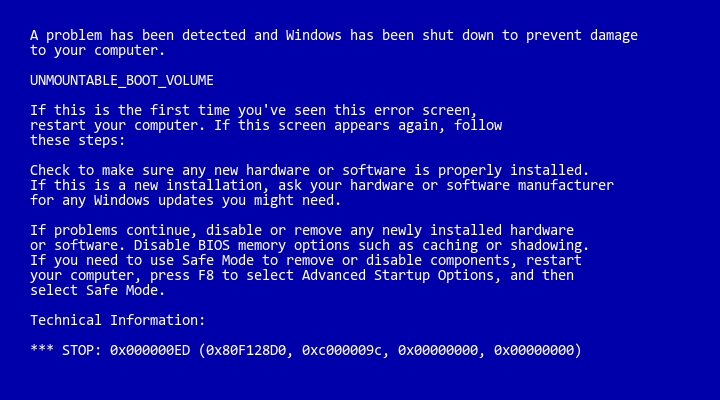
I couldn’t believe the first time I saw the sad smiley blue screen. It seemed like such a ridiculous thing for Microsoft to have done.
Then I remembered fiddling on Macs as a kid, if you screwed up you’d see a bomb. If you did something really wrong you’d get the mac icon with Xs for eyes.
The point being: cutesy errors are about as old as personal computing, but they do seem to becoming more prevalent.
One I recall from the early Mac era was the Kermit file transfer tool. [1] You'd run it on two computers. On one you'd tell it to SEND some file. Then on the other you'd type RECEIVE. A colleague of mine got absolutely fucking livid when he instead typed RECIEVE and it replied "I before E except after C".
He did have a point; the programmer obviously knew what was intended, but instead of just leaving it to a generic syntax error he went out of the way to have the computer be snotty. But the rage still seemed wildly disproportionate to me.
Years later, John Scalzi had a good way of putting it: "The failure mode of clever is asshole." [2]
Sure, we could all be more resilient. But sometimes offense is useful and valid! If I am urgently trying to get something done and somebody else picks that time to clown around and interfere with me, I don't think it's unreasonable to get mad.
I like joking around a lot, but reading the room is an important skill. To me it's important that the person I'm joking with actually enjoy it. A failed joke, one that annoys them is a mistake. People who persists in making jokes that the targets aren't laughing at are not really making jokes anymore; they're just being dicks. Which can also be a valid activity, but nobody should confuse it with joking around.
I felt the same way the first time I saw the new BSoD. It did at least have an error code displayed. But I couldn't agree with the article more, after a bug just ruined my day the last thing I want to see is an insincere cartoon trivializing my problem.
Last night and this morning I was locked out of my email because Duo wouldn't text me a 2FA code. There were no other options shown, just "we sent you a new code" and a phone number for the help desk. It was frustrating and I was upset, but at least they didn't show a sad cat with a bandaged paw. At least I was able to talk to a human, because my problem was important to me.
It's not just that they're more prevalent, but as computers become increasingly necessary it's more and more likely that bugs are causing damage. We should be more conscious of that fact.
Honestly, the new BSOD has everything I need - the stop code that happened and the module name so that I can start thinking about the problem while it gathers the dump. Not really looking for a stack trace or register info until it restarts and I can load the debugger.
> I couldn’t believe the first time I saw the sad smiley blue screen. It seemed like such a ridiculous thing for Microsoft to have done.
What's much worse is that it shows the screen for all of three seconds before automatically rebooting (at least for some errors), so you need to go through at least two or three boot cycles just so you can read the goddamn fucking error message. I used Windows for the first time in over a decade last week and had some issue with the disk, and it just kept rebooting and I had to quickly snap a picture so I could read the message because by the time I could orient myself on the screen it was too late. I cannot comprehend how anyone thought this would be a good idea. I cannot even comprehend how someone could comprehend it. :( indeed.
Yeah. You can actually change the behavior, so that the default is to just stay on the blue screen until the user manually reboots. Why someone ever thought automatic reboot was a good idea, or how they haven't bothered to change the default for 30 fucking years, is beyond me.
I don't recall Windows XP doing it back in the day. Or if it did, it didn't for boot errors like in Windows 10. I'm not sure because it's been a long time, but as I mentioned in my other comment, I had people come in with hand-written copies of all of the BSOD message, and you need some time for that (and fairly sure those folks didn't change some setting).
Automatic reboot isn't so bad, but just change it to a minute, or 30 seconds, or "press a key to abort reboot". An intern can do this. Hell, I'd send a patch, let me just find the Windows repo on GitHub...
Rest assured that not only XP, even 2000 did the same, and of course it did BSOD when booting, the most common being 0x0000007b "Inaccessible boot device".
But automatic reboot is a setting in the Registry, the issue is just with the default being "reboot" (I believe this was changed in XP, 2K just stayed on the BSOD by default, if I recall correctly).
Why someone ever thought automatic reboot was a good idea
For a server, which might only be accessible remotely, it is.
For an interactive computer, I agree that it isn't.
I believe this was a heritage from the NT series --- the 9x BSoDs just sat there and waited for you to reboot (except when things got so bad that it triple-faulted...)
I thought the default was to reboot after dumping memory to disk as a dumpfile, which tended to give you ample time with slow hard drives.
Somehow my system got itself into a state for a while where it had a registry key set to just not make dump files, and that key was not fixed even when using the normal control panel based settings panel that is meant to let you change those settings, OR the dedicated microsoft tool built to give administrators more control over BSODs.
The correct way to troubleshoot a BSOD isn't on the BSOD screen anyway. You open up the dumpfile in windbg and click "analyze" so it can spit out some good details for you.
Came here to say the same. The problem is they seem to be hiding information (for some reason):
Instead of being able to search "errornumber appname", you're stuck with a pastel picture of some cartoon character shrugging and text of "whoops! something happened. why don't you try restarting?"
Instead of being able to search "errornumber appname", you're stuck with a pastel picture of some cartoon character shrugging and text of "whoops! something happened. why don't you try restarting?"
Are you referring to Teams, by any chance?
I don't mind them being artsy, but if that's a replacement for the actual detailed error message, it both makes the user and the people trying to help helpless.
Imagine helping someone over the phone or in person; e.g. if you can see "error 10060", you know instantly that it's a network connection problem. If it's an access violation ("illegal operation" was unfortunate but still far more informative terminology) or a c0000005, the application probably messed itself up. You can ask people to read you error codes or search them yourself (being sure to quote them --- the horrible vagueness of search engines is another rant I won't get into here, although it also adds to the problem...). If all the application says is "something wrong", no one can help. All but the extremely perceptive could as a result be easily mislead into reinstalling the application, reinstalling the OS, and all manner of other stupidly destructive and ultimately futile actions, only to find out that the problem was ultimately due to something else entirely.
> Came here to say the same. The problem is they seem to be hiding information (for some reason):
Back when I worked at a computer shop I've had customers come to the shop with a hand-written report of the Windows XP BSOD message; like, all of this.[1] They were always very nice people by the way.
Also, all the text is boilerplate and 100% irrelevant to the actual error (UNMOUNTABLE_BOOT_VOLUME). It's not going to be fixed by a Windows update (which you can't install since you can't boot the thing) or disabling "caching" BIOS options. Not showing any text instead of that is probably better. It wouldn't be too hard to make a error message → useful description map for common problems like this, but good error messages/help was never Windows' strong point...
I think prevalence is important here. Everyone seems to be injecting cuteness into everything today. Blog posts or README files overflowing with emojiis and meme images. I'd really like to banish the rocket emoji. The metaphor is exhausted. The corporation-as-a-friend is everywhere.
Interestingly, some errors started out life as deadly serious and only became humorous later. "lp0 on fire". Printers used to really catch fire. Unix really was suggesting that maybe you want to look into that. The message still exists in Linux (as far as I know), but today seems rather funny to some people. Or can read like PC LOAD LETTER[1] to others.
I hated that bomb. It tended to appear at 11:00 PM when trying to print from Adobe PageMaker (pre-Indesign) at the end of a long sprint to get master prints to a publisher. That bomb meant I wasnt't going home for a few hours because MacOS had chosen that as the moment where some extension, previously playing nicely, was in conflict with another. It meant I'd get to do a binary search through deactivating /reactivating extensions to find the offender.
Keep in mind that each iteration required a reboot, and this was at a point in computing history where booting a computer filled with specialized publishing & editing programs each with their own hooks into the OS was a task that could be measured by the length of an extremely generous bathroom break.
And all I had to go on for error messages was a bomb and the number "-10 error". I hated that bomb. I don't think I fully recovered from the trauma & stress caused by unstable OS's until well into OS X's life and a few years of Windows 7 on the MS side of things.
And yes, this is my digital equivalent of the previous generation's "I had to walk 10 miles to school in the snow up hill, both ways"
I think the difference is that the two errors you described are very severe errors in which the machine may not know exactly what is wrong, and there isn't really any information to show to an end user other than a bunch of error logs or something. A cutesy error here is somewhat more appropriate, and can be kind of funny if you think about it like "welp, I really broke it this time lol."
However, the author described a case where an app messed up its auth flow. It knows exactly what went wrong, and it could easily present a much more helpful description. Who knows what a token is, or what headers are? Maybe it could even just try the request again, all while keeping the client informed. Instead, the app seems to have a simple try/except that handles the error by alerting the user with a cutesy message and dev-speak and nothing else, which is pretty annoying.
I also think any image is better than an ironic/snarky iphone alert.
> It knows exactly what went wrong, and it could easily present a much more helpful description.
Could it? The error in question sounds like a programing error. Either the client application did not provide a token the backend was expecting, or the backend lost it. What usefull error can be provided here other than “pray someone prioritises this bug and fixes it in the next release”? Or perhaps “think hard about what is so unusual about your usage or setup that you have fallen off the happy path and reached a state QA didn’t catch yet”
> Will it work if I try again? Do I have a ticket for my return journey? Should I call support? Or is this ticket completely hosed?
A good error message should try to answer these questions, because that is what the client is wondering. "Token header not found" doesn't even address the client as the audience; it's a message for a developer, written by a developer. Even if it has no solution, it should at the very least say "please contact us".
Yes, a good error message should tell you that. I’m not disputing that. I use this application regularly and it provides clear and usefull error messages when the network is down, or when you made a typo with your card details. It generally works. This, what we are seeing here is some off-nominal edge case. Have you seen code where a developer commented “// this should never happen”? That code is running there.
Should there be such a state? No, there shouldn’t be. The developers should work hard to make the applications always work, and when it can’t because of no fault of their own provide a clear explanation of what is wrong. (The network is down, the backend is overloaded, card declined, no tickets available, etc etc)
But still, bugs happen. Clearly that is what is going on here. Something violated the assumptions the developers made. What I’m saying is that when that happens it is very hard to answer any of those questions. “Will it work if I try again?” Maybe? Unless it won’t for a hundred and one possible reasons. “Do I have a ticket for my return journey?” Idk, does it look like you have a ticket? You tell me. “Should I call support?” Maybe? That sounds usefull, we want to know that something that shouldn’t happen happened. Unless offcourse we fumbled big and our phones are already on fire, in which case please don’t call support.
It is easy to say that an error message should provide information like that and a very good thing to aim for, but I’m disputing if it “can” in every unexpected situation.
For anybody else wondering, this means you need to visit that URL by hand, e.g., by copying it to the clipboard and pasting it into the location text widget then pressing Return or whatever. Don't click it.
EDIT: wait, wtf, I did the above once - and now it works when I click it. Go figure


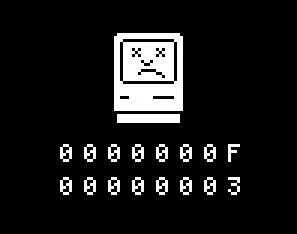
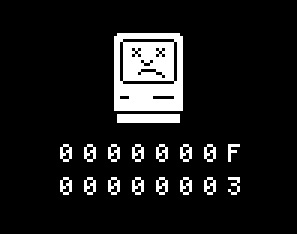
Then I remembered fiddling on Macs as a kid, if you screwed up you’d see a bomb. If you did something really wrong you’d get the mac icon with Xs for eyes.
The point being: cutesy errors are about as old as personal computing, but they do seem to becoming more prevalent.