I have a 15-90 and a zigzag attachment. I would note that the trick to the attachment is that it works by shifting the fabric from side to side. A machine with a built-in zigzag function shifts the needle. This means that you're trying to move the fabric in both axes through a machine cycle rather than just one, and that two wholly separate mechanisms are doing it: the feed dogs handle forward, and the attachment handles side to side.
I've found that the heavier your fabric is the less likely it is that you'll be satisfied with the zigzag attachment. In particular, if you're trying to bar tack reinforcement points in gear, you might have a hard time.
The buttonhole attachment, on the other hand, covers the feed dogs in the bed of the machine, and the buttonholer handles all of the movements of the fabric on its own. I've had fairly good luck with it. If you're only doing bar tacks, you can set it up to make a "button hole" with the sides overlapping, and it does a pretty good job.
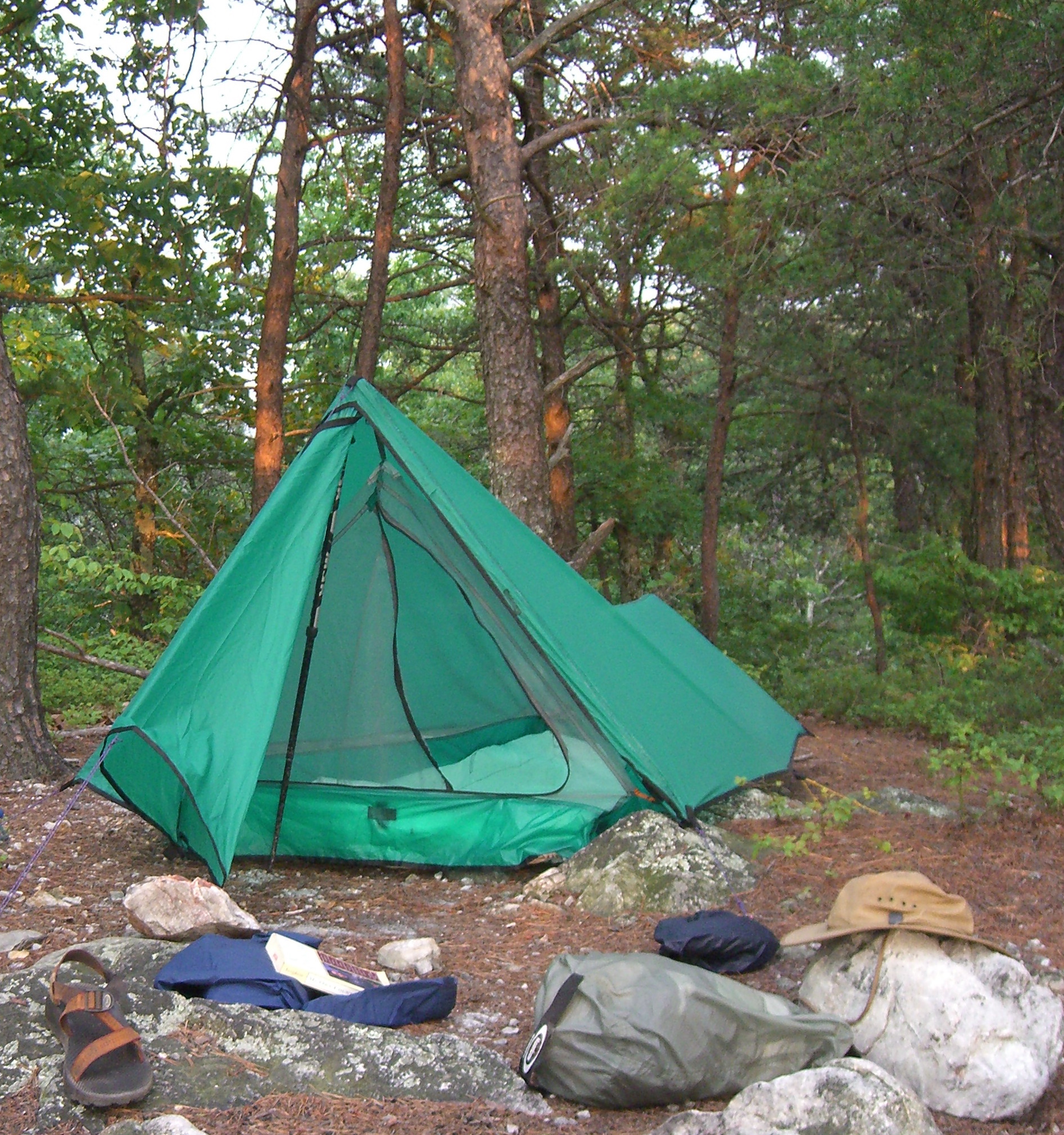
I've sewn my own lightweight tent, and I've found that you really don't need a zigzag for that (assuming a pattern that doesn't require one, obviously). Packs and duffel bags, on the other hand have a lot more stress on the points where the straps attach to the bag, and you'll likely want to be reinforce those points with bar tacking.
Great explanation!
I have the other zigzag model, the "Automatic Zigzagger", model 160985 which uses cams. Have only used it for finish work on thin fabrics but did use it to mend and reinforce denim garments, and it worked quite well there as well (though again it might be different if I tried to stick to an edge there).
Tent is probably the most dreadful project I have on my list, I followed some very talented MYOG hobbyist (@leahikes) as she was designing sewing (and then resewing) her DCF tent (which she used on the A.T. this year) and getting all the angles right for a good pitch seems an epic effort. Very impressive that you managed to do that!
Thanks! I think you're greatly overestimating the amount of perfection in my tent :-)
I made my own pattern and just kind of went with it after making a 1/2 scale prototype. It pitched well enough and kept me mostly dry on the AT in 2010.
If you're dreading the project, I'd encourage you to find the nearest small child and ask them to draw you a tent. Then go make what they drew. That's pretty much what I did [0]. If you keep it down to minimum viable tent, it's really not too bad. Just practice the zipper on scrap first if you've never sewn one before :-D
Thanks for the encouragement! The tent looks pretty great, considering what was available in 2010 both in terms of fabrics choice and educational materials.
Nowadays I'm mostly a flat-tarp user. I use an HMG 10' x 8' tarp which I used with some success (and some failure) on the HRP and GR54.
Since I live in Israel, hiking locally means dry but often windy or humid (but not rainy) conditions, and for that purpose, I hope to be able to downsize to a 5' x 7' tarp, which I think I'll try my hands at once the hiking season begins here.
I think that unlike everyday garments (some) hiking garments can be very forgiving. An example is a SilPoly rain pants I made last year for a fall GR54 hike. It's not pretty and I wouldn't use on a trail like the A.T for fear of frying myself, but it worked perfectly to keep me warm in stormy days.


I've found that the heavier your fabric is the less likely it is that you'll be satisfied with the zigzag attachment. In particular, if you're trying to bar tack reinforcement points in gear, you might have a hard time.
The buttonhole attachment, on the other hand, covers the feed dogs in the bed of the machine, and the buttonholer handles all of the movements of the fabric on its own. I've had fairly good luck with it. If you're only doing bar tacks, you can set it up to make a "button hole" with the sides overlapping, and it does a pretty good job.
I've sewn my own lightweight tent, and I've found that you really don't need a zigzag for that (assuming a pattern that doesn't require one, obviously). Packs and duffel bags, on the other hand have a lot more stress on the points where the straps attach to the bag, and you'll likely want to be reinforce those points with bar tacking.