"'God is dead, God is dead' ...Perdition! When God dies you'll know about it."
I first came across Greg Bear reading his short story Petra in Mirrorshades: The Cyberpunk Anthology[1]. I still have the book and just took that quote from it.
I found it mind bending when I first read it.
As a kid brought up as a Catholic I was told that the world exists because of God never stops thinking about us. Regardless of if we believe in God, God believes in us and that's the important thing.
So teenage me, obsessed with hard SciFi and Cyberpunk in particular, runs bang into Petra.
It's a story about a world where God has died. With no supreme being to hold the world in its mind the rules of reality break down.
It was such a crazy concept and it came just at the right time in my life. As an adult, I no longer believe in the supernatural but I still remember the illicit feeling of reading Petra back when I did and it definitely changed me.
To continue the homage to GB as a recommendation thread, I think programmers and systems engineers would enjoy GB's "Strength of Stones" (1981).
In the story, autonomous mobile cities designed to last a very long time begin to fail. GB shows a profound understanding of human society and the bemusement of people who believe they have design a solution well.
FTA: "After a review of the possible outcomes by the medical team, and following the wishes expressed in his advance directive, Bear was taken off life support and died two hours later." (Emphasis added.)
Advance directives are important; my wife and I have long had them. I've said many times to our adult kids that I want family resources to be put to better use than just keeping me alive on life support when realistically there's little hope of recovery.
I'm visiting my parents this weekend and what with all the nostalgia of that, seeing this pop up on HN really felt like a punch to the gut.
Whenever I see his name, I'm transported back to a small town public library in the UK where his novel, Eon and its Arthur C. Clarke nomination took me from a young boy reading more popularist Sci-Fi authors straight into a much harder world of sci-fi authors and it left a huge impression.
Another big loss to the Sci-Fi literary community.
Yes, Eon! Amazing book. Darwin's Radio is a really fun idea too. Definitely recommend that if you enjoyed Eon. Very different, but equally creative and fascinating.
The only Greg Bear books I've read are Forge of God and Anvil of Stars.. they were well-written, but the story sucked IMO. It was just so dark, and full of vengeance. A whole universe burning in the fires of vengeful rage, haha.
Are his other books like that too? Or is the tone a little less murderous?
So many sci-fi books come across as basically the same, I like Forge of God precisely because it is so dark and uncompromising and is like works like Gateway and Worlds or Ballard’s works that read more as literature than genre sci-fi.
Also from the view point of SETI there is the awful truth that we really shouldn’t be trying to communicate w/ other life because the most practical meaningful form of interstellar communication is bombing with relativistic or sub-relativistic projectiles. See The Killing Star where aliens watched Star Trek: The Original Series and thought we might be dangerous, then saw Star Trek: The Next Generation and realized they could take us.
Some concepts are hard to grasp because of their scale.
Greg Bear was the first person who really made me understand time slowing down as speed increases in Anvil of Stars.
Also the destruction of earth in “The Forge of God” was so visceral that I was depressed in a dark place for days after finishing it.
Not to mention one of the few authors who very well explained the role of bacteria and viruses in very entertaining and hard sci-fi believable fashion.
He had an aortic dissection in 2014. They repaired that (and put in a new heart valve) but apparently there was a complication, a "false lumen". This (as I understand it) is a sack of low circulation velocity in the artery where blood can clot. And apparently here it released into the arterial flow during surgery a week ago (in a desperate attempt to repair it?) and caused massive embolism across his brain.
Perhaps I’m morbid, or just interested in medicine, but I really appreciate when some detail about the cause of death is provided in an obituary. Not only is it a useful memento mori, but it also reflects the conscientious planning by the author.
You're not morbid. In the case here, let's just note that many famous people haved died as a result of aortic dissection (immediately or not). It's worth knowing how common it is so it can be avoided or detected. Keeping your blood pressure under control helps reduce its incidence, for example.
"It's not paper." Gogarty said. He dipped it in his tea cup. The letter did not absorb, nor did it drip upon removal. He held it in both hands and made a vigorous tearing motion. Though he carried the motion through, the letter remained in one piece, in one hand, having passed through the other hand in some unobvious fashion.
I forgot "Blood Music" was one of his. That along with "Press Enter" by John Varley are the two sci-fi stories that really freaked me out as a kid. The idea of having your body controlled and then rebuilt at the cellular/molecular level for the purposes of some emergent intelligence that arose from nanobots really got me.
Although the nanotech is indicated by the title and takes up much of the story, he leads the focus toward quantum physics. Another physicist/novelist, John G. Cramer, commented on the Blood Music in a popular article on quantum reality. (https://www.npl.washington.edu/av/altvw140.html)
"Queen of Angels" is one of few books that made me cry in two separate parts, for two different reasons, and I think it may have been the point at which I reflected and understood explicitly the rule for taking expected darkness and turning it to unexpected light.
Goodbye, Greg Bear. May there be a hand held out in darkness for you.
Greg Bear, I think, may be the last of the major classic scifi authors. Author C Clarke is gone, so is Frank Herbert and Robert Heinlein and Isaac Asimov. I can't think of any who are still alive who belong to that club.
He was writing a bit later. Take a look at the Wikipedia article[1] on the "Golden Age" writers - looks like Robert Silverberg is the last of that era still with us.
(Edit: Not to belittle Bear if you grouped him with them on the quality of his writing rather than contemporaneity)
I don't exactly group them the way most would. I blend what Wikipedia calls Golden Age and New Wave together, where you had a ~40 year block of amazing authors cranking out most of today's top 100 list. Then, after that, you have this fade in of where cyberpunk themes start developing a new age of scifi. So, I consider "classic scifi" ending vaguely around the year 2000, and cyberpunk and modern scifi starting in the mid 80s, clearly these overlap.
Also, I think we're transitioning into yet another new age of scifi that is post-cyberpunk; smaller in nature, less grandiose, less "living amongst the stars and living a space opera", less "living in a dystopia with extra steps", more "the AI winter will never end and we have to live with the promise never being delivered" and more "oops, we left someone behind on Mars and now he has to eat potatoes to survive". Whatever this new era will be called, it started roughly in the early 2000s, starting when the classic scifi era ended, overlapping with the middle of the cyberpunk era.
> "oops, we left someone behind on Mars and now he has to eat potatoes to survive".
You should read his most recent book Project Hail Mary then. It's a much grander concept than that, and I absolutely would put it up against books from the great sci-fi era that I read growing up.
I don't get it, I think today space opera is probably the most vital it's ever been. You have everything from Wayfarers to Teixcalaanli to Machineries of Empire to Xuya to Three-Body Problem.
> I blend what Wikipedia calls Golden Age and New Wave together
Well, you do you, but nobody will understand what you mean and I don't think there's any thematic, aesthetic, literary, or social basis for this.
It's weird to see Bear (1951) lumped in with Clarke (1917), Herbert (1920), Asimov (1920) and especially Heinlein (1907). Much (maybe even most?) of Bear's generation is still alive!
Even in terms of "what would a 30-50yo today have found on the local bookstore's sf shelf as a child to whom all past is equally distant?", Niven, Delaney, Robinson and Silverberg (who actually published in the final days of the "Golden Age", unlike Bear) are still with us.
Also in the "Silver Age" crowd that Greg Bear is part of
Joe Haldeman, William Gibson, Piers Anthony, David Brin. Lois McMaster Bujold, Orson Scott Card, KW Jeter, George Lucas, George RR Martin, Phillip Pullman, Rudy Rucker, Dan Simmons, Harry Turtledove, John Varley, Connie Wilson, Timothy Zahn are all around
Though it is sad he joins the ranks of authors from his generation who died earlier than expected - Pratchett, Iain Banks, Robert Jordan ..
It really sucks. Last year I discovered I hadn’t read Surface Detail, which came as a real shock as I was sure I’d read everything he’d written many times.
Considered never reading it so there’d always be a new Ian M Banks, but the temptation was too great. Glad I did too as it was excellent.
Everyone else seems to be either younger, or if not at least they're known for works that were published slightly later. However, these authors are in roughly the same generation:
I was not a reader as a kid. I just didn’t ever read books. But around age 13, I had to read a book for school. I picked up Eon at the library, and I read it, and actually wanted to read the whole thing.
After that I got my hands on every book he had written. Moving Mars is possibly the only book I ever read twice.
Later in life reading sci-fi is no longer an interest of mine, however his books were transformative for me.
Moving Mars is my favorite of his works as well. His other book, Heads, is something of a prequel, although Moving Mars does a good job of standing on it's own.
I loved the forge of god and anvil of the stars. He wrote life into his books, impossible decisions, moral conundrums and still, one day feasible technology, he dreamed ever onwards.
May the great simulation resurrect him other heat death.
That's very sad. I was reading Darwin's Radio while travelling in Cambodia in 2001 when the WTC attacks occurred. In the aftermath, with the anthrax scare and the CDC response it was sometimes hard to tell the difference between what was happening in the book and in real life. Amazing writer.
A sad loss. His books meant a lot to me at a particular time in my life, and I still re-read them sometimes. Queen of Angels and Moving Mars are probably my favourites, along with Eon and Blood Music. His works always delivered thoughtful depth and satisfying stories.
The area beyond the white line is littered with the deranged and
abandoned equipment of dozens of fruitless investigations. I have gone
there to pray, to indulge in my own apostasy against rationalism, to hope
that my words can reach into the transformed matter and information
Trying to reconcile my own feeling that I sinned against Fiona Task-
Felder, as Thierry had sinned against so many... I cannot make it
sensible.
No one will understand, not even myself, but when I die, I want to be
placed in the Ice Pit with my sister and William. God forgive me, even
with Thierry, Robert and Emilia, and the rest of the heads...
In the Quiet.
Man I'm sad he won't write more but I appreciate how much he gave us.
My shelves are filled with three things... Some fantasy, a bunch of textbooks and a whole heap of 20th century Science Fiction. Bear is featured prominently and will continue to live on in page and thought for a long time to come.
He leaves behind a great legacy. I can highly recommend Blood Music, Eon, or Forge of God if you have never read one of his books. However, my personal favourite was actually the (Halo) Forerunner Saga series.
Greg Bear is my first serious hard sf author. The Wind From A Burning Woman!! (Not just the story, the whole collection!) (I mean, sure, Forge of God, Anvil of Stars, Blood Music.. But still)
My personal favourite is Queen of Angels. (The sequel was a disappointment).
Eon is the best, but it's tied to the geopolitics of the 80s.
Blood Music is, I think, almost as good as Eon but isn't quite so "of it's time". Slightly more accessible. I'd start there. He also has a fine body of short fiction, including the short Blood Music is based on. For that, you could try the collection Tangents.
He was one of my favorite authors. I remember reading "Eon" many years ago. I thought it was the best book I had ever read. Then I read "The Forge of God" and found it even better.


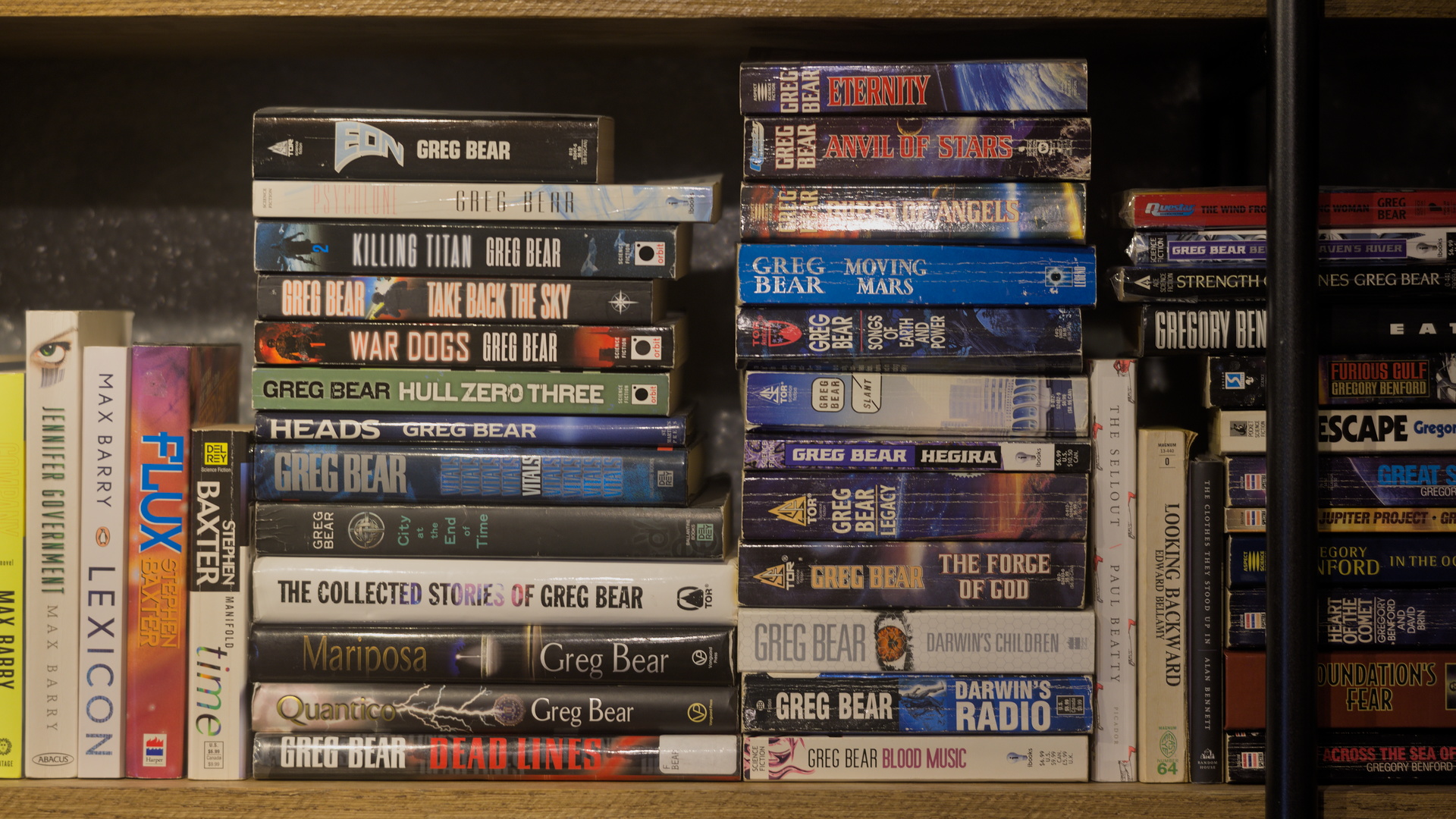
I first came across Greg Bear reading his short story Petra in Mirrorshades: The Cyberpunk Anthology[1]. I still have the book and just took that quote from it.
I found it mind bending when I first read it.
As a kid brought up as a Catholic I was told that the world exists because of God never stops thinking about us. Regardless of if we believe in God, God believes in us and that's the important thing.
So teenage me, obsessed with hard SciFi and Cyberpunk in particular, runs bang into Petra.
It's a story about a world where God has died. With no supreme being to hold the world in its mind the rules of reality break down.
It was such a crazy concept and it came just at the right time in my life. As an adult, I no longer believe in the supernatural but I still remember the illicit feeling of reading Petra back when I did and it definitely changed me.
RIP Greg, you were brilliant!
1. https://www.goodreads.com/book/show/302702.Mirrorshades