Sadly, in the US, the National Enquirer has broke actual news in the past.
I get the feeling for all the tabloid stuff, someone on the Daily Mail's staff just loves to find all the weird scientific studies and news that can be turned into bat-boy-style headlines. With the main difference being that the Daily Mail doesn't make up the original discovery but might be a bit hype-driven. I do wish they would provide a bit better links to the story.
The other sad thing, and it is truly sad, is that they sometimes actually are more factual about stories in the US great plains then the US east coast papers[1].
1) the NY Times in particular seems to be incapable of choosing the correct state for North / South Dakota Senators.
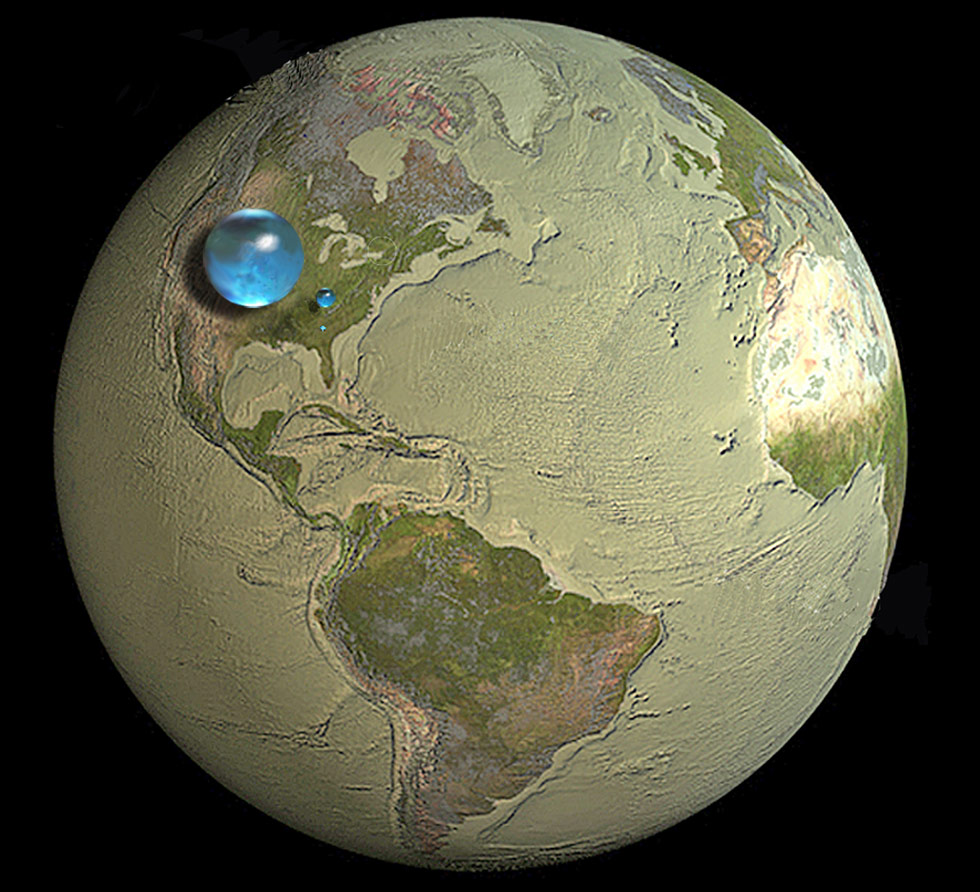
I know that truth can be stranger than fiction, but am I the only one a little hesitant to believe that underneath the U.S. alone is a reservoir that is three times the volume of all the oceans combined?
EDIT: I didn't mean to imply that this exists only under the U.S. and nowhere else. I meant to imply "so far, the existence of this reservoir has only only been confirmed under the U.S.; the rest of the world is unknown at this point".
The deepest point in earth's oceans is 12 km or so, and the average is ~4km. Now, imagine this discovered reservoir is 400 km "deep". It means it will have 3x the volume of all oceans even if its surface area is 30 times smaller.
  Sure enough, they found signs of wet ringwoodite in
  the transition zone 700 kilometres down, which
  divides the upper and lower regions of the mantle.
From wikipedia:
  The transition zone is part of the Earth’s mantle, and
  is located between the lower mantle and the upper
  mantle, between a depth of 410 and 660 km.
So, if our planet is roughly 12,000 km in diameter (6,000 km to the center), then this region of depth represents a 100-200 km thick shell where pockets of water may exist. But let's max it out, and try to find the volume ((4/3) * (pi r^3)) using very rough, round numbers to get an upper ceiling.
Hypothetically, if it were a continuous shell of pure, fresh water encapsulating the entire inner mantle and core, and if it happened to be 200km thick, with an inner surface at 600 km deep (the shell's floor starts at a radius of 5,400 km) and an outer surface at 400 km deep (the shell's ceiling stops at a radius of 5,600 km), the intervening space could collect possibly a volume close to 76 billion liters of water.
Compare this to a hypothetical scenario, where our planet's rocky crust has a radius of 5,995 km, and is completely covered in one giant ocean of water 5 km deep (think Water World with Kevin Costner) for a total diameter of 12,000 km, this huge ubiquitous ocean would only contain 2 billion liters of water.
So, in a world of perfect spherical maximums, rounded to the nearest billions in liters, this subterranian zone could contain 38 times the water we currently observe on the surface of the earth.
Wait, you're right. I think I dropped about maybe 4 zeroes off the exponential notation. Strike the "billion" and make it like 10^11th or 10^12th power. Either way, I think the ratios still work.
...and oh yeah, by the way, my units were the wrong order of magnitude; should've been kiloliters (not just liters), on top of the exponential notation.
It makes perfect sense when you plug the numbers. They're talking about a thin layer of extremely dry, hot rocks in the earth's mantle. Something like 1-2% water by weight [0] in ringwoodite -- about 35-80 grams/liter. (Liquid water at the surface is >1,000 grams/liter). The catch is, it's a staggering volume: the earth's mantle is ~3,000 km thick, and the comparatively "thin" layer they're looking at, the transition zone, is ~250 km [1] -- this compared to the oceans' depth of ~4 km [2].
    "The water storage capacity of the upper and lower
    mantles is less than 0.2 wt%. The transition zone has a
    storage capacity of approximately 0.5–1 wt% due to a
    water solubility of about 1–3 wt% in wadsleyite and
    ringwoodite, which are the major con- stituents of the
    transition zone. Thus, the transition zone may be a
    major water reservoir in the Earth’s interior."
The Earth is huge and the oceans cover only a tiny sliver of the surface. Doesn't really surprise me.
They said they only have evidence underneath Earth. Whether it's under other countries is still under investigation. To emphasize my point, note how he states that if this water were all to rise to the surface, then only the mountain tops would be visible.
Right. I didn't mean to imply that the water is only under the U.S. I meant to say that under the U.S. there is 3 times the volume of the world's oceans. That seems like an awfully large amount of water for an area that comprises around 2% of the Earth's surface. If this rock wraps around the entire Earth evenly, that suggests that there is 150 times the volume of water of all the Earth's oceans 700 kilometers down. The idea that the oceans, which cover 70% of the surface and may be miles, deep only make up .007 of the volume of water on Earth blows my mind.
EDIT: 2% = 1/50th of the surface. 3-oceans * 50 = 150. (1 * all earth's oceans) / (150 * all earth's oceans) =~ 0.00666...
By measuring the speed of the waves at different depths, the team could figure out which types of rocks the waves were passing through. The water layer revealed itself because the waves slowed down, as it takes them longer to get through soggy rock than dry rock.
Jacobsen worked out in advance what would happen to the waves if water-containing ringwoodite was present. He grew ringwoodite in his lab, and exposed samples of it to massive pressures and temperatures matching those at 700 kilometres down.
To me, as someone who knows not that much about all this, that sounds like it could well be hooey. It could be voodoo. It could be a Tall Tale.
Can anyone explain to me (like I am 5 years old) how such things get vetted or taken seriously or whatever?
Suppose you have an earthquake at a known location, or you set off a large underground explosion at a known location. This causes several different kinds of waves to radiate out from that location.
Seismometers can detect those waves. How fast the waves of a given type move depends on the kind of rock or soil they are moving through. When we measure how long the wave took to go from the point of origin to a given seismometer, that tells us a little bit about the kind of rock or soil on that wave's path. The wave might have passed through many different kinds of rock or soil, so just looking at one wave doesn't tell much--just that the path had some mix of rock and soil overall that gave that speed.
We aren't limited to one wave, fortunately. Every time something generates detectable waves, we get a little more data on the composition of the rock and soil on the paths between that source and every seismometer that measures those waves.
The more data we get, the more constraints that puts on what kind of rock and soil can be where and still be consistent with all of the observations.
For things reasonably near the surface the deductions from seismic wave analysis can be checked against observation from tunnels and wells to verify that the methods work.
Observing how waves travel through planetary bodies is one of the most useful methods for looking into the interior of these objects. On a fundamental level, it's an advanced version of knocking against a large metal silo to determine if it's empty or full.
However, detailed findings can be tricky sometimes. In this case, the geologist calculated beforehand what the frequency absorption fingerprint of "rock containing water" would be, and then he found a matching signature in the measurements he took.
Indeed there are several things that could have gone wrong: the signature of the substance might be different than previously assumed, or the seismic measurements themselves could be faulty.
Over time we'll get more measurement opportunities and we'll refine our models as more scientists will work on this. There might be more evidence from other sources available if we know how to look for it, too. So the confidence level in this finding will be modified in the future.
Right now it's just an intriguing but singular result that deserves further study.
Right now it's just an intriguing but singular result that deserves further study.
See, I guess that is my issue here: The article talks like we KNOW this for sure, not like "preliminary results suggest..." when no one has sampled anything that deep to verify it etc.
What are you asking to have explained, the science? Like, how seismic waves propagate at different speeds through materials of different densities? Or how the observed propagation of seismic waves through the planet after multiple earthquakes had anomalies that matched those predicted in the presence of "wet" (hydrous) ringwoodite? Or how they created ringwoodite in the lab and subjected it to temperatures and pressures like those that might be found in the mantle?
Have you ever seen the beginning of the movie The Core? Just about the only real bit of science in it is that sound travels differently through different materials in the mantle.
To be vetted, an experiment will be peer reviewed by others for obvious mistakes, compared to existing results and mathematical models, and duplicated by others.
I don't mean to be demeaning, but in situations like this, admitting your ignorance on a subject is a great first step, but the next is learning how to best phrase questions.
Here, you would be better off asking about the parts you don't understand such as how they came to their conclusion, or how their reasoning considering the article works.
I remember in the 90's there was a conspiracy theory going around that the 'global elites' had created a massive submarine base - in the middle of the Amazon jungle, i.e. hundreds of miles from the oceans - specifically to use as a survival plan in case of a massive flood. There was even a site dedicated to the 'discovery' of photo's of the massive submarine, taken from a light airplane which crashed .. the camera was found and later the pictures were made available.
I wonder if the author of "Flood" had heard of this theory and incorporated it into his book. Try as I might I can't find any details about this jungle submarine base any more - seems its been wiped off the 'net.
Another thing I thought of is the Cataclysm as described by Szukalski, that weirdo. He posited that every 64,000 years, the Earth undergoes a massive upheaval due to "Gravity heat" which busts open the Earths' core and releases massive amounts of water from within. Now that there is actual scientific evidence of this whacky theory, I'm starting to get a bit more interested in finding that jungle submarine base .. ;)
Yeah, I've whiled away a few ergs on the topic, but its an amusement more than a serious pursuit. It does amuse me that the memory hole is deep and wide, and this "jungle submarine base" conspiracy has fallen into the maw .. still, if there were an 'ultra-elite' class of people, you'd expect them to know all the details of the apocalypse before us plebes do ..
One can easily hide something that has less than 20 or so meters hight (because trees rarely get over that height), and smaller than a few trees in area. If the thing you want to hide is bigger than that, you'll have better luck in a cave, or disguising it as a rock and placing it in the middle of a desert.
Wow. Never heard of this book before, looks like a good read and actually kind of scary that this could be a reality (based off of the synopsis). The thought of the world slowly being swallowed by water leaking from beneath the Earth's surface really creeps me out.
It's a really good read, there's a follow up as well which I enjoyed but it didn't work quite as well as the first. The book runs through from the first days to about 30/40 years later and covers what the impact of the ever changing sea level does to civilisation.
It is pretty grim, but after looking at a predicted sea level rise map I realised I'd be in a reasonably safe area for a while and that cheered me up a bit.
The existence of subterranean oceans is not based in reality at all. All this reference to oceans in the mantle is science journalist bullshit. There is no ocean at 700 km depth.
The paper refers to the mineral ringwoodite, for which the anhydrous formula is (Fe,Mg)SiO4. Hydrous ringwoodite has the capacity to take some OH groups in the mineral structure, probably in a coupled substitution with vacancies/defects/some trace element such as titanium. Recently a ringwoodite sample was found that had 1.5 weight % H2O in its structure. What that means is it is entirely unlikely that there will ever be free water in the mantle, because you can dissolve so much of it in the minerals. Free water can only exist when the minerals can not longer fit any more in them.
What the authors did was take some hydrous ringwoodite and put it in a diamond anvil cell and heat a bit of it with a laser. The bit they heated transformed into the minerals perovskite and ferropericlase, and amorphous material the authors interpret as quenched silicate liquid (i.e. glass, analogous to obsidian). The perovskite and ferropericlase have less capacity to dissolve H2O than the ringwoodite, so when ringwoodite breaks down, some H2O is releasd. However, instead of forming free water, the H2O reacts with the other minerals to form a silicate liquid (i.e. magma with some H2O dissolved in it). This reaction is referred to as dehydration melting: the reaction of a hydrous mineral phase to form other mineral phases and a silicate liquid. You dehydrate a mineral and form melt.
The authors then relate the mineral scale reactions to global scale seismic structure. Low velocity regions are observed when mantle downwells from above the 660 km continuity to below it. Low velocity zones are interpreted to be associated with the presence of silicate liquids. Thus, the authors suggest that downwelling of hydrous ringwoodite bearing mantle from above the 660 discontinuity to below it will result in a phase change to pervoskite + ferropericlase + silicate liquid, consistent with the presence of low velocity zones. The amount of silicate liquid produced is about 1%. You don't need much silicate liquid to make low velocity zones.
This entire story does not involve free H2O at any stage. Any reference to oceans is misleading.
If the story of the great flood (Holy Bible) is real - could it be that this is where all of the water has gone? Could this water some time in the future "rise up" once more and create a second worldwide flood?
Epic floods are somewhat of a staple in early mythology (not just the bible exclusively), but the thing to keep in mind is these civilizations did not have the means of detecting the scope of potentially global events. So even if flood myths are based on real events, they're most likely catastrophic but local occurences. This is supported by geological evidence which shows flood events in many regions over time, somewhat fluctuating sea levels, but never a truly global flood.
If the biblical account is accurate, then no, there won't be another worldwide flood, because God promised to never destroy the Earth with water again.
Good point. Since there's already been ice ages, that only leaves fire and earth ;-) Though then again, some people say the dinosaurs are extinct because of meteor strikes, so maybe earth is done too?
> could it be that this is where all of the water has gone? Could this water some time in the future "rise up" once more and create a second worldwide flood?
Science answers questions like this with evidence, but the inherent premise in your first question is that there was a world wide flood to begin with and there is no evidence other than religious anecdotes to support this.
Assuming that there was a world wide flood just doesn't make sense when there is no compelling reason to think there ever has been such a thing. However, what kind of process would you imagine would bring enough water out from under the Earth for 370 days and then make it go back. We are talking about an enormous amount of water. If you wanted to build a pump that could move such volumes of water out of the Earth, and then back in you are entering the realm of fantasy. Of course if you're willing to assume the work of supernatural powers that's where you started from.
There are a great deal of many problems with a world wide flood story, the origin of all that water is just one. Kangaroos making a trip from Australia to the Middle East and back for a boat trip is another.
There was an book by Graham Hancock, who is known mostly for very fringe theories on aliens and history, called Underworld where he argued that flood myths, which appear all over the world, were caused by an actual great flood caused by the melting of the ice sheets over North America during the last ice age. The reason it happened instantaneously as a flood and not a gradual rise in sea levels is because, or so he argues, the ice sheet melted and pooled in the middle (as ice does) and eventually broke through the ice walls.
Then, he claims that the water didn't go anywhere and argues that we have little evidence of human civilization and agriculture before the end of the last ice age is because the cities of humanity now currently exist under the sea, in areas which were once coastline before the sea level rose. He also argues that the greatest trove of new information about humanity is underwater, which on a whole has had very little archaeological research done.
> Could this water some time in the future "rise up" once more and create a second worldwide flood?
It could create a flood. Not a second one.
> could it be that this is where all of the water has gone?
No. The process doesn't seem reversible.
Analogy. If someone tells you they filled a balloon with water and pierced it, and later you see a balloon with water, you may believe they un-pierced it, unless you know physics and you learned that you can't un-pierce this balloon just like that. Then, the more likely explanation is either that someone filled another balloon, or that they didn't pierce it after all.
If the great flood had been real, either we'd find evidence of there being a lot less oceans in the Pleistocene (which we do not), or we'd come from another planet. (But then, how would we have traveled? Why is there no evidence of it? Why do we fit perfectly in a common phylogeny with all other species?)
All in all, that theory doesn't (puts on sunglasses) hold water.
> 11 In the six hundredth year of Noah’s life, on the seventeenth day of the second month—on that day all the springs of the great deep burst forth, and the floodgates of the heavens were opened. 12 And rain fell on the earth forty days and forty nights.
It isn't ambiguous under the commonly accepted scientific facts of the time, in that particular civilization.
They believed that they were on a flat earth under a dome that separated the atmosphere from huge amounts of water above (hence the blue color of the sky) and below (hence the oceans). They believed that the dome leaked sometimes, causing rain. They believed that the flat earth leaked too, causing rivers.
Seems dubious given the other half of the line. The author wrote "the springs of the great deep burst forth, and the floodgates of the heavens were opened". Did they mean "it rained, and also it rained"?
I'm by no means defending the lunacy, but it would be an efficient way of transferring such a huge amount of water: heat it up using the core or the holy kettle and let the steam rise up through the earth, which would then fall down as rain.
An ocean as imagined by Jules Verne in Journey to the Centre of the Earth. A splendid bit of early fantasy fiction. I recommend 'Lost' - the chapter where the narrator gets separated from his Uncle in caverns 70 miles underground.
It would be so cool to get a sample of that water (assuming it does in fact exist) and see what type of life is in it (if any). It would be almost like seeing life from another planet.
> In the mantle, temperatures range between 500 to 900 °C (932 to 1,652 °F) at the upper boundary with the crust; to over 4,000 °C (7,230 °F) at the boundary with the core. [1]
Those would be some pretty extreme extremophiles!
> However, it is thought unlikely that microbes could survive at temperatures above 150 °C, as the cohesion of DNA and other vital molecules begins to break down at this point. [2]
Aww man! Though there are some pretty amazing extremophiles out there anyway!
After reading this article, I was reminded of [0]. The Earth's core is hot due to the presence of radioactive isotopes, both the uranium-238 and thorium-232 series occur in substantial quantities. This could alter the chemical composition of the water present due to radiolysis.
The quote would better be placed around 'discovered' rather than 'ocean' considering it's all lab experiments and a pair of wet diamonds. Not to dismiss the hypothesis/theory, which seems pretty solid (no pun intended), but it's not like we discovered a new ocean like the Europeans discovered a new continent centuries ago.
One would think that water's density is smaller than the rock. Why wouldn't it eventually rise to the surface above the denser material if the surrounding rock wasn't solid?
1) Porosity is the ratio of the volume of openings (voids) to the total volume of material. Porosity represents the storage capacity of the geologic material. On the other hand, permeability is a measure of the ease with which fluids will flow though a porous rock. Although a rock may be highly porous, if the voids are not interconnected, then fluids within the closed, isolated pores cannot move. This situation is commonly found in nature and represents a challenge for the extraction or the injection in reservoirs.
Nevertheless, I have no idea of the porosity level that could exists at those depths.
2) At 700km depth pressures are of order 21 Giga Pascals (~207000 atmospheres) and temperatures about ~1900ºC. Water is not the water we know at these conditions, it is a supercritical fluid. The line separating liquid and gas phases ended at much lower temperatures.
I thought at those depths the rock isn't solid, so why would water (or supercritical fluid) need a lot of pores to go through? Not to mention, can't supercritical fluids effuse through solids?
Very likely not a biosphere because of the very extreme temperatures (for any type of life anyways, even extremophiles), but a lot of things we've discovered over the years used to be thought to be impossible too!
It's worth pointing out that fundamentally, humans like to live ... and live more successfully ... in places where their needs are met. That generally means ample food - plants and animals - and ample fresh water.
These generally co-occur in water rich areas, such as low-lying coastal regions or flat, regularly inundated river plains. Thus, flooding in relatively populated early centers of civilization is likely to be a common experience across human cultures, purely by the geographical reality of proximity to water.
Furthermore, recording such events is natural in a literate civilization since the destruction a nontrivial event might cause against food, shelter and population would affect all echelons of society.
AFAIK the Epic of Gilgamesh does not include the "fountains of the deep" aspect of the Noah story that's relevant here, and also there aren't a lot of Sumerian creationists around.
I was simply pointing out that there are many flood stories in many cultures. I added another link for more references. I just know that Gilgamesh is one of the oldest. Many cultures, including the some Indians in North America, have incorporated it into their mythology.
> I was simply pointing out that there are many flood stories in many cultures
Being in many cultures isn't evidence against the story, as it seems you are trying to imply.
It could simply mean there was one huge flood and lots of cultures recorded it.
I am aware there is no scientific mechanism to cause a worldwide flood, this is explicitly about divine intervention. (i.e. a miracle, not creationism pseudo science).
Everything that happens on a geological scale leaves geological evidence. There is no such evidence for a global flood. It's not just the mechanism for causing the flood that's missing, but any sign of it whatsoever. I grew up learning about and believing in a global flood, and confronting the hard truth that there is no evidence for a flood was an important part of my intellectual development.
However, since there are reasons other than reason and evidence for people to believe in a flood, no amount of reasoning or evidence will change those beliefs, so I propose we focus on the tantalizing science fiction implications instead.
There is, however, plenty of evidence for a huge, huge flood at about the correct time. About 1/3 of the Black Sea was dry land until about 6000 BC [1]. The theory goes that it went from essentially dry land with forests and cities and ... to open sea in as little as 2 months, which can't have been a pleasant experience for the inhabitants.
Also note that floods don't simply go in a straight line from A->B. In practice because towns are built on the more stable land, what you'd see happen is pretty much the worst possible scenario : the water would surround cities, first making most roads unusable (non hardened ones because they become mud, hardened ones because some parts of them collapse). Then the water level would rise until nothing remains above the water level. (I've got some experience living in Northwest Europe, and every 20 years or so you get introduced to this problem firsthand)
Of course, even though the affected area was huge, it was still a local phenomenon.
It is indeed fascinating to study possible true origins of flood myths and other myths, but it's important to remember that finding a possibly true local origin doesn't provide evidence for a miraculous flood, whether global or local.
The absence of evidence is not proof of the contrary. I am an atheist and I laud your dedication to evidence based reason, but don't go overboard and ignore things many people believe are true, often they do for a reason.
That said, if there never was such a flood there would likely be evidence that it never happened.
I'm curious what you think "evidence that it never happened" would look like, except for looking like the absence of evidence?
What would evidence that there was never a global flood look like? One example might be "lack of a global species disruption in the fossil layer". But that's just absence of evidence again.
You're talking about the idea of the Genesis flood, occurring some 4500 years ago, drastically rearranging the recently-created Earth's geology, wiping out every living thing except for the few that survived on a boat that landed on a single mountain in what is modern-day Turkey?
I think there are some predictions you could make there. However every single one of them is just so far divorced from what we observe that they aren't even worth enumerating.
Absence of evidence is not "proof" of the contrary, but it is evidence of the contrary.
"Proof" is a complicated word. People typically take it to mean "slam-dunk, 100%, without-a-doubt proves the case." But little in science ever works like that. Math, sure, where you can prove things analytically. But when trying to "prove" things about the universe, you have to collect bodies of evidence, and see how well that evidence matches expectations.
So, when you go out looking for something, and despite your best efforts, cannot find it, then that may not "prove" that something did not happen, but it is good evidence in support that it did not.
Despite centuries of scientists looking hard for evidence of it (and knowing what kind of evidence they are looking for, adn being able to get it), they've been unable to get any. That's as strong evidence of the inexistence of a phenomenun as you can get.
> Go check sedimentary layers in affrica / Arabia / golden triangle
1. Why only those? Isn't it global?
2. This comment has no value without an academic paper to reference. If nobody has studied it, this is just hot air. If someone has, you are expected to link to it in these lands.
IIRC, there is some evidence of a very large flood in...western Asia, I think?...caused by a highland sea breaking through a natural dam and emptying into a lowland area, right around the time that humans were starting to keep histories. It was big enough to affect multiple distinct cultures at the time. There's a theory that that's the origin of the ubiquitous Great Flood stories.
Also the Missoula Floods[0], though it's possible nobody was really around, and if there was, probably not many ( assuming humans started migrating ~18,000 years ago, it's possible some were there)
> also there aren't a lot of Sumerian creationists around
Given Christianity has roots in Judaism and Judaism probably has some roots in Sumerian religion, I'm not sure if you could say that. Religions evolve from other religions, and in a geographic area, are likely to have common ancestors.
Yes, but American protestant fundamentalists looking for something that superficially looks like it might theoretically maybe back up their literal interpretations of the Bible will care about this announcement in a way that most of the Babylonians won't. :P
Why would this be unreasonable? If I were to propose a scientific theory and a discovery were made that provided evidence that the theory were correct, we would call it good science. Why is it considered anything less to point out that the Bible made a statement that is strengthened by the same discovery?
Water trapped in crystals as hydroxide ions far underground do not exactly constitute a gushing source of floodwater. You'd need divine intervention to get a flood from this stuff -- and if you're already bringing the Hand of God into it, do you really need a geological mechanism to complete the story?
There have been quite a few times that science has confirmed accounts in the Tanakh and New Testament ... large portions of both are dedicated to conveying history regardless of whether you believe in the spiritual aspects described.
By "science has confirmed accounts", do you mean anything more than "has confirmed that some historical locations used for these stories actually existed"?
(by way of illustration: most of Robert Parker's Spencer novels are set in Boston. You could prove via archeological evidence that the buildings and streets mentioned in these stories exist - they weren't invented out of whole cloth - but this wouldn't prove Spencer himself ever existed much less did any of the things claimed about him in the stories.)
The first thing I thought of too. A massive earthquake with juust the right condition could squeeze some water in the ocean. Or tsunami like event for a simpler explanation. Or something just big enough to make a good splash in some sea.
The flood myth is very persistent but we need to have in mind that humanity was tiny back then. So even a 2011 Japanese like tsunami could be the flood.
There have been large tsunamis caused by underwater landslides - notably the Storegga Slide off Norway that inundated a lot of areas in what are now Scotland and Norway ~8000 years ago.
It's probably easier to bring three oceans worth of comets to rain on Earth than it would be to dig that deep and extract that water.
Eventually we will opt to dismantle the Earth to build more habitats, but it'll be more like peeling an onion layer by layer. By the time we are peeling 700 km, we'll encounter the water.
Who? Fundies assert that the world won't be flooded again (as per God's promise after the original flood). They are waiting for the world to be destroyed the second time by fire, not water.
well its neat they could be some basis for it. Granted they would never have known about this but if there were a chance the water could break surface, catastrophic earth quake or some such fun never experienced since that allowed this water to reach the surface, just imagine the outcome. After all you would not have water falling from the sky, it would just be there all around you.
I'm not sure why you think creationists are dumb people. Even scientists don't agree with all theories in the science books.
So yeah, maybe there was an event where fountains of the deep opened up. Some people believe dinosaurs were killed because after that a change in atmosphere provided less food. Others believe a comet killed them. There is and isn't proof for both theories so maybe there is truth in both.
Our creation / existence is one big riddle everyone tries to solve different.
Are you one of those people who think that "evolution is just a theory"? Creationists are dumb people. So are people believing in homoeopathy or astrology.
I am not saying that you are a creationist,but I am saying that everyone shouting "evolution is just a theory!!" is almost universally wrong.
>>But we also have no proof for evolution.
Then you must have missed a lot of pretty much everything going in science in the last ~300 years. If ancient bones are not "scientific" enough for you, look at bacteria, which evolve(yes,evolve, not magically change due to divine intervention) in a space of days,not millennia.
In the not too distant future, when water becomes a valuable commodity, we'll have "I drink your milkshake" situations that will get geopolitical very fast.
What makes you think this doesn't happen already. Arizona called in the National Guard on California during construction of tunnels out of Lake Mead. Mexico has threatened to take the US to international court over the salinity of the Colorado River. Dynamite was set off numerous times on the aqueducts that bring water to LA. Hostages have been taken and killed over the construction of dams in South America. Fresh water already is the scarcest resource we have in the American West. Far scarcer than oil by a long shot.
>Fresh water already is the scarcest resource we have in the American West.
What does that mean? I'm not sure how you'd go about quantifying scarcity in any meaningful way. Are we going by volume? Price? If price, then price per what?
You have to consider price, particularly in the American West, as desalination can make as much fresh water as you can afford.
The only thing stopping California from building massive solar-powered desalination plants is that bullying the surrounding states is (currently) cheaper and easier (politically).
Water will never become a valuable commodity for the foreseeable future (on a global scale). Most of the Earth's surface is covered by water, and we do very little that actually destroys water. What may become valuable is drinkable water, which is easily obtainable from sea-water (for the right price), an local access to water.
The first of these problems has an easy free market solution, and sets a hard cap on the value of drinkable water (as de-salination plants can scale linearly to meet our needs). The second of these is more difficult, but still has a worst case scenerio of needing to move people to water rich areas, and re-build infastructure to support the new population distribution, as well as dealing with a decrease in the habitable land area.