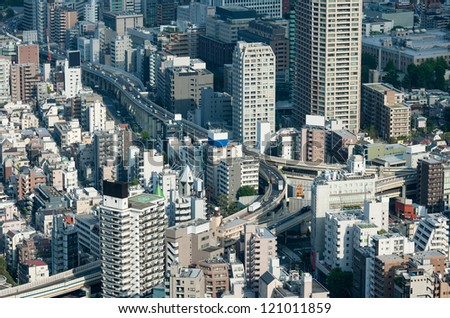
Tokyo is a much bigger city. They solved the problem by building elevated toll highways. Much simpler solution than digging new holes everywhere and keeping those silly carts running.
Doesn't this just mean that they are expensive? I heard complaints about how expensive Tokyo's subway is. Reducing price and propping the system with tax can be a better approach in the long term, because that can encourage more people to use public transit and reduce demand for costly highways.
(Also, one could argue that the freedom to move around at an affordable price is a basic service the government should strive to provide, although I'm sure some people will regard such an idea as socialist nonsense.)
I was in Tokyo recently. You can cross most of the city by subway/train for ~300 yen, or $2.66 USD at today's change rate. Compare to San Francisco, where I live. A Muni ticket is around $2.25, and a BART ticket ~$4... both with much worse service and smaller coverage.
You could argue, perhaps, that the price is expensive relative to what Japanese people earn, but from my impression it was a very effective and reasonably priced public transportation system.
I can only speak from experience for Hong Kong's MTR system. It has over 100% farebox recovery as well. Fares are distance-based [0] so it's hard to tell, but the average seems to be US$1.20 or so per person (unless you are traveling to Shenzhen) one way, which doesn't include transfers to the privately-run buses. If you believe in the Big Mac index at all this doesn't seem to be much more expensive compared to the US. (Note that it doesn't include transfers to buses.)
But the MTR actually was subsidized by the government, which let MTR Corporation develop the land above the subway to make malls and stuff, which they make even more money on. Presumably some of this profit gets reinvested into the system itself.
It's hard to say, because there's a few different subway operators in Tokyo, and if you switch between them your fare doesn't transfer. An example is JR and Tokyo Metro. There also exists Tobu lines, which run on Tokyo Metro lines, but sometimes have a different schedule. In my experience, the base fare (the price of entry) seems a little high, but the price stays the same for the first few stops, meaning that going 2 stops is more expensive than 4 stops. I think this effect continues into longer subway lines, and the prices of going to different stations is staggered if they are close together (e.g. if two stations are close enough, the price will be the same to go to if you come from the same location). I would argue that Tokyo's subway, overall, is probably about the same price if Bart was the same size.
Beyond the price, Tokyo Metro is almost always on time and pretty clean, and generally the delays happen late at night (the delays are only for a minute or two). Having been here for over a month, I've only experienced one daytime delay that lasted more than 30 seconds.
It only costs that much if you're staying far away or going pretty long distances. I stay in a station pretty far from Central Tokyo (past Kita Senju on the Tobu line) and to get to somewhere like Ginza costs less than 400 Yen, which is about $3.75. However, a chunk of that cost is due to Tobu, and if I was staying in Kita Senju or Ueno my trip would only be about 200-250 Yen.
If you are going from Kita Senju to Ginza then you would be using the Hibiya line. That trip will cost 195yen. Which is the same price for going all the way down to Roppongi where Google is. The Tokyo Metro and Toei lines tend to only have two or three prices depending on distance. This is why going two and three stations almost always costs the same.
Since employers always pay for commuting costs a regular working person spends very little on train tickets day to day. Me and my wife spend about $100 per month between us. With our companies paying a further $70 per month for each of us for our passes to work.
Living in another crowded city, Hong Kong, perhaps I can offer some perspective: We have tons of elevated tools highways and bypasses aimed at reducing traffic, the problem is all these elevated roads needs to go around a lot of tall buildings. Going underground with subway already provides us with better solution to a lot more of our traffic problem. What the boring company's proposing isn't all that different from the subway solution (we already have subway going three or four level deep), it simply allows cars to transported via subway.
That's the difference though, they're not talking about putting tons of people down there, they're talking about putting a small handful at a time (at most) by using cars. It appears much less efficient.
Pay today or pay tomorrow. I don't think it is an outlandish thought IF $100M/mile tunnels are achieved that the TCO for an elevated roadway will be higher. Elevated roadways have to be replaced eventually. Tunnels are more durable, look at the Holland Tunnel for example, 89 years old and no need for replacement in sight. And it's $48M price tag would be $3.3B today for 1.62 miles.
Well, given that both tunnels and elevated roads are still being built, the most expensive likely varies depending on the situation. If Musk really reduces the cost of tunneling by 10x, that calculus will shift in the direction of tunneling, obviously.
Dirt roads are extremely cheap and have been around forever. That doesn't make them the best choice in a modern society.
But rock comes with supporting structure, whereas you need to build those into "sky tunnels". This limits just how much "sky tunnels" you can make in two ways - there's only so much space on the ground you can use, and there's only so much weight it can support. That, and people will get anxious if their sky is totally obstructed by highways in the sky.
Tensile-strength-to-volume ratios for many materials is ridiculously high. Tunnel wall, ceiling, and floor quantities represent massive overengineered for that purpose
A cable tramway is one option for an aerial system. The load-bearing capacity of a 15mm steel cable is impressively high, and it can be strung along pylons.
Not that you'd want to bolt street cars to such a system, but it's an example of a possible people-mover that doesn't require persuading a multiple-kilometers-long bolus of solid granite it'd prefer being elsewhere.
Whilst I'm aware that Musk's premise here is that he can be the boringest guy ever, I'll note that the Gotthard Base Tunnel, in Switzerland, required 17 years of excavation to extend 35.5 km.
Tunnel systems can also give rise to some interesting cascade failure modes. Cab-forward deisel locomotives aren't generally considered a risk factor, until they are. Summary of an accident report, here, five souls lost to bad design of stock and tunnel, inadequate maintenance, poor judgement, and panic response:
Parking is a bigger problem in tokyo if you drive, and the tolls are expensive.
The newer the subway lines in Tokyo are fun because they have to built in under the others (as referenced in the FAQ), you can tell you're on a new line when you descend down flights and flights of stairs.
Yes, for a MagLev train that achieves the fantasy of hyperloop (but is actually happening now). From my perspective, hyperloop and TBC are each 100% upside down in terms of their approach. America can only dream of 505km/hr interstate ground transport.
I'm writing this from aboard the Nozomi express Shinkansen at around 300km/hr, by the way. Just left 名古屋駅.
Hah, amused to be able to read kanji after so many years (nagoya-eki :P)
I have ridden on the Nozomi and it's a fantastically smooth ride. There are indicators of the current speed on the wagon passage doors and it is incredible when it achieves 270+ km/h and everything is passing by so quickly, and yet you can drink your beverage from a cup just fine, just like in an airplane :)
That is still going 3D but without the significant speed increase. Also it is much more beautiful and less noisy to have highways out of sight so that the city is left for people and bikes, as opposed to stacked highways towering over head.
Next to NYC, commuting in Tokyo is effectively trouble-free. It may be crowded, but it's also predictable when the crunch times will be. Trains are on time. Cars keep moving and don't block every intersection with incessant honking.